The articlegameplay, story, development, reception
Gameplay
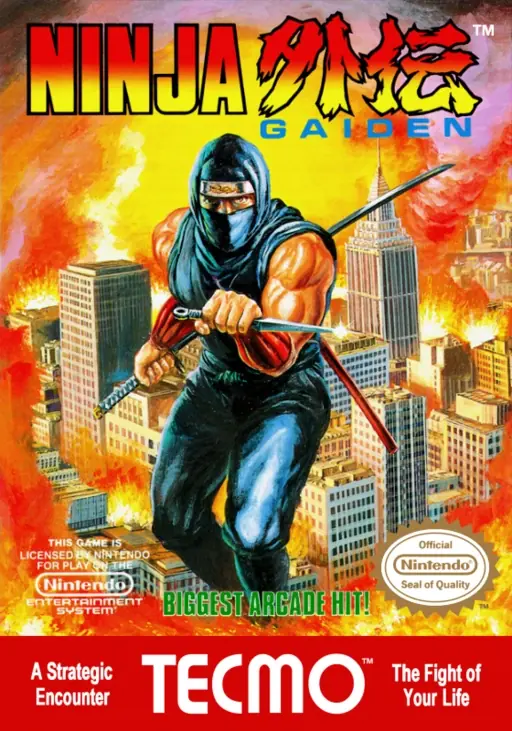
Ninja Gaiden is a side-scrolling platform game in which the player takes control of the player-character, Ryu Hayabusa, and guides him through six "Acts" that comprise 20 levels. A life meter represents Ryu's physical strength, which decreases when he is hit by an enemy or projectile. A "life" is lost when the life meter is depleted entirely, when Ryu falls off the screen, or when the timer runs out. A game over screen appears when all lives are lost; however, the player may restart the level where this occurred by continuing.
At the end of every Act, the player fights a boss; bosses have life meters depleted by player attacks. When its life meter is depleted entirely, a boss is defeated. Each boss is one of the "Malice Four"—evil underlings of the Jaquio, the game's main antagonist. The Malice Four consist of Barbarian, Bomberhead, Basaquer, and their leader Bloody Malth.
Players attack enemies by thrusting at them with Ryu's Dragon Sword—a katana-like sword passed down by the Hayabusa clan for generations. They can also use secondary weapons that consume Ryu's "spiritual strength". These include throwing stars, "windmill throwing stars", which cut through enemies and return like boomerangs, a series of twirling fireballs named "the art of the fire wheel", and a mid-air slashing technique called the "jump & slash". When Ryu's spiritual strength meter is too low, the player cannot use secondary weapons.
Players can replenish Ryu's spiritual strength by collecting red and blue "spiritual strength" items found in lamps and lanterns. Other items found along the way include hourglasses that freeze all enemies and projectiles for five seconds, bonus point containers, potions that restore six units of physical strength, "invincible fire wheels" that make Ryu temporarily invincible to attacks and 1-ups.
Ryu can jump on and off ladders and walls, and by using the directional pad, he can climb up or down ladders. Ryu can spring off walls by holding the directional pad in the opposite direction he is facing and pressing the jump button. He cannot attack while on walls or ladders. Players can use this technique to get Ryu to climb up spaces between walls and columns by holding down the jump button and alternating between left and right on the directional pad. He can also climb a single wall vertically by springing off it and then quickly pressing the directional pad back towards the wall.
Ninja Gaiden's highly responsive, fast-paced gameplay is achieved through the use of limited animation techniques that use fewer frames for animation. For example, the walk cycle animation only used four frames, while contemporary games like Prince of Persia required 12 frames.
Story
In Japan, Ninja Ryu Hayabusa finds a letter by his father, Ken, who was seemingly killed in a duel by an unknown assailant. In the letter, Ken instructs his son to find an archeologist named Walter Smith in America. Ryu travels to the nation, but before he can find Dr. Smith, he is shot and kidnapped by a mysterious young woman; she hands him a demonic-looking statue before releasing him.
Ryu then sees Walter, who tells him of the demon statues he and Ken had found in some ruins in the Amazon. Walter tells Ryu of an evil demon named Jashin that "SHINOBI" defeated, whose power was confined into "Light" and "Shadow" demon statues. Ryu shows Walter the "Shadow" demon statue given to him by the woman, but during their conversation, a masked figure named Basaquer suddenly breaks into the cabin and steals the Shadow statue. Ryu gives chase, defeats Basaquer, and retrieves the statue, but when he returns, he finds Walter mortally wounded and the Light statue is missing.
As Walter dies in his arms, three armed men apprehend Ryu and take him with them.
Ryu is taken to an interrogation room, where he meets agent Foster, head of the Special Auxiliary Unit of the Central Intelligence Agency who denies being responsible for Smith's death. He explains that years ago, a more-than-2000-year-old temple was discovered by Dr. Smith in the Amazon, of which he mysteriously sealed. The Special Auxiliary Unit has been monitoring the activity of Guardia de Mieux, also known as "the Jaquio", who recently moved into the temple where the body of the demon was confined. Using the statues, the Jaquio plans to awaken Jashin and use it to destroy the world.
Ryu is flown to the north-west corner of Brazil, where he is dropped off in a parachute in the jungle near the temple. He discovers the Jaquio has captured the girl who handed him the "Shadow" statue earlier. He orders Ryu to give up the demon statue after threatening the girl's life, then drops Ryu through a trapdoor and into a catacomb.
After fighting his way back to the top of the temple, Ryu encounters Bloody Malth, whom he defeats. As he is dying, Malth reveals that he was the one who dueled with Ken, who is still alive.
When he reaches the temple's inner chambers, he discovers his father under Jaquio's control as the Masked Devil. He destroys a crystal orb on the temple chamber wall that was controlling Ken and releases him from Jaquio's hold. An enraged Jaquio shows himself and tries to kill Ryu with a fiery projectile, but Ken throws himself in front of Ryu and takes the hit. Ryu subsequently kills Jaquio, but then a lunar eclipse causes the demon statues to revive Jashin.
After Ryu defeats the demon, a dying Ken tells Ryu to leave him behind in the temple while it collapses, and to take the young woman with him. Afterwards, Foster, communicating via satellite, orders the girl to kill Ryu and steal the demon statues; she chooses to be with Ryu instead of carrying out the order. The two kiss, and the woman tells Ryu her name, Irene Lew; they watch as the sun rises.
Development
Ninja Gaiden was developed and released around the same time as the beat 'em up arcade version of the same name; neither of the games were ports of each other but were parallel projects developed by different teams. According to developer Masato Kato (listed as "Runmaru" in the game's credits), the term "ninja" was gaining popularity in North America, prompting Tecmo to develop a ninja-related game for the NES at the same time the arcade version of Ninja Gaiden was being developed. Hideo Yoshizawa (listed as "Sakurazaki") developed and directed the NES version. Ninja Gaiden was Masato Kato's first full-time project as a video-game designer, and he contributed the game's graphics, animations and instruction-manual illustrations.
Drawing inspiration from the Mario series, Yoshizawa kept the same title but changed everything else; it became a platform game as opposed to a beat 'em up such as Double Dragon, and the gameplay was modeled after Konami's Castlevania, with Ryu being equipped with a katana-like Dragon Sword, shurikens, and ninpo techniques such as fire wheels. In designing the protagonist Ryu Hayabusa, the development team wanted him to be unique from other ninjas. They designed him with a ninja vest to place emphasis on his muscles, and they furnished him with a cowl that arched outward. They originally wanted to equip Ryu with sensors and a helmet with an inside monitor to check his surroundings, but that idea was scrapped.
According to Kato, they used specific locations and environments to justify the need for having a ninja for a main character. A further concern, according to Yoshizawa, was to appeal to the gameplay-oriented expectations of Ninja Gaiden's target audience, mainly represented by experienced players who appreciated challenging game design. He recalled that during development, Tecmo adhered to "the philosophy that the user would throw a game away if it wasn't hard enough". As a result, Yoshizawa decided to give the game an overall high level of difficulty.
Yoshizawa placed greater emphasis on the story, unlike the arcade version, and wrote and designed a plot that included over 20 minutes of cinematic cutscenes—the first time an NES game contained such sequences. Yoshizawa stated that the adoption of this presentational style came from his earlier aspiration for a career in commercial filmmaking, which led him to seek an opportunity "to put in a movie somehow". His idea was to reverse the then-prevailing trend wherein the narrative aspects of contemporary NES games were undervalued by consumers with the inclusion of an interesting plot that could engage those players. Tecmo called the cutscene system "Tecmo Theater" in which the game reveals the storyline between Acts through the use of animated sequences.
They are used at the beginning of each Act to introduce new characters such as Irene Lew, Walter Smith, and the Jaquio. This feature uses techniques such as close-ups, alternate camera angles, differing background music, and sound effects to make the game more enjoyable for players. Unlike earlier titles such as Final Fantasy, the cutscenes consisted of large anime art on the top half of the screen with dialogue on the bottom half. This made the artistic style more reminiscent of manga titles such as Lupin III and Golgo 13.
Dimitri Criona, Tecmo USA's director of sales and marketing, said that console games had an advantage over arcade games in that they allowed the creation of a longer game and the inclusion of cutscenes, which Tecmo trademarked as "cinema screens". He noted console games required a different reward structure than arcade games. The game contains a feature that was originally a glitch but was left in the final game intentionally, according to Masato Kato; having lost to any of the game's last three bosses, the player is sent back to the beginning of the sixth act.
When the game's text was translated from Japanese to English, the game needed to be reprogrammed to accomplish this; different companies handled this process in different ways. Tecmo's Japanese writers wrote rough translations in English and then faxed them to the American division. According to Criona, the American division would "edit it and put it back together, telling the story in a context that an American English speaker would understand. This would go back and forth several times".
Moreover, the game's text was stored in picture files instead of raw computer text. Because of the NES's hardware limitations, the English text needed to be very clear and concise to fall within those limitations; many times, different words with the same meaning but with fewer characters had to be used. All symbols and objects were scrutinized by Nintendo of America, who had specific rules on what could be included for North American releases; for instance, any Satanic, Christian, or any other religious, sexual, or drug-related references were not allowed.
In the original Japanese version, Ryu's father's name is Joe Hayabusa. In the English localization, the father's name was changed to Ken Hayabusa, inspired by the nickname of Tecmo USA president Hakata.
Reception
While moderately successful in Japan, the game was significantly more successful in North America, where it became a major commercial hit. According to Tecmo USA's Dimitri Criona, high demand led to repeated orders for Ninja Gaiden in increments of 60,000 cartridges per order. On the Computer Entertainer video game charts, it reached number three by August 1989 (below Super Mario Bros. 2 and Blaster Master).
On the Toy & Hobby World charts, it was the second top-selling video game by October 1989 (below Zelda II). On the Famitsu USA charts, it was the second top-selling NES game by December 1989 (below Tetris).
Ninja Gaiden went on to sell about 300,000 units in Japan and 1.5 million units in the United States, for a total of over 1.8 million cartridges sold worldwide. Reflecting on his career as a game designer, Yoshizawa considered Ninja Gaiden–along with Klonoa: Door to Phantomile–his proudest accomplishment, explaining that the title enjoyed the best sales performance out of all of his projects.
The game debuted at No. 3 on Nintendo Power's Top 30 list for July–August 1989, behind Zelda II: The Adventure of Link and Super Mario Bros. 2; it stayed at No. 3 in the September–October 1989 issue.
The Nintendo Power Awards '89 featured the game as one of the top games that year. It was nominated for Best Graphics and Sound, Best Challenge, Best Theme, Fun, Best Character (Ryu Hayabusa), Best Ending, and Best Overall; and it won for Best Challenge and Best Ending. In its preview of Ninja Gaiden II: The Dark Sword of Chaos, the magazine said that "the colorful, detailed and dynamic cinema scenes of the original Ninja Gaiden set a standard for action game narration that has since been widely emulated. These cinema scenes made Ninja Gaiden play almost like a movie."
Beyond press coverage by Nintendo Power, the game received strong reviews and publicity from other video gaming magazines upon its release. In a review from VideoGames & Computer Entertainment, the presentation and gameplay were compared to Castlevania, while the cinematic cutscenes were compared favorably to Karateka and other computer games by Cinemaware. The review praised the game's animation in these cutscenes and noted Tecmo's usage of close-ups and body movements. The reviewer said that while the cutscenes were not fluid, they were effective and entertaining and provided important information about what the player was supposed to do.
He appreciated the game had unlimited continues which slightly offset its difficulty, but he criticized it for having over-detailed background graphics especially in the indoor levels, saying that some bottomless pits and items in these levels become slightly camouflaged. From July to October 1989, the game was listed at No. 1 on Electronic Gaming Monthly's Top Ten Video Games list; it fell to No. 2 on the list behind Mega Man 2 in the November issue.
In their Best and Worst of 1989, it received awards for Best Game of the Year for the NES and Best Ending in a Video Game for all consoles. The staff said that Ninja Gaiden "proved to be an instant winner" with its cinematic cutscenes and unique gameplay. They added the game's climax was better than some movies' climaxes at the time and that it established continuity for a sequel, which would be released the following year. Later in June 1994, the magazine ranked it at No.
4 on a special list of Top Ten Most Difficult Games of all time for all consoles.
The July 1990 pilot issue of UK magazine Mean Machines featured Ninja Gaiden on the cover; the magazine was distributed as part of the July 1990 issue of Computer and Video Games. In its review, Julian Rignall compared the game to its beat 'em up arcade counterpart, which was titled Shadow Warriors. He noted the game has great graphics that feature diverse backgrounds and character sprites; he especially praised its use of cartoon-like animation sequences between Acts where the game's plot unfolds. He enjoyed the game's difficulty especially with the bosses, but he noted the game will seem tough at first until players become accustomed to the controls.
He criticized the game for its sound, which he said did not fit with the graphics and was "racy" but added "what's there is atmospheric and suits the action". He highly recommended the game to fans of the beat 'em up and combat genres. A review in Computer Entertainer complimented the games story and "excellent animation" which they found enhanced the martial arts-themed gameplay.
Mean Machines reviewed the game again (the NES version now officially titled Shadow Warriors in Europe) in its July 1991 issue. In the review, Matt Regan and Paul Glancey praised its detailed and animated character sprites and its difficulty level. The game's high standards of gameplay, sound, and overall depth impressed Regan; he noted the game's frustrating difficulty but pointed out that it has unlimited continues. Glancey compared the game to the 1990 NES version of Batman (released later in 1990) with its similar wall-jumping mechanics; he said that its graphics were not as well-developed as Batman's but were still satisfactory.
He praised its detailed sprites and their animations along with the "Tecmo Theater" concept, noting that the cutscenes "help supply a lot of atmosphere". He said it is one of the best arcade-style games on the NES as well as the best ninja-related game on the system.
The Japanese magazine Famitsu gave it a score of 28 out of 40. The game received some praise and criticism in the August 1991 issue of German magazine Power Play. The review praised the game for its attention to detail and challenge and noted players need to master certain gameplay skills to move on. Criticisms included a "lack of variety" and dullness in gameplay which was compared to a "visit to the tax office". The PC Engine version was briefly mentioned in the December 1991 issue of Electronic Gaming Monthly as part of a review of games that had been released outside the U.S.