
The articlegameplay, story, development, reception
Gameplay
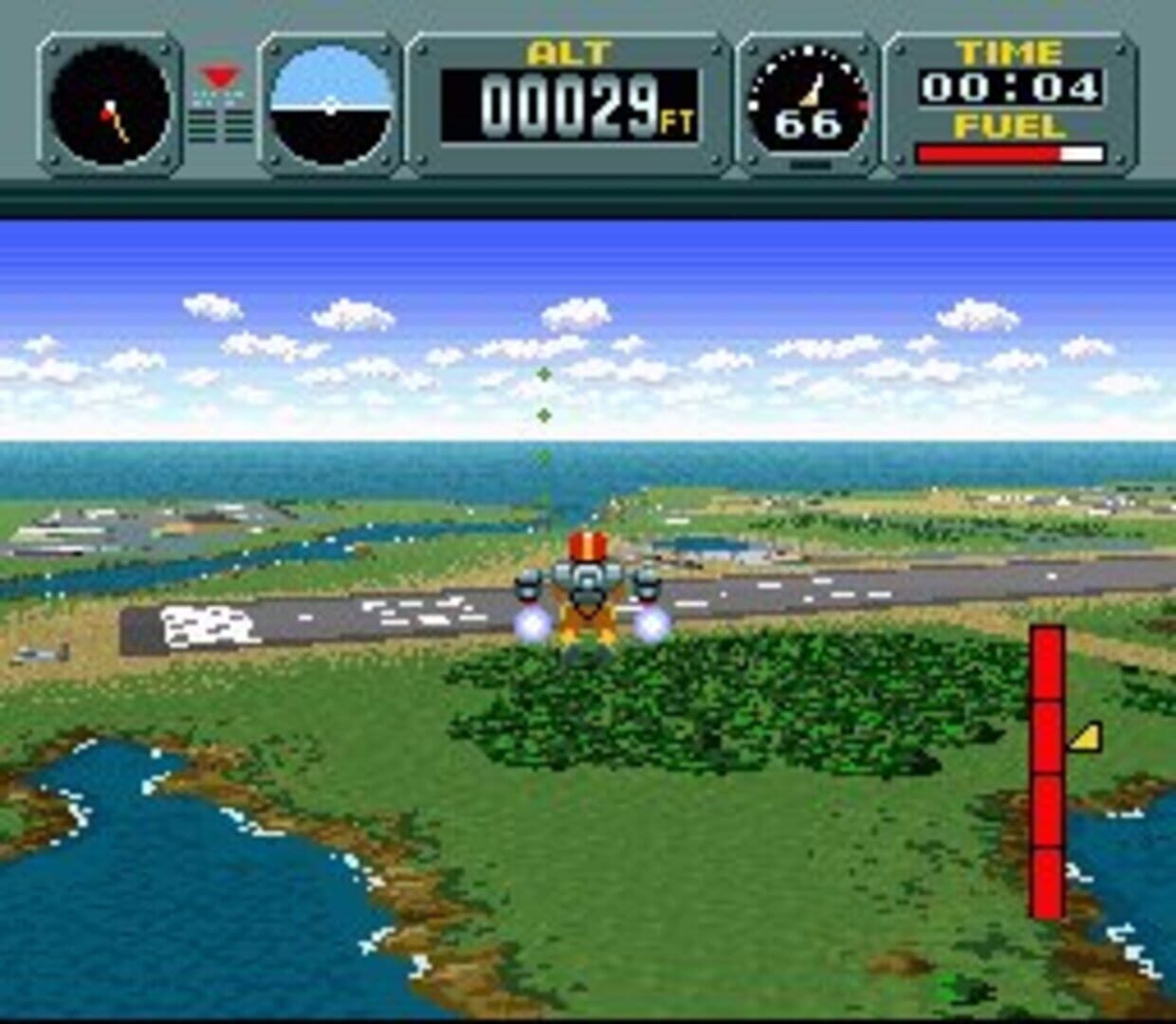
Pilotwings takes place at a flight club which is divided into four distinct training areas. The player's objective is to pass each training area and earn licenses based on the difficulty of the courses. Each area features 2—4 events, which may be played in any order. In each event, the player controls one of four aerial vehicles and must complete a task (usually flying through floating markers) then land safely and accurately within a time limit.
Upon completing an event, the player earns points and receives comments from the instructors. Points are awarded based on criteria such as the time taken to complete the event, the accuracy of the landing, and the completion of the stated objective. To pass a training area and move to the next one, the combined scores from the events must exceed a specific threshold. Each training area can be replayed if necessary, and passwords allow players to save their progress.
Development
Pilotwings was developed by Nintendo Entertainment Analysis and Development (EAD), a team consisting of members of the company's Research & Development divisions, under the leadership of producer Shigeru Miyamoto. Nintendo EAD completed Pilotwings and two other games (Super Mario World and F-Zero) within 15 months of the debut of the Super Nintendo Entertainment System. Pilotwings was released in Japan on December 21, 1990, one month after the system's launch, and was later released in North America in August 1991 as a launch title. The game's musical score was composed by Soyo Oka, while her superior Koji Kondo was responsible for the sound programming and the helicopter theme.
Six tracks from the game, including a rearranged version of the skydiving theme, appeared on the Nintendo Super Famicom Game Music album, released in Japan on March 4, 1992. Six piano-arranged versions of songs from the game were included on the Nintendo Super Famicom Game Music: Fun Together with Beyer CD, which was released in Japan on November 30, 1993.
Reception
Pilotwings was positively received during both its initial release and in retrospective reviews. The game drew praise for its presentation, with publications describing its use of Mode 7 graphics as "stunning" and "jaw-dropping". Pilotwings was generally seen as a showpiece title for the Super NES, demonstrating its Mode 7 features, built-in sprite scaling, and high-end sound chip in a conspicuous manner. Its level of challenge was also positively noted; Mean Machines found that practicing the flight tests and reaching the end of the game was very rewarding. Official Nintendo Magazine remarked in 2009, "This early SNES title is still enjoyable enough to be considered a true classic."
In February 2006, Pilotwings was listed as the 153rd best game on a Nintendo console by Nintendo Power. They also listed it as the 20th best game on the Super NES. IGN listed it in their list of the "Top 100 Games of All Time" at number 74 in 2003, and at number 91 in 2007. They later named it the 80th best Super NES game.


