
The articlegameplay, story, development, reception
Gameplay
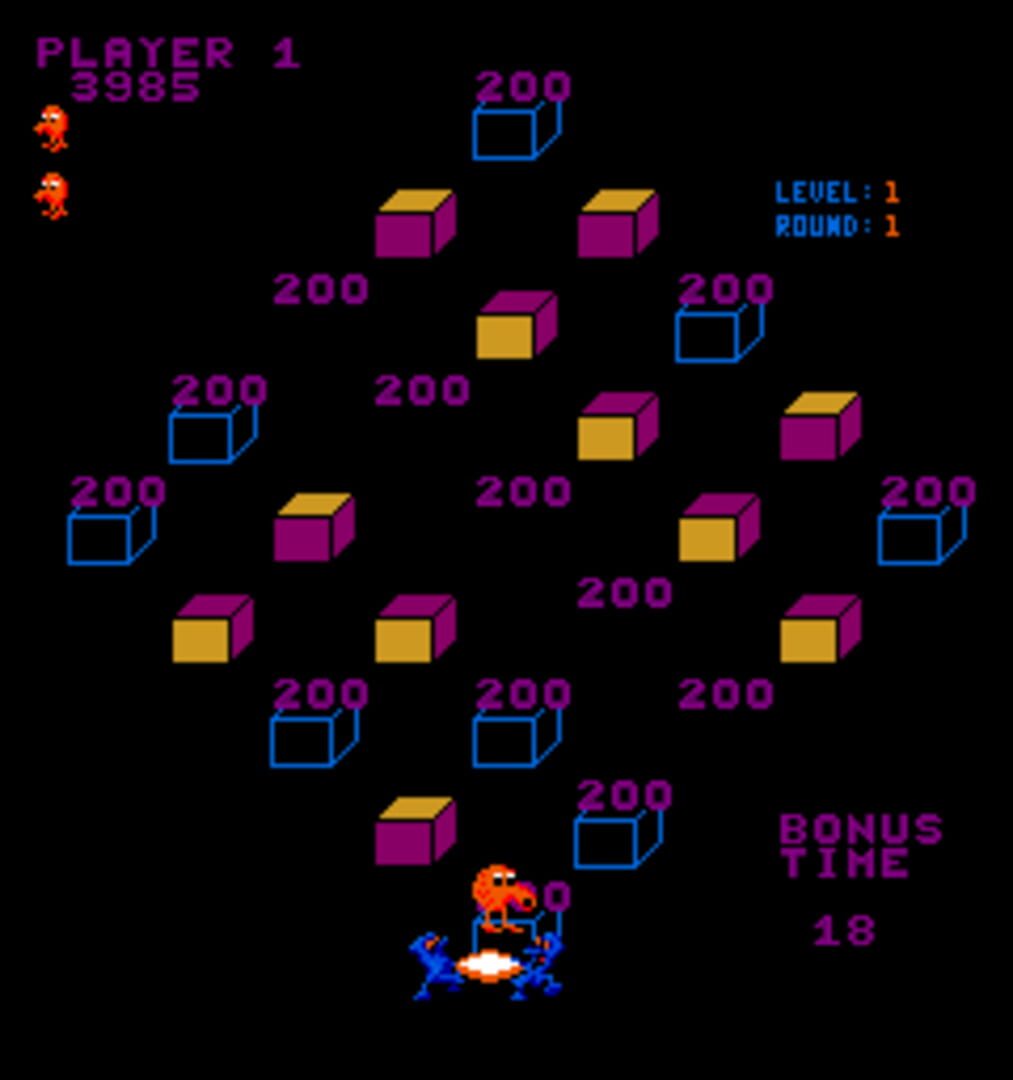
Q*bert is an action game with puzzle elements played from an axonometric third-person perspective to convey a three-dimensional look. The game is played using a single, diagonally mounted four-way joystick. The player controls Q*bert, who starts each game at the top of a pyramid made of 28 cubes, and moves by hopping diagonally from cube to cube. Landing on a cube causes it to change color, and changing every cube to the target color allows the player to progress to the next stage.
At the beginning, jumping on every cube once is enough to advance. In later stages, each cube must be hit twice to reach the target color. Other times, cubes change color every time Q*bert lands on them, instead of remaining on the target color once they reach it. Both elements are then combined in subsequent stages. Jumping off the pyramid results in the character's death.
The player is impeded by several enemies, introduced gradually to the game:
Coily – Coily first appears as a purple egg that bounces to the bottom of the pyramid and then transforms into a snake that chases Q*bert. He is often considered the main antagonist and Q*bert's arch-nemesis. Q*bert will die if he collides with Coily.
Ugg and Wrongway – Two purple creatures that fly or hop along the sides of the cubes in an Escheresque manner. Starting at either the bottom left or bottom right corner, they keep flying toward the top right or top left side of the pyramid respectively before leaving the pyramid by reaching the end. Both are dangerous. Q*bert will also die if he collides with them.
Slick and Sam – Two green creatures that descend the pyramid and revert changed cubes to their original color, but do not harm Q*bert.
Contact with purple enemies results in a life lost, whereas the green ones are removed from the board upon contact. Colored balls occasionally appear at the second row of cubes and bounce downward; contact with a red ball also results in a life lost, while contact with a green one immobilizes the on-screen enemies for a limited time. Multicolored floating discs on either side of the pyramid serve as an escape from danger, particularly Coily. When Q*bert jumps on a disc, it transports him to the top of the pyramid. If Coily is in close pursuit of the character, he will jump after Q*bert and fall to his death, awarding bonus points and removing all enemies and balls (though they reappear after a few seconds).
Points are awarded for each color change (15 or 25), defeating Coily with a flying disc (500), remaining or unused discs at the end of a stage (at higher stages, 50 or 100) and catching either green balls (100) or Slick and Sam (300 each). Bonus points are also awarded for completing a screen, starting at 1,000 points on the first screen of Level 1 and increasing by 250 on each subsequent completion, up to 5,000 starting in Level 4. Extra lives are granted for reaching certain scores, which are set by the machine operator.
Development
Programmer Warren Davis wrote that he was inspired by a pattern of hexagons implemented by fellow Gottlieb developer and Mad Planets designer Kan Yabumoto.
In a different telling, the initial concept began when artist Jeff Lee drew a pyramid of cubes inspired by M. C. Escher. Lee believed a game could be derived from the artwork, and created an orange, armless main character.
The character jumped along the cubes and shot projectiles, called "mucus bombs", from a tubular nose at enemies. Enemies included a blue creature, later changed purple and named Wrong Way, and an orange creature, later changed green and named Sam. Lee had drawn similar characters since childhood, inspired by characters from comics, cartoons, Mad magazine and by artist Ed "Big Daddy" Roth. ", which Lee originally presented as a joke.
Warren Davis, who was hired to work on the game Protector, noticed Lee's ideas and asked if he could use them to practice programming randomness and gravity as game mechanics. Thus, he added balls that bounce from the pyramid's top to bottom. Because Davis was still learning how to program game mechanics, he wanted to keep the design simple. He also believed games with complex control schemes were frustrating and wanted something that could be played with one hand.
To accomplish this, Davis removed the shooting and changed the objective of saving the protagonist from danger. As Davis worked on the game one night, Gottlieb's vice president of engineering, Ron Waxman, noticed him and suggested to change the color of the cubes after the game's character has landed on them. Davis implemented a unique control scheme; a four-way joystick was rotated 45° to match the directions of Q*bert's jumping. Staff members at Gottlieb urged for a more conventional orientation, but Davis stuck to his decision.
Davis remembered to have started programming in April 1982, but the project was only put on the schedule as an actual product several months later.
A MOS Technology 6502 chip that operates at 894 kHz generates the sound effects, and a speech synthesizer by Votrax generates Q*bert's incoherent expressions. The audio system uses 128 B of RAM and 4 KB of EPROM to store the sound data and code to implement it. Like other Gottlieb games, the sound system was thoroughly tested to ensure it would handle daily usage. In retrospect, audio engineer David Thiel commented that such testing minimized time available for creative designing.
Thiel was tasked with using the synthesizer to produce English phrases for the game. However, he was unable to create coherent phrases and eventually chose to string together random phonemes instead. @!" in Q*bert's speech balloon.
Following a suggestion from technician Rick Tighe, a pinball machine component known as a "knocker" was included to make a loud sound when a character falls off the pyramid. This knocker consists of a solenoid with a plunger that strikes the mounting bracket (which in turn is firmly fastened to the cabinet). Foam padding was added to the area of contact on the bracket; the developers decided the softer sound better matched a fall rather than a loud knocking sound. The cost of installing foam, however, was too expensive and the padding was omitted.
The Gottlieb staff had difficulty naming the game. Aside from the project name "Cubes", it was untitled for most of the development process. The staff agreed the game should be named after the main character, but disagreed on the name. Lee's title for the initial concept—Snots And Boogers—was rejected, as was a list of suggestions compiled from company employees.
@! as the title. @! as the title on the units' artwork.
During a meeting, "Hubert" was suggested, and a staff member thought of combining "Cubes" and "Hubert" into "Cubert". Art director Richard Tracy changed the name to "Q-bert", and the hyphen was later changed to an asterisk. In retrospect, Davis expressed regret for the asterisk, because it prevented the name from becoming a common crossword term and it is a wildcard character for search engines.
, before being widely distributed. @! in a public location, a Brunswick bowling alley, dates back to September 11, 1982. Gottlieb also conducted focus groups, in which the designers observed players through a one-way mirror.
The control scheme received a mixed reaction during playtesting; some players adapted quickly while others found it frustrating. Initially, Davis was worried players would not adjust to the different controls; some players would unintentionally jump off the pyramid several times, reaching a game over in about ten seconds. Players, however, became accustomed to the controls after playing several rounds of the game. The different responses to the controls prompted Davis to reduce the game's level of difficulty, a decision that he would later regret.
Q*bert is Gottlieb's fourth video game. A copyright claim registered with the United States Copyright Office by Gottlieb on February 10, 1983 cites the date of publication of Q*bert as October 18, 1982. Video Games reported that the game was sold directly to arcade operators at its public showing at the AMOA show held November 18–20, 1982. Gottlieb offered the machines for $2600 per unit.
Cash Box magazine listed the mass-market US release date as December 1982. The game was distributed in Japan by Konami and Sega in March 1983. It was also released in Euro
Reception
Q*bert is Gottlieb's only video game that earned considerable critical and commercial success, selling around 25,000 arcade cabinets. In the United States, it was among the thirteen highest-grossing arcade games of 1983. A cocktail version of the game was later produced. These machines have since become collector's items.
When the game was first introduced to a wider industry audience at the November 1982 AMOA show, it was immediately received favorably by the press. Video Games magazine placed Q*bert first in its list of Top Ten Hits, describing it as "the most unusual and exciting game of the show" and stating that "no operator dared to walk away without buying at least one". The Coin Slot reported "Gottlieb's game, Q*BERT, was one of the stars of the show", and predicted that "The game should do very well".
Contemporaneous reviews were equally enthusiastic, and focused on the uniqueness of the gameplay and audiovisual presentation. Roger C. Sharpe of Electronic Games considered it "a potential Arcade Award winner for coin-op game of the year", praising innovative gameplay and outstanding graphics. William Brohaugh of Creative Computing Video & Arcade Games described the game as an "all-round winner" that had many strong points.
He praised the variety of sound effects and the graphics, calling the colors vibrant. Brohaugh lauded Q*bert's inventiveness and appeal, stating that the objective was interesting and unique. Michael Blanchet of Electronic Fun suggested the game might push Pac-Man out of the spotlight in 1983. Neil Tesser of Video Games also likened Q*bert to games released in the early 1980s in Japan, like Pac-Man and Donkey Kong, due to the focus on characters, animation and story lines, as well as the "absence of violence".
Computer and Video Games magazine praised the game's graphics and colors.
Electronic Games awarded Q*bert "Most Innovative Coin-op Game" of the year. Video Games Player called it the "Funniest Game of the Year" among arcade games in 1983.
Q*bert continues to be recognized as a significant part of video game history. Author Steven Kent and GameSpy's William Cassidy considered Q*bert one of the more memorable games of its time. Author David Ellis echoed similar statements, calling it a "classic favorite". com's Jeremy Parish and Kim Wild of Retro Gamer magazine described the game as difficult yet addictive.
Author John Sellers also called Q*bert addictive, and praised the sound effects and three-dimensional appearance of the graphics. Cassidy called the game unique and challenging; he attributed the challenge in part to the control scheme. IGN's Jeremy Dunham believed the controls were poorly designed, describing them as "unresponsive" and "a struggle". He nonetheless considered the game addictive.
Edge magazine attributed the success of the game to the title character. They stated that players could easily relate to Q*bert, particularly because he swore. Computer and Video Games, however, considered the swearing a negative but the character appealing. Cassidy believed the game's appeal lay in the main character.
He described Q*bert as cute and having a personality that made him stand out in comparison to other popular video game characters. The authors of High Score! referred to Q*bert as "ultra-endearing alien hopmeister", and the cutest game character of 1982.
Legacy
According to Jeremy Parish, Q*bert is "one of the higher-profile titles of the classic era". In describing Q*bert's legacy, Jeff Gerstmann of GameSpot referred to the game as a "rare arcade success". In 2008, Guinness World Records ranked it behind 16 other arcade games in terms of their technical, creative and cultural impact. Though successful, the creators of the game did not receive royalties, as Gottlieb had no such program in place at the time. Davis and Lee nonetheless expressed pride about the game continuing to be remembered fondly.
Q*bert became one of the most merchandised arcade games behind Pac-Man, although according to John Sellers it was not nearly as successful as that franchise or Donkey Kong. The character's likeness appears on various items including coloring books, sleeping bags, frisbees, board games, wind-up toys, and stuffed animals. In a flyer distributed in 1983, Gottlieb claimed over 125 licensed products. However, the video game crash of 1983 depressed the market, and the game's popularity began to decline by 1984.
In the years following its release, Q*bert inspired many other games with similar concepts. The magazines Video Games and Computer Games both commented on the trend with features about Q*bert-like games in 1984. They listed Mr. Cool by Sierra On-Line, Frostbite by Activision, Q-Bopper by Accelerated Software, Juice by Tronix, Quick Step by Imagic, Flip & Flop and Boing by First Star Software, Pharaoh's Pyramid by Master Control Software, Pogo Joe by Screenplay, Rabbit Transit by Starpath, as games which had been inspired by Q*bert. Further titles that have been identified as Q*bert-like games include Cubit by Micromax, J-bird by Orion Software, and in the UK Bouncer by Acornsoft, Hubert by Blaby Computer Games, Pogo by Ocean, Spellbound by Beyond, Vector Hopper by Kristof Tuts, and Hoppy Hop by Josyan.
In 1983, Q*bert was adapted into an animated cartoon as part of Saturday Supercade on CBS, which features segments based on video game characters from the golden age of video arcade games. Saturday Supercade was produced by Ruby-Spears Productions, the Q*bert segments between 1983 and 1984. The show is set in a United States, 1950s era town called "Q-Burg", and stars Q*bert (voiced by Billy Bowles) as a high school student, altered to include arms, hands, jacket, and sneakers. He shoots black projectiles from his nose, which he calls "Slippy Dew", to make his enemies slip. Characters frequently say puns that add the letter "Q" to words.
Unlike the other shows in the package, in November 2015, Sony Pictures Home Entertainment released this segment on DVD in Region 1; Sony Pictures owned the rights to Q*bert due to Columbia Pictures owning Gottlieb during its development. The two-disc collection features 17 of the 19 episodes of the series.
Gottlieb released the pinball game Q*bert's Quest in 1983. It has two pairs of flippers in an "X" formation and uses audio from the arcade game. Gottlieb produced fewer than 900 units, but in Japan Game Machine listed Q*bert's Quest in their June 1, 1983 issue as being the second most-successful flipper unit of the year.
Q*bert is seen being played in the 1984 film Moscow on the Hudson starring Robin Williams.
The 1993 IBM PC role-playing game Ultima Underworld II: Labyrinth of Worlds has a segment where the player has to solve a pyramid puzzle as a homage to Q*bert. In the 2009 action-adventure game Ghostbusters: The Video Game, a Q*bert arcade cabinet can be seen in the Ghostbusters headquarters.
Q*bert alongside his enemies Coily, Slick, Sam and Ugg (except Wrong-Way) appear as homeless characters in Game Central Station due to their game being unplugged from the arcade in Disney's Wreck-It Ralph franchise.
Q*bert appears in the 2015 film Pixels as a supporting character, the film having produced by copyright owner Sony.
In 2014, Q*bert makes a cameo appearance in the RadioShack Super Bowl XLVIII commercial "The '80s Called".
The game has been referenced in several animated television series – Family Guy, Futurama, The Simpsons, Robot Chicken, Mad and South Park.
On November 28, 1983, Rob Gerhardt reached a record score of about 33 million points in a Q*bert marathon. He held it for almost 30 years before George Leutz from Brooklyn, New York, played one game of Q*bert for eighty-four hours and forty-eight minutes on February 14–18, 2013, at Richie Knucklez' Arcade in Flemington, New Jersey. He scored about 37 million points.
Doris Self, credited by Guinness World Records as the "oldest competitive female gamer", set the tournament record score of about 1.1 million for Q*bert in 1984 at the age of 58. Her record was surpassed by Drew Goins on June 27, 1987, with a score of about 2.2 million. Self continually attempted to regain the record until her death in 2006.
On November 18, 2012, George Leutz broke the Q*Bert tournament world record live at the Kong Off 2 event at The 1up Arcade and Bar in Denver, Colorado. Leutz scored about 3.9 million points in just under eight hours, earning 1.5 million points on his first life, beating Self's score using a single life. Leutz's score was verified by Twin Galaxies. The video ends at a score of 3.7 million points, 1.5 million points over the previous record.
==== Faster Harder More Challenging Q*bert ====
Believing that the original game was too easy, Davis initiated development of Faster Harder More Challenging Q*bert in 1983, which increases the difficulty, introduces Q*bertha, and adds a bonus round. The project was canceled. Davis released the ROM image onto the web in December 1996.
==== Q*bert's Qubes ====
Several video game sequels were released over the years, but did not reach the same level of success as the original. The first, titled Q*bert's Qubes, shows a copyright for 1983 on its title screen, whereas the instruction manual cites a 1984 copyright. It uses the same hardware as the original. The game features Q*bert, but introduces new enemies: Meltniks,