The articlegameplay, story, development, reception
Gameplay
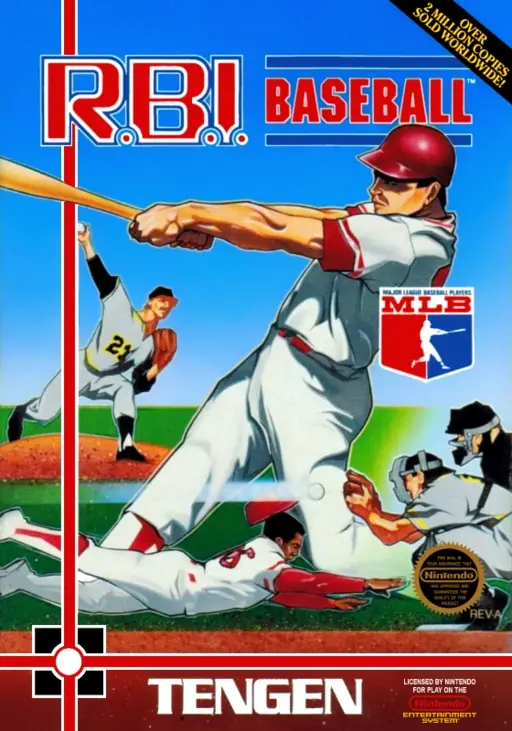
RBI Baseball was the first console game of its kind to be licensed by the Major League Baseball Players Association (MLBPA) and used actual MLB player names, unlike other baseball video games of the late 1980s. As it was not licensed by Major League Baseball (MLB) itself, it did not use team names or logos. Instead, the game contained 8 teams listed by only their location: Boston, California, Detroit, Houston, Minnesota, New York, St. Louis, and San Francisco; their real-life, MLB counterparts were the first place teams in each division in 1986 (Boston, California, Houston, New York) and 1987 (Detroit, Minnesota, St.
Louis, San Francisco) MLB seasons. The game also boasted two All-Star teams, American League and National League; the two featured established veterans such as George Brett, Mike Schmidt, Dale Murphy and Andre Dawson—none of whom appeared on the other eight teams—and up-and-coming players like Mark McGwire, Andrés Galarraga, Kevin Seitzer and José Canseco.
Development
Namco developed and released Pro Yakyū: Family Stadium (Pro Baseball: Family Stadium) for the Family Computer (Famicom), the first game in their Family Stadium series, on December 10, 1986. Pro Baseball: Family Stadium was created by Namco programmer Yoshihiro Kishimoto, who had previously worked on games such as Baraduke (1985).
Atari Games released a Nintendo VS. I. Baseball in 1987. I.
Reception
Most every edition of R.B.I. Baseball typically received "generally unfavorable reviews" from critics starting with its 2014 reboot, according to review aggregator Metacritic. R.B.I. Baseball 19 received "mixed or average reviews".
I. Baseball 14 and 15 "bad". Forbes gave bad reviews to 16, 17, and 18. 18 was criticized for its animation and collision detection.