
The articlegameplay, story, development, reception
Gameplay
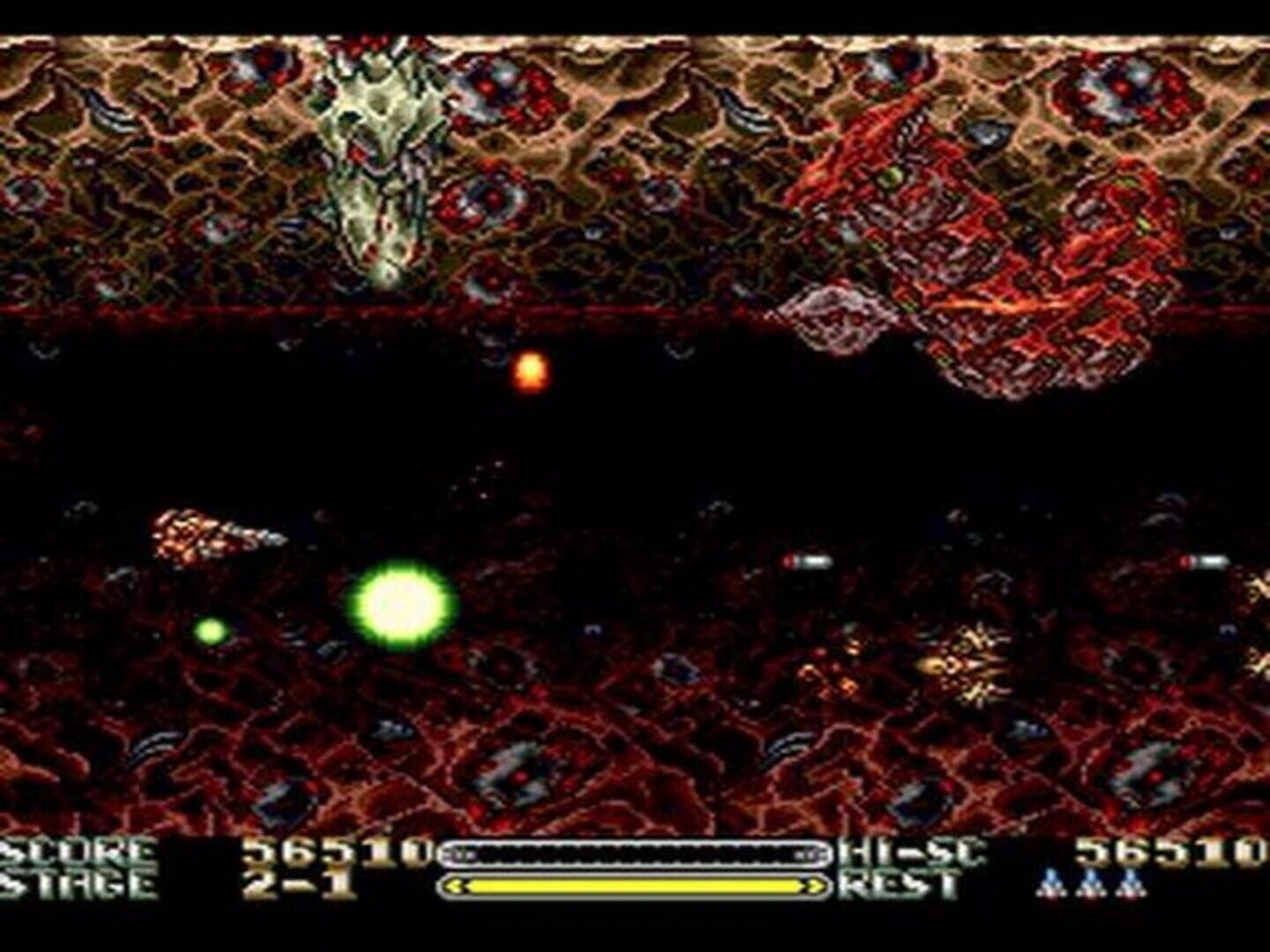
Rayxanber III is a science fiction-themed horizontally scrolling shooter game reminiscent of R-Type, in which the player takes control of a fighter pilot controlling the ES3 Donner Kyle space craft deployed into the homeworld of the Zoul Empire, in retaliation for the destruction of a mother ship from Earth. Gameplay is overhauled but follows the same structure as its predecessors, with the player controlling the ship through six increasingly difficult stages over a constantly scrolling background, populated with an assortment of alien enemy forces and obstacles, and the scenery never stops moving until a boss is reached, which must be fought to progress further.
There are three types of weapon units in the game the player can acquire by collecting their respective colors dropped by carriers when shot down and alternate between each one by obtaining another weapon during gameplay. Each weapon can be powered-up before they are maxed out, and collecting any weapon unit equips the ship with a set of two satellite-like options that fire at the specific direction the unit, which is constantly rotating, faces before being obtained. The ship is also capable of performing a dash maneuver to evade incoming enemy fire or obstacles. New to the series is the addition of a secondary charge attack that shoots two missiles to obliterate enemies, while double-tapping the fire button breaks them into homing missiles.
Development
Rayxanber III was developed by Team 50, a group within Data West responsible for the original Rayxanber (1990) for FM Towns and Rayxanber II (1991) for the PC Engine CD-ROM². Kazuhide Nakamura reprised his role as designer and Naokazu Akita led its creation as producer. Yoshiyuki Washizu and Yukinori Taniguchi acted as co-programmers, while artist Takeharu Igarashi was responsible for the pixel art. The soundtrack was scored by Yasuhito Saito, who also composed for the previous entries in the Rayxanber trilogy, and worked on titles such as Layla and The 4th Unit series.
The game was published in Japan by Data West on June 26, 1992, for the PC Engine Super CD-ROM². An English localization was slated to be published by Turbo Technologies in December 1992 and showcased at the 1992 Summer Consumer Electronics Show, but it never materialized. In a 2020 interview with Japanese gaming website DenFaminicoGamer, a Data West representative commented that there were no current plans for a digital re-release of the Rayxanber series through their official online store, but would consider it if there is demand.
Reception
Rayxanber III was anticipated by Japanese players, but received mixed reception from critics who reviewed it as an import title. Mega Fun's Christian Schweitzer praised the game's graphics, sound and fun factor, but criticized aspects such as the "jerky" framerate, collision detection issues and high difficulty level, feeling that it did not came close to Gate of Thunder. Nevertheless, Schweitzer regarded it as one of the best games on the PC Engine. Video Games' Julian Eggebrecht labeled it as a mediocre and superfluous title for shoot 'em up fans, citing the lack of frills with new ideas as its main shortcoming, while stating that it heavily stole from R-Type "without achieving its brilliance."
Consoles Plus' Douglas Alves and Doguy commended the visuals, animations, music and playability, but criticized its presentation, sound effects and low difficulty. Both reviewers ultimately found it to be a well-realized but easy shoot 'em up below other shooters for the PC Engine like Gate of Thunder and Seirei Senshi Spriggan. Joypad's Alain Huyghues-Lacour and Jean-François Morisse compared it with Gate of Thunder, criticizing its stages for their short length and lack of variety, but gave positive remarks to the game's fast pacing and controls. Joystick's Jean-Marc Demoly wrote that "Rayxanber III is a very good shooting game, inferior all the same to Gate Of Thunder, which remains as reference in this field. DuoWorld's Victor Ireland regarded it as a letdown compared to Rayxanber II, noting the "look alike" stages, colors, limited parallax scrolling and lack of imagination.


