
The articlegameplay, story, development, reception
Gameplay
The first player controls Vic Viper and the second player takes the reins of debuting spacecraft Lord British, which is sometimes referred to as "Road British" due to the ambiguity of Japanese-to-English romanization. The game features six stages which alter between horizontal and vertical scrolling.
Players are allowed to continue from where they leave upon death instead of being returned to a predefined checkpoint as per Gradius tradition. There are no continues in single player mode, and two in the two-player mode. The number of continues can be changed through DIP switches. The player gains power-ups by picking up capsules left behind by certain enemies, as opposed to the selection bar used in other Gradius games. However, the Japanese version of Life Force keeps the selection bar.
Many of the power-ups can be combined. For example, an option fires a second (or third) salvo of missiles or ripple/plutonic lasers if these power-ups have been attained. The ripple and laser, however, are mutually exclusive. The only power-up that can survive the ship's destruction is the options (called "multiples" in the English release), they followed the exact flight path of the player's ship and fired when they did, but were otherwise invulnerable. Upon the ship's destruction, the options float in space for a brief time before disappearing; the new ship can grab and retain them.
Development
The arcade version of the game was released under its original title in Japan and Europe, and as Life Force in North America. The Japanese and European versions are nearly identical, but the American version changes the game's plot by adding an opening text that establishes the game to be set inside a giant alien life-form which is infected by a strain of bacteria. Stages that feature starfield backgrounds were changed to the web background from Stage 1 to maintain consistency with the organic setting of the plot. The power-ups are also given different names, with the "Speed-Up" becoming "Hyper Speed", the "Missile" becoming the "Destruct Missile", the "Ripple Laser" becoming the "Pulse Laser" and "Force Field" becoming the "Shield". Narration is added to the beginning of each stage, detailing the area of the alien's body which the player is currently inhabiting such as "Enter stomach muscle zone" or "Bio-mechanical brain attack".
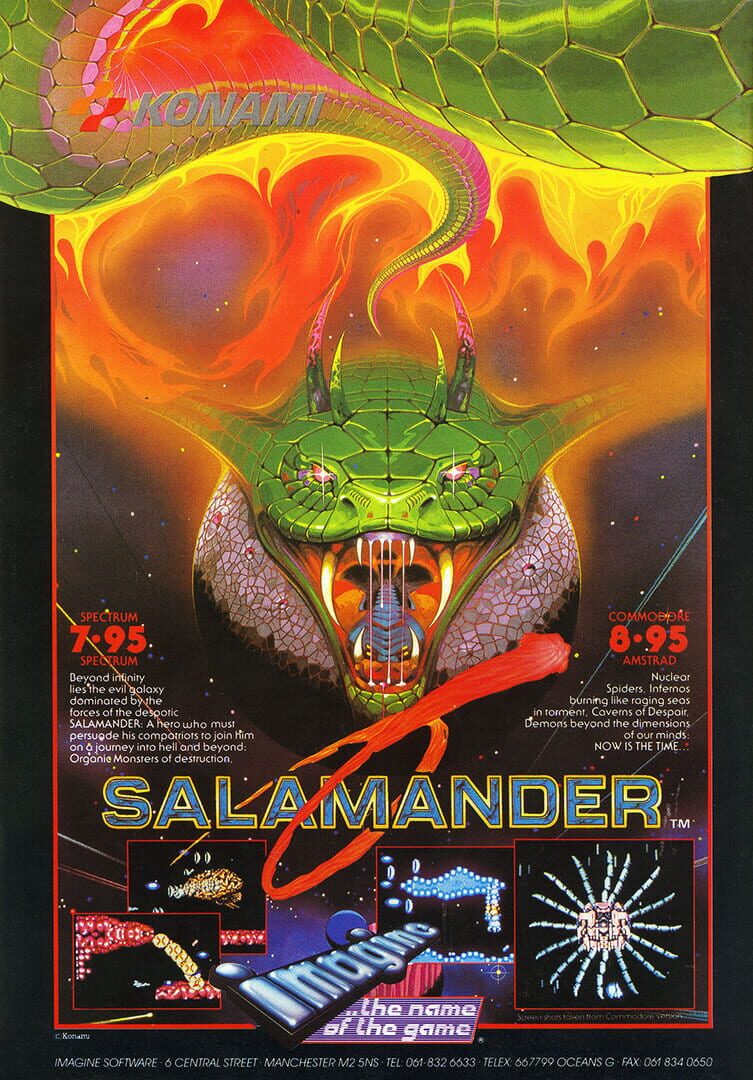
Konami later released an enhanced version of Salamander in Japan in 1987 bearing the American title of Life Force which further fleshes out the organic motif. All of the backgrounds and mechanical enemies are completely redrawn and given organic appearances. The power-up system was also modified, with the Japanese Life Force using the same power-up gauge as the original Gradius. Some music tracks have been completely changed for this release and the power-up gauge is arranged differently for both players.
Reception
In Japan, Game Machine listed Salamander on their August 15, 1986 issue as being the second most successful table arcade unit of the month. It went on to be the top-grossing arcade game on Japan's Gamest charts between September and October 1986.
In 1997, Electronic Gaming Monthly rated the NES version the 76th best console video game of all time, calling it "one of the coolest shooters ever, and ... one of the first big two-player simultaneous shooters on the NES." They particularly noted that the graphics in the fire stage were "mind-blowing back in the day". In 1993, Commodore Force ranked the game at number 19 on its list of the top 100 Commodore 64 games.


