The articlegameplay, story, development, reception
Gameplay
Sam & Max Beyond Time and Space is a 3D graphic adventure game with largely the same gameplay elements as Sam & Max Save the World; the player controls and directs Sam via a point-and-click interface through a variety of different environments to solve puzzles. The player can interact with a number of different items and non-player characters through a dialogue tree, which may be required to complete certain puzzles.
The game now implements an adjustable hints system, support for widescreen monitors, more realistic animations, and additional mini-games within each episode. Beyond Time and Space features a calibration assistant when first run, which allows the player to set their graphics and difficulty settings before playing. During each episode, the player can unlock decals after playing mini-games using Sam and Max's 1960 DeSoto Adventurer. The iOS port of the episodes received online leaderboards for Whack da Ratz, a Whac-A-Mole-style minigame, which was modified to continue indefinitely, and a soundboard. There is also a tutorial on the first puzzle seen on Save the World's first episode, "Culture Shock", highlighting the basics of puzzle solving and game interface.
Story
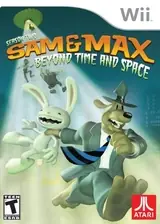
Like Sam & Max Hit the Road and Save the World, Beyond Time and Space continues the investigations of the titular duo Sam and Max, together known as the Freelance Police. Sam (voiced by David Nowlin) is a six-foot tall Irish Wolfhound who wears a gray suit and fedora and is generally very friendly and inquisitive, though he isn't above solving cases using force. Max (voiced by William Kasten) is described as a "hyperkinetic rabbity-thing" and is the more sociopathic and trigger-happy member with a complete lack of conscience and enjoys solving cases in the most chaotic way possible. He became President of the United States during the previous season.
Some characters from the previous season return in Season Two including a convenience store owner and consipracy theorist Roscoe Bosco; Sybil, a local business owner; US Secret Service agent Superball; Abe Lincoln, the head of the Lincoln statue from the Lincoln Memorial, the Computer Obsolescence Prevention Society (COPS), a group of old computers, one of whom is revealed to be built by Sam; Jimmy Two-Teeth, a rat who lives inside the duo's office; and the Soda Poppers, a group of former child actors, later revealed to be the masterminds behind the evil plots at Hell during the final episode.
New characters were also introduced in this season, including Flint Paper, a hard-boiled detective and Sam and Max's next door neighbor (though an already existing character in the Sam & Max franchise); Girl Stinky and Grandpa Stinky, vitriolic co-owners of Stinky's Diner; Santa Claus and his elves; the Moai heads of Easter Island; Jürgen, a vampire living in Stuttgart whose lair has Frankenstein's monster; Ms. Bosco, Bosco's deceased mother living as a ghost in the present; "THEM", a group of time-traveling mariachis who appear during someone's birthday; and the Devil. Sam and Max also revisit their past and future selves during "Chariots of the Dogs" as well as briefly transforming into their younger selves in "Moai Better Blues".
A year after the events of Save the World, Sam and Max, self-styled vigilante detectives known as the Freelance Police, suspect that their pet goldfish Mr. Spatula has turned evil. He is suddenly killed by a giant robot. After taking down the robot, with the help The two head to the North Pole and find Santa firing upon the elves with a machine gun.
Suspecting Santa is possessed, Sam and Max conduct an exorcism, but discover the demon is possessing an elf instead. With help from the Spirits of Christmas Past, Present, and Future, the demon is reduced to a plate of Jell-O, which Santa inadvertently eats and becomes possessed. Sam and Max knock Santa out, learning the demon was meant for Satan but sent to Santa due to a typo. They send Santa to Hell and deliver all the Christmas presents in his place.
A month later, Sybil and Abe get sucked into a Bermuda Triangle portal. Sam and Max follow and arrive on Easter Island, populated by missing people turned to babies by the Fountain of Youth, and are told by the local Moai that a prophecy states that a volcano will erupt and destroy them. In a nearby cave, they discover a group of aquatic Ocean Chimps who worship the Moai's giant stone feet, and the ghost of Mr. Spatula has established himself as their High Priest, planning to use a machine to trigger an eruption.
Sam convinces the Ocean Chimps that Max is the true High Priest, but Mr. Spatula sets off the eruption, only for Sam and Max to use a giant Bermuda Triangle to divert the lava. The two swim back to shore with Abe, who has broken up with Sybil, while the Moai are suddenly abducted.
Sometime later, the city is attacked by zombies from the Zombie Factory, a nightclub in Stuttgart run by the vampire Jürgen. Using traditional vampire weaknesses to lower Jürgen's popularity and make him vulnerable, Sam and Max pursue Jürgen but get caught in a death-trap and killed. The two reawaken as zombies and find Jürgen sleeping in his coffin and their souls trapped waiting to be shipped off to Hell. They retrieve a Soul Mater device from Sybil, inadvertently convincing her to get back together with Abe, but accidentally end up in each other's bodies.
The two force Jürgen into his own deathtrap, and his soul is abducted. As Sam and Max return to their bodies, their neighbor and fellow detective Flint Paper arrives to announce Bosco has gone missing.
The three break into Bosco's store to look for clues, but Sam and Max inadvertently signal a UFO, which abducts them. They find Bosco, who has turned into a cow after stumbling into a time-traveling elevator and inadvertently altering the events of his birth. Sam and Max use the elevator to travel through time and restore Bosco, and they discover the UFO is piloted by past, present and future versions of a mariachi named Pedro, who travel through time in order to perform at everyone's birthday and collect souls for Hell to pay for their spaceship. Bosco is overwhelmed and dies of a heart attack, and the mariachis decide to use his soul to fill their quota.
Sam and Max trick the mariachis into leaving so they can rescue Bosco's soul, but they accidentally send it to Hell and trigger the ship's self-destruct sequence. The two follow Bosco's soul through the portal, while the spaceship explodes just as it reaches the beginning of time, causing the Big Bang.
Sam and Max emerge in a subway station to Hell below their office. After gaining access to the train, they discover Hell to be an office environment employing their deceased enemies from past episodes. Satan ignores the two, but they interfere by freeing all their deceased friends' souls from their personal Hells. Sam demands that all these souls be released, and Satan agrees, but tricks Sam into taking their place.
Max frees Sam, only to discover Satan is no longer in charge of Hell, which has been taken over by the Soda Poppers. The trio fire Satan and initiate a series of new evil plots, but Sam and Max thwart each of these and convince
Reception
The first episode, "Ice Station Santa", received generally positive reviews, receiving an aggregated score of 82% on GameRankings and 82/100 on Metacritic. Reviewers noted that the game's first episode was slightly longer and more challenging, though not too difficult, than seen in the previous season. IGN stated that, while some puzzles were basic, a lot of puzzles are more involved and have multi-part solutions. Adventure Gamers noted that the puzzles seen in the episode had more depth than in the previous season and lacked any unfair dialogue or design elements, though it noted that it lacked a memorable puzzle as seen in Save the World.
TouchArcade noted that players would find more success with some puzzles by interacting with character dialogue trees, praising the episode for being "efficiently designed". However, reviewers criticized the inclusion of some new and reappearing characters to be obnoxious and unnecessary. IGN noted that the Soda Poppers "outlasted their comedic value" and "[brought] absolutely nothing to the plot", while Adventure Gamers did not find supporting character Stinky to be amusing, though they were hopeful she would be improved in later episodes.
"Moai Better Blues" fared similar reception, with a score of 80/100 on Metacritic and 81% on GameRankings. The episode's humor and writing was again widely praised: IGN and GamesRadar praised the frequent use of throwaway gags, with the latter website naming it the funniest episode up to that point, though TouchArcade stated that the episode "skates by on its pedigree and the humor and charm of Purcell's vision. Reviewers also praised the puzzle solutions, specifically the portal mechanic and the Fountain of Youth puzzle to be clever. However, reviewers criticized the episode length being too short.
TouchArcade criticized the final puzzle as "particularly boring" and "awkwardly executed". Critics generally saw the episode as an improvement to the previous one, though TouchArcade noted it to be weaker than "Ice Station Santa".
"Night of the Raving Dead" received aggregate scores of 79/100 on Metacritic and 80% on GameRankings. Critics lauded the introduction of Jurgen as an entertaining antagonist to the episode and as a parody of the emo subculture; TouchArcade noted that Jurgen's early establishment as the villain of the episode allows the writers to display more nuance to the story. Reviewers also praised the episode's cultural references to other media, including Grim Fandango and the Resident Evil franchise. Joseph Leray of TouchArcade noted that the episode attempted to re-imagine the social commentary of the episode's name sake of Night of the Living Dead.
Steve Butts of IGN applauded the use of Sam recalling the first half of the story rather than using a traditional narrative as an effective way to build up tension. Reviewers also praised the DeSoto mini-game, a homage to Paperboy, to be much easier and entertaining than in previous episodes, though IGN, while implying that the mini-game provided more variety, criticized it for being too easy. Nonetheless, criticism was still shown by reviewers for the episode's predictable and obtuse puzzles.
"Chariots of the Dogs" was much more positively received than the last episode and considered by critics as one of the best episodes of the season. Critics praised the time traveling storyline: Dan Whitehead of Eurogamer noted that a time travel story opens up possibilities for many gags, as well as a way to alleviate the repetition for visiting the same locations frequently. The same reviewer also praised the episode for its references to other time travel media such as Doctor Who and Bill & Ted. Steve Butts of IGN lauded Sam and Max's interactions with their past and future selves, especially to future Sam, as inventive.
M. 's spaceship to be the best part of the episode, mentioning that the control deck was the "best-looking new set" in the series. , was more critical of the accompanying musical number, noting that the execution and the lyrics was a weak point. Critics were divided on how well the episode's humor was executed: some publications named this episode as the funniest in the series, though GameSpy noted the lack of any satirical elements compared to other episodes was a detriment to the episode's humor.
The episode received aggregated scores of 85/100 on Metacritic and 85% on GameRankings.
", received positive acclaim with publications noting the episode as a satisfying and great conclusion to the game. Reviewers praised the episode's satirical depiction of Hell as a dull corporate office, and Satan as an unsatisfied executive, Allen Rausch of GameSpy praising the satirical humor that was lacking in the previous episode. Reviewers also praised the puzzles as having complex but accessible and clever solutions, however, other reviewers were more critical of them: Steve Butts of IGN mentioned that the puzzles weren't as challenging or rewarding as "Chariots of the Dogs", and Joseph Leray of TouchArcade noted that the puzzles "lacked punch". Dan Whitehead of Eurogamer criticized the puzzles entirely as "rudimentary inventory games" and "fetch quests" with a lack of items to collect.
IGN also criticized the return of unnecessary traveling between locaitons via the soul subway. Anise Hollingshead of GameZone and Rausch of GameSpy noted this episode to be the best and funniest in the series. "What's New, Beelzebub?" received an aggregated score of 85% on GameRankings and 85/100 on Metacritic.
The iOS port of the episodes were well-received by critics, noting it to be an improvement performance wise over Telltale's previous iOS release, Jurassic Park: The Game, while also maintaining the high graphical quality seen in the PC rel