
The articlegameplay, story, development, reception
Gameplay
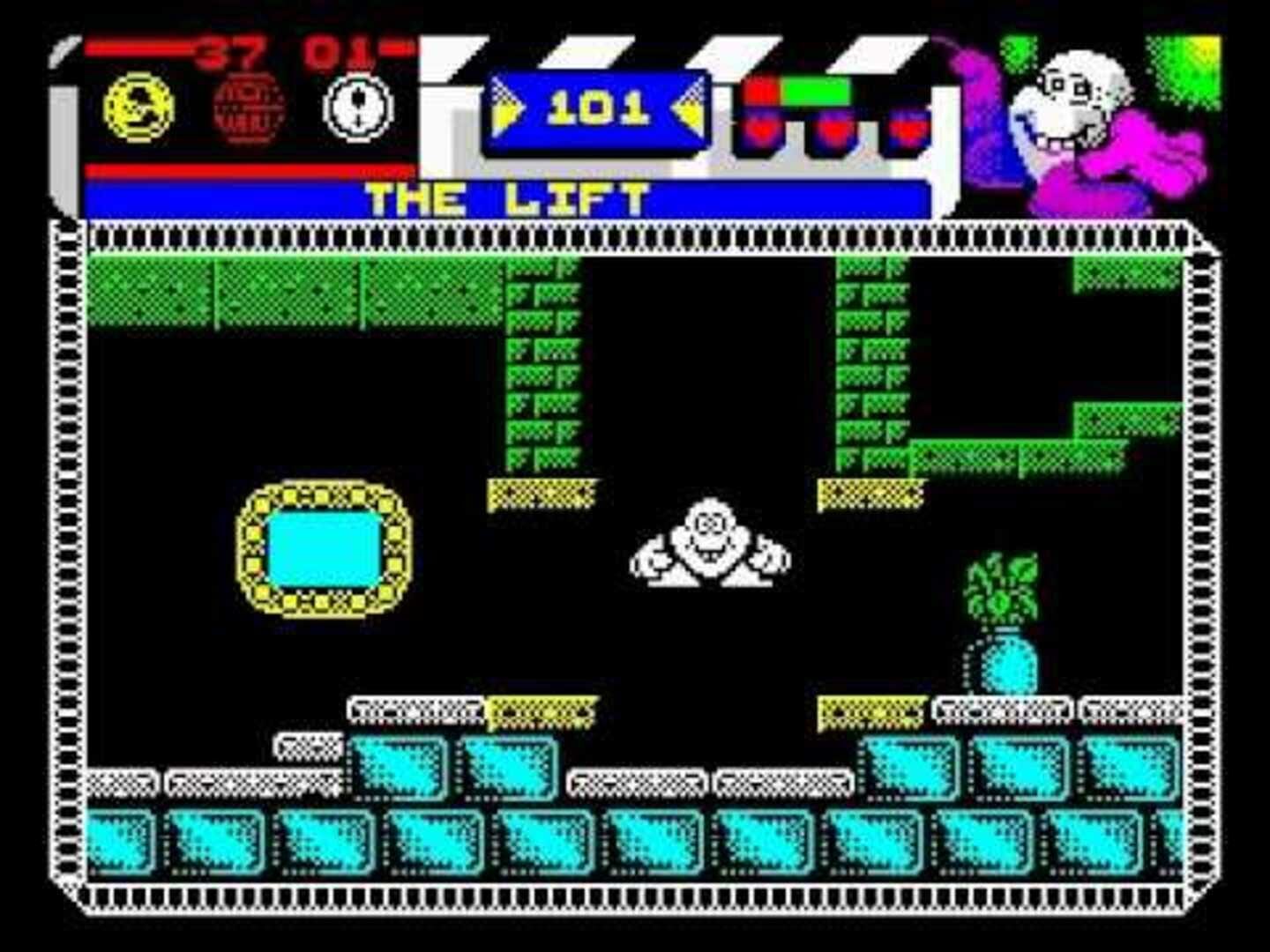
Players guide Seymour through the game's locations, solving puzzles by collecting up to three objects at once and using them in pre-set locations. Movement from one screen to the next is enabled through flip-screen, when Seymour touches the outer edge of one screen he is transported to the next. The film studio where the game takes place features several rooms such as an office and eight film sets accessed from a maze of backlots, where each screen is only slightly different from the last. The doors to film sets are locked and Seymour must first locate the relevant key to gain access. The sets' themes include films such as The Wizard of Oz and King Kong, as well as sets based on generic genres such as horror films and science fiction films.
Characters throughout the film studios and movie sets will help Seymour on his quest with new objects and advice, but only if he helps them first. Seymour's observations when collecting objects and sarcastic exchanges with other characters are communicated through speech bubbles. One example of a puzzle is the Frankenstein's monster which must be created by combining body parts in a specific location on the horror film set. Once the monster is completed it smashes through one of the set's walls, allowing Seymour to access the set next door.
Story
Seymour has been given the starring role in a Hollywood film and duly arrives at the film studio to begin work. It transpires that the studio's boss, Dirk E. Findlemeyer the second, has taken a vacation to Miami. Findlemeyer has taken the key to his safe with him, which prevents filming from commencing because the safe contains the film scripts.
Seymour must blow the safe with dynamite to access the scripts and then collect 16 Academy Awards from around the game and award one to each of the actors. Only then can filming commence.
Development
Beginning with Magicland Dizzy, Codemasters sub-contracted Big Red Software, headed by Paul Ranson, to assist in the production of future Dizzy games in the series. The success of Dizzy: Prince of the Yolkfolk prompted Big Red Software to take the series in a new direction. The publisher decided that the titular egg character's next adventure should be set in a world based on real-life.
Big Red Software started work and had 90% completed the project, which had the working title Movieland Dizzy, before the team was told to replace Dizzy with a new character. This was because the creators of Dizzy, the Oliver Twins, disagreed with the direction that Movieland Dizzy was taking the character, and after discussions Codemasters agreed. Pete Ranson, Paul's brother, was one of Big Red Software's graphic designers and was given the job of creating a new character. This character began as a misshapen egg, was given fingers, and was given jump animations that lacked Dizzy's bounce.
Reception
Both the Amstrad CPC and ZX Spectrum versions received high review scores, one exception being the review in Sinclair User which was less positive. 64. The magazine's reviewer wrote that despite the game featuring "brilliant humour and some of the best puzzles and animation seen in an arcade adventure", it remained a "cruel parody" of the Spectrum version that "plays with all the style and grace of a drunken elephant!" The Amiga version received both positive and average scores.
Seymour himself received a mixed response due to his appearance. Comments ranged from Seymour having "snatched Dizzy's crown" to him being called "a peeled potato on legs", an "albino mutant lardball" and "a sort of slug-type thing". David Crookes of Retro Gamer called Seymour a popular element and Big Red's most "infamous" character, but commented that Seymour did not match up to Dizzy.
Legacy
Five sequels were released in 1991 and 1992: Super Seymour Saves the Planet, Seymour: Take One!, Stuntman Seymour, Sergeant Seymour Robot Cop, and Wild West Seymour.


