
The articlegameplay, story, development, reception
Gameplay
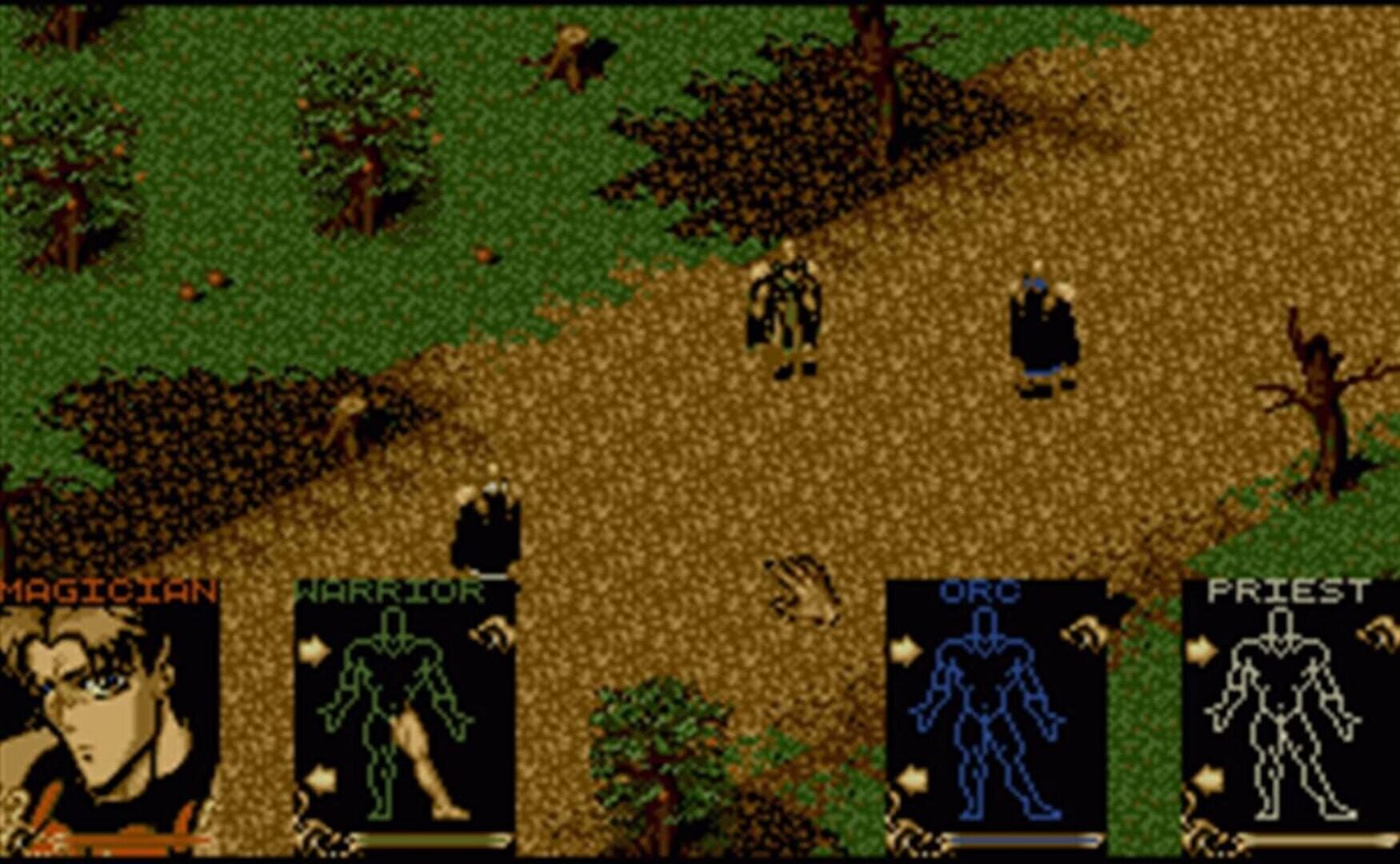
The player controls a party of four adventurers, each of which may be controlled individually; this is sometimes required for puzzle-solving. Characters in Shadowlands are governed by four statistics: Combat, Magik, Strength, and Health. Characters are aligned to one of four roles: Magician, Warrior, Orc, and Priest. Characters must eat and drink, or they may die.
An important aspect in Shadowlands is light: in dark areas torches are needed for characters to see, and they burn out over time. Small creatures, such as rats, follow the player and drain characters' health gradually each turn, and they cannot be killed. Scorpions act similarly, but do not follow the player and instead must be avoided.
Story
Shadowlands is a fantasy role-playing game in which the player controls four characters either as a party or as individuals.
Development
The Amiga version of Shadowlands began development in November 1990, and was released in March 1992. British gaming magazine The One interviewed Dean Lester, the designer for Shadowlands' Amiga version, for information regarding its development in a pre-release interview. Shadowlands was conceived due to the popularity of RPGs at the time, with Lester particularly citing Dungeon Master's success, stating that "We'd all played and enjoyed Dungeon Master and we were looking forward to a really long project as well. We'd only had about six months on a lot of our previous work, particularly, the coin-op conversions, and we felt that a 12-month project would really show what we could achieve."
Due to Dungeon Master's impact on the 16-bit gaming scene, Lester notes RPGs as an 'increasingly important element of the gaming market in the future', further stating that "Expectations are getting higher as standards improve, and the best way to fulfil those expectations is with a complex mouse-driven strategy game, not just another shoot'em up." Shadowlands is designed with an 'arcade-style' isometric viewpoint and its controls & UI are 'simplified' due to Lester's design philosophy that "if a game system is relatively familiar to games players, it has more chance of success".
Reception
Computer Gaming World gave the game a positive review, stating that "Shadowlands .... doesn't exactly break new ground, but it does have an approach that is unique and features that set it apart from the rest". The magazine liked the flexible approach to questing with one party or multiple parties, and the use of light and shadow to affect gameplay. The game was reviewed in 1993 in Dragon #192 by Hartley, Patricia, and Kirk Lesser in "The Role of Computers" column. The reviewers gave the game 4 out of 5 stars.
The One gave the Amiga version of Shadowlands an overall score of 93%, calling it "one of the best dungeon-delving role-playing games to come along since Eye of the Beholder." The One praises Shadowlands' design and gameplay, stating that "It's obvious right from the start that an awful lot of thought has gone into the game's design, from the easy-to-use controls to the use of light as more than just a graphical effect ... The real beauty of Shadowlands is that combat takes a back seat to the environment, but still manages to feature strongly enough to add excitement to the proceedings." The One praises Shadowlands' uniqueness, expressing that "The very fact that each of the four characters can be controlled independently of each other sets it apart from the likes of Cadaver, Dungeon Master, et al, and allows you to come up with all manner of strategies in fights and solutions to puzzles."


