
The articlegameplay, story, development, reception
Gameplay
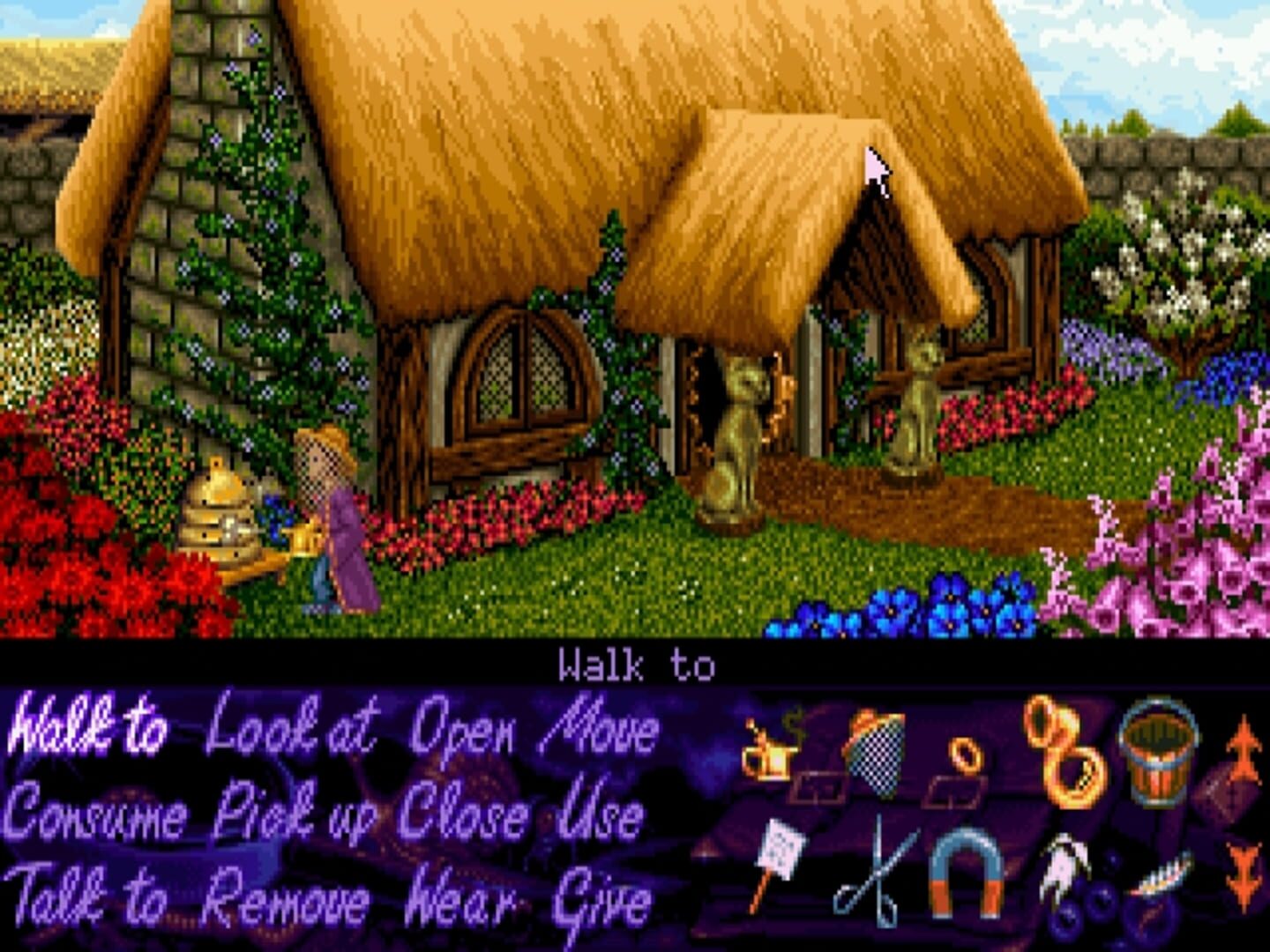
As a point-and-click adventure game, the player controls the protagonist, Simon, by using the mouse. The iOS and Android versions use touchscreen controls instead. Gameplay involves the player moving Simon to different locations in the game, interacting with objects and other characters at each site. The player can make Simon perform actions through verbal commands like "Look at", "Talk to", and "Give", with objects that are picked up being placed into an inventory.
Using these items requires the right verbal command and then selecting the target for that object. The game primarily involves talking to people for information, including hints or acquiring items, and using the correct items to solve puzzles. A menu system is provided for loading, saving and quitting the game via a postcard contained in the inventory. A fast-travel system is also provided in the form of a map in the inventory that can be used up until a certain point in the story.
Story
The story takes place in a parallel universe to the real world, where magic and monsters exist, although it contains some modern items and elements. The game's world features elements that are parodies of those from popular fantasy novels and fairy tales, including Rapunzel, The Lord of the Rings, Discworld, The Chronicles of Narnia, Jack and the Beanstalk, and the Three Billy Goats Gruff.
On his 12th birthday, a young boy named Simon is surprised when he receives a dog as a present from his parents, which he names Chippy. Unknown to Simon, his parents found the dog at their front door without warning, wrapped in paper, and possessing a book that nobody could read and which was eventually dumped in the loft. Sometime after his birthday, Simon hears Chippy playing around in the loft, to which he discovers it holding the book in its mouth. Reading it, he notes it is titled "Ye Olde Spellbooke", and unwittingly blurts out a spell on one of the pages.
Development
Mike Woodroffe, Simon the Sorcerer's director and producer, wanted to create the game to exploit a market for comic adventure games, which he realised existed due to the success of Monkey Island 2: LeChuck's Revenge. His son, Simon, penned the script. He was inspired by Terry Pratchett (Adventure Soft originally intended to make a Discworld game, but were unable to obtain a licence), and he and his father hoped that he would become involved with the game. Although he chose not to become involved, the script still contained his original humour.
Many scenes are based on fairy tales, and the Wise Owl was modelled on Patrick Moore. Woodroffe said that Adventure Soft (then known as HorrorSoft) had done enough horror games and wanted to try a comedy game. Switching genres prompted the name change.
Reception
Simon the Sorcerer received critical acclaim: across all platforms, the humour and visuals in particular were commended, although criticisms included the controls and the linear nature. The game's global sales surpassed 600,000 units by September 1999.
The Amiga version received generally high ratings. CU Amiga praised the high quality graphics and how much fun the game was to play. Amiga Computing's Simon Clays also praised the graphics and the locations, saying the locations' stylisation made the game resemble a fairy tale. He also enjoyed the puzzles and detail in the game.


