The articlegameplay, story, development, reception
Gameplay
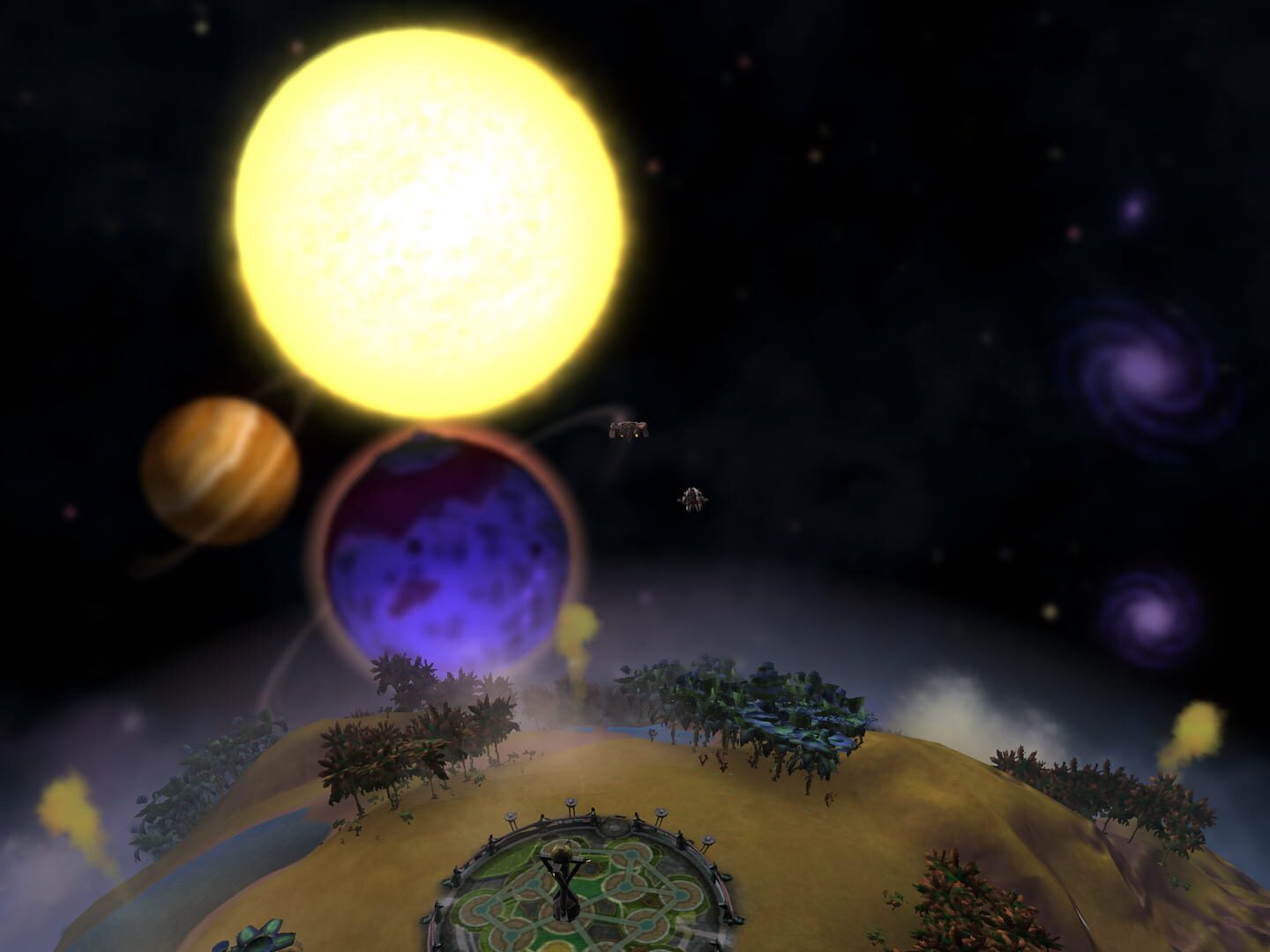
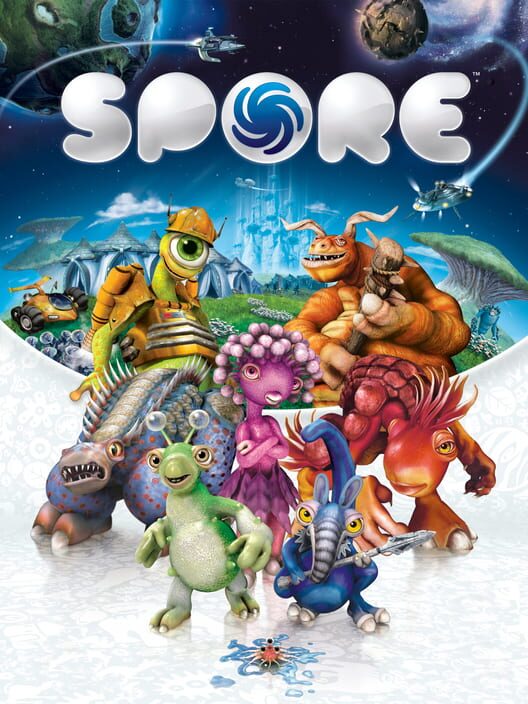
Spore allows the player to develop a species from a microscopic organism to its evolution into a complex creature, its emergence as a social, intelligent being, to its mastery of the planet, and then finally to its ascension into space, where it interacts with alien species across the galaxy. Throughout the game, the player's perspective and species change dramatically.
The game is broken up into distinct "stages". The outcome of one phase affects the initial conditions and leveling facing the player in the next. Each phase exhibits a distinct style of play, and has been described by the developers as ten times more complicated than its preceding phase. Phases often feature optional missions; when the player completes a mission, they are granted a bonus, such as a new ability or money. If all of a player's creations are eliminated at some point, the species will respawn at its nearest colony or the beginning of the phase.
Unlike many other Maxis games, Spore has a primary win condition, which is obtained by reaching a supermassive black hole placed at the center of the galaxy and receiving a "Staff of Life". However, the player may continue to play after any goal has been achieved. The first four phases of the game, if the player uses the editors only minimally, will take up to 15 hours to complete, but can take as little as one or two hours. Note that there is no time limit for any stage: the player may stay in a single stage as long as they wish, and progress to the next stage when ready.
At the end of each phase, the player's actions cause their creature to be assigned a characteristic, or consequence trait. Each phase has three consequence traits, usually based on how aggressively or peacefully the phase was played. Characteristics determine how the creature will start the next phase and give it abilities that can be used later in the game.
Spore is a game that is separated into stages, each stage presenting a different type of experience with different goals to achieve. The five stages are the Cell Stage, the Creature Stage, the Tribal Stage, the Civilization Stage, and the Space Stage. Once the primary objective is completed, the player has the option to advance to the next stage, or continue playing the current stage.
==== Cell Stage ====
The Cell Stage (sometimes referred to as the tide pool, cellular, or microbial stage) is the very first stage in the game, and begins with a cinematic explanation of how the player's cell got onto the planet through the scientific concept of panspermia, with a meteor crashing into the ocean of a planet and breaking apart, revealing a single-celled organism. The player guides this simple microbe around in a 3D environment on a single 2D plane, reminiscent of Flow, where it must deal with fluid dynamics and predators, while eating meat chunks or plants. The player may choose whether the creature is a herbivore or a carnivore prior to starting the stage. The player can find "meteor bits" (apparently from the aforementioned panspermic meteor) or kill other cells to find parts that upgrade their creature by adding abilities such as electricity, poison or other parts. Once the microbe has found a part, the player can call a mate to enter the editor, in which they can modify the shape, abilities and appearance of the microbe by spending "DNA points" earned by eating meat chunks or plants in the stage.
The cell's eating habits in the Cell Stage directly influence its diet in the Creature Stage, and only mouths appropriate to the diet (Herbivore, Carnivore, or Omnivore) established in the Cell Stage will become available in the Creature Stage. Once the creature grows a brain and the player decides to progress to the next stage, the creature editor appears, prompting the user to add legs before the shift to land. The Creature editor differs in that it gives the player the ability to make major changes to the creature's body shape and length, and place parts in three-dimensional space instead of a top-down view as in the Cell editor.
==== Creature Stage ====
In the Creature Stage, the player creates their own land creature intended to live on a single continent. If the player attempts to swim to another island, an unidentified monster eats the player, and the player is warned not to come again. The biosphere contains a variety of animal species which carnivorous and omnivorous creatures can hunt for food, and fruit-bearing plants intended for herbivores and omnivores. The player creature's Hunger becomes a measured stat as well as its Health in this stage; depletion of the Hunger meter results in Health depletion and eventual death of the player creature unless food is eaten.
In the Creature Stage, the player has a home nest where members of their own species are located. The nest is where the player respawns following death, and acts as a recovery point for lost HP. Other species' nests are spread throughout the continent. While interacting with them, the player can choose to be social or aggressive; how the player interacts with other creatures will affect their opinion of the player's species.
), NPC creatures will eventually consider the player an ally, but if the player harms members of their species, they will flee or become aggressive upon sighting them. The player can heal in allied nests and add allied creatures to their packs. Epic creatures, which are rare, aggressive creatures more than twenty times the player's height, feature prominently in the Creature Stage. The player cannot use social interactions with an Epic creature.
There are also Rogue creatures which may be befriended or attacked. Additionally, spaceships may appear in this stage and abduct a creature.
Progress in the Creature Stage is determined by the player's decisions on whether to befriend or attack other species. These decisions will affect the abilities of the player's species in subsequent stages of t
Development
Spore uses procedural generation extensively in relation to content pre-made by the developers. Wright mentioned in an interview given at E3 2006 that the information necessary to generate an entire creature would be only a couple of kilobytes, and went on to give the following analogy: "think of it as sharing the DNA template of a creature while the game, like a womb, builds the 'phenotypes' of the animal, which represent a few uploaded and downloaded freely and quickly from the Sporepedia online server. This allows users to asynchronously upload their creations and download other players' content, which enriches the experience of the game as more of its players progress in the game."
Reception
IGN Australia awarded Spore a 9.2 out of 10 score, saying, "It [Spore] will make you acknowledge just how far we've come, and just how far we have to go, and Spore will change the way you think about the universe we live in." PC Gamer UK awarded the game a 91%, saying "Spore's triumph is painfully ironic. By setting out to instill a sense of wonderment at creation and the majesty of the universe, it's shown us that it's actually a lot more interesting to sit here at our computers and explore the contents of each other's brains." In its 4.5 (of 5) -star review, GameSpy wrote "Spore is a technological triumph that introduces a whole new way of tapping into a bottomless well of content."
Most of the criticism of Spore came from the lack of depth in the first four phases, summarized by Eurogamer's 9 of 10 review, which stated, "for all their mighty purpose, the first four phases of the game don't always play brilliantly, and they're too fleeting." 1UP.com reasoned in its B+ graded review, "It's not a perfect game, but it's definitely one that any serious gamer should try." GameSpot in its 8.0 of 10 review called Spore "a legitimately great game that will deliver hours of quality entertainment", but criticized the "individual gameplay elements [that] are extremely simple." Jason Ocampo's IGN 8.8 of 10 review stated, "Maxis has made an impressive product that does so many incredible things" but added, "while Spore is an amazing product, it's just not quite an amazing game."
The New York Times review of Spore mostly centered on lack of depth and quality of gameplay in the later phases of the game, stating that "most of the basic core play dynamics in Spore are unfortunately rather thin." While a review in PC Gamer US stated that "it just isn't right to judge Spore in the context of so many of the other games we judge", Zero Punctuation was also critical of the game, claiming it did not live up to the legacy of The Sims: "The chief failing of Spore is that it's trying to be five games, each one a shallow and cut down equivalent of another game, with the Civilization Stage even going so far as to be named after the game [Civilization] it's bastardizing."
Criticism has also emerged surrounding the stability of the game, with The Daily Telegraph stating:
"The launch of Spore, the keenly anticipated computer game from the creators of The Sims, has been blighted by technical problems." In an interview published by MTV, Spore designer Will Wright responded to early criticism that the phases of the game had been dumbed-down by explaining: "We were very focused, if anything, on making a game for more casual players. Spore has more depth than, let's say, The Sims did. But we looked at the Metacritic scores for Sims 2, which was around ninety, and something like Half-Life, which was ninety-seven, and we decided — quite a while back — that we would rather have the Metacritic and sales of Sims 2 than the Metacritic and sales of Half-Life."
In its first three weeks on sale, the game sold 2 million copies, according to Electronic Arts. It received a "Silver" sales award from the Entertainment and Leisure Software Publishers Association (ELSPA), indicating sales of at least 100,000 copies in the United Kingdom.
During the 12th Annual Interactive Achievement Awards, the Academy of Interactive Arts & Sciences awarded Spore with "Outstanding Achievement in Gameplay Engineering", along with receiving nominations for "Computer Game of the Year" and "Outstanding Innovation in Gaming".
Spore uses a modified version of the controversial digital rights management (DRM) software SecuROM as copy protection, which requires authentication upon installation and when online access is used. This system was announced after the originally planned system met opposition from the public, as it would have required authentication every ten days. Additionally, EA released the game under a policy by which the product key of an individual copy of the game would only be authenticated on up to three computers; however, some users ran afoul of the limitations as the software would consider even a slight change of hardware to constitute a different computer, resulting in all authorizations being used up by those who often upgrade their computer. In response to customer complaints, this limit was raised to five computers.
After the activation limit has been depleted, EA Customer Service will consider further activations on a case-by-case basis. A survey conducted by EA revealed that only 14% have activated on more than 1 PC and less than 1% of users have tried to activate Spore on more than 3 PCs.
By September 14, 2008 (ten days after the game's initial Australian release), 2,016 of 2,216 ratings on Amazon gave the game one out of five stars, most citing EA's implementation of DRM for the low ratings. Electronic Arts cited SecuROM as a "standard for the industry" and Apple's iPod song DRM policy as justification for the control method. Former Maxis developer Chris Harris labeled the DRM a "screw up" and a "totally avoidable disaster".
The SecuROM software was not mentioned on the box, in the manual, or in the software license agreement. An EA spokesperson stated that "we don't disclose specifically which copy protection or digital rights management system we use [...] because EA typically uses one license agreement for all of its downloadable games, and different EA downloadable games may use different copy protection and digital rights management.” A cracked version without the DRM was released two days before the initial Australian release, making Spore the most torrented game on BitTorrent in 2008 and, according to one estimate, the most pirated game ever at that time.
On September 22, 2008, a class action lawsuit was filed against EA, regarding the DRM in Spore, complaining about EA not disclosing the existence of SecuROM, and addressing how SecuROM runs with the nature of a rootkit, including how it remains on the hard drive even afte