
The articlegameplay, story, development, reception
Gameplay
The game gives the player the choice of playing as Claude or Rena, with the journey evolving and ending differently depending on the choices one makes. There are ten other playable characters in the game, though the player can only recruit six of them to fill out their eight-member party, and some recruitment choices will make other characters no longer available. The Second Story's gameplay is broadly similar to that of most RPGs. The player goes from town to town and dungeon to dungeon, following the central story and occasionally branching off to perform side quests. Characters gain experience points from battle and level up as a result, becoming gradually stronger as time passes and more battles are fought.
Battles play in real time, during which the player has manual control over their character, as opposed to choosing options from a menu. Battles take place on a broad battlefield, over which the player's character can move without limit, allowing them to trade blows face-to-face with the enemy or circle around for a flanking attack. The other party members (up to 3 others) are controlled by the game's AI; the player may change an ally's strategy to one of six different pre-determined options (such as "Spread out and attack", "Save your Magic Points", and "Stand Still and Don't Do Anything").
Nine different batches of skills are sold in in-game shops; once unlocked this way, they must be learned by committing battle-earned "Skill Points" to them. Some skills raise a character's statistics, some unlock Specialty abilities, and some provide bonuses in battle (such as the ability to counter-attack). Specialties allow the characters to create a wide variety of items, and include Herbal medicine, Cooking, Writing, Composing and Musicianship, Pickpocketing and Training. Furthermore, the entire party can contribute to "Super Specialty" skills such as "Master Chef", Blacksmithing, Publishing and "Reverse Side", which allows the character to counterfeit valuable items at the risk of lowering their allies' opinion of them. Every item created has some sort of tangible benefit (foods restore Hit Points and/or Magic Points, training increases the gain in Experience Points, and written novels can be submitted to a publisher, with royalties collectable later) but every attempt requires the expenditure of a consumable item, and may fail to produce anything useful.
A mechanic called "Private Actions" allows the player to influence the relations between their characters. During a "Private Action", the player's party temporarily breaks up during a visit to a town, with each character going their own way to shop, visit friends and family, or relax. The player's main character (either Claude or Rena) can then interact with their allies, often with the option of making one of those allies like another character more or less. This "relationship point" mechanic can have a major effect in battle—if Character A's close friend is felled, Character A will get major combat bonuses for a short time—and also determines what ending the player will see, as each party member's scene plays out differently depending on who they befriended. There are 86 possible endings.
Story
D 2452), twenty years after the original game, Star Ocean. The game tells the stories of Claude C. Kenny, son of Ronyx J. Kenny, and Rena Lanford, a young girl living on the planet Expel.
Claude, having recently been commissioned as an Ensign in the Earth Federation, is given his first mission under the supervision of his father. This first mission is to survey the planet Milocinia (renamed Milokeenia in the PSP port), where a mysterious energy field appears. Finding a mysterious device on Milocinia, Claude begins to examine it close-up, despite orders to keep away from it. As he approaches, the machine activates, teleporting him to Expel.
Once on Expel, Claude meets Rena who mistakes him for the "Hero of Light", spoken of in legends on Expel because he wields a "Sword of Light" (actually the standard-issue Phase Gun all Federation officers carry) and is dressed in "alien raiments". She takes him back to her village, Arlia, for corroboration.
In Arlia, it is explained to Claude that a meteorite crashed into Expel. Almost immediately afterwards, monsters began appearing, and natural disasters occurred with increasing frequency and intensity. Believing that these events were related, the people of Expel called the meteorite the "Sorcery Globe". Though he explains that he is not the Hero of Light, Claude offers to investigate the Sorcery Globe, in the hopes that it might help lead him home. Rena assists him as his native guide and hopes to find knowledge about her origin, being an orphan.
Though their journey takes them the long way around, Claude and Rena (and whichever characters the player decides to recruit) manage to travel across Expel and finally reach the Sorcery Globe and encounter the Ten Wise Men. The Sorcery Globe, which the Ten Wise Men call the "Quadratic Sphere", is a device they planted on Expel in order to steer it into a massive energy formation called Energy Nede, from which the Ten Wise Men were exiled thousands of years ago. It is their hope to return to Energy Nede using Expel as a vessel. They succeed and the entire planet of Expel is destroyed by its collision with Energy Nede.
After engaging the Ten Wise Men in battle, they are defeated. Claude and Rena survive due to being within the teleportation zone cast by the Ten Wise Men as the travel to Energy Nede. They are met by Mayor Narl who explains who the Ten Wise Men are, why they were exiled, and that, now that they are back, they hope to destroy the entire universe using advanced Heraldry (magic). Narl furthermore announces that Energy Nede has the ability to restore Expel by using powerful Heraldry to turn back time, but this is only possible if the Ten Wise Men are defeated. Claude and Rena agree to help in the resistance, and embark on various voyages to strengthen themselves, obtain information and learn about the enemy.
Eventually Claude and Rena along with their friends assault the Ten Wise Men's stronghold at Fienal, where they put an end to the enemy once and for all. The ending is composed of scenes describing the fates of the party's characters, and changes slightly depending on if the player discovered the Ten Wise Men's true identity and "raison d'être" through the means of Private Actions.
Development
Enix opted to use sprites for characters in order to realize an anime style of character visuals that they felt was not yet possible with polygonal models.
Reception
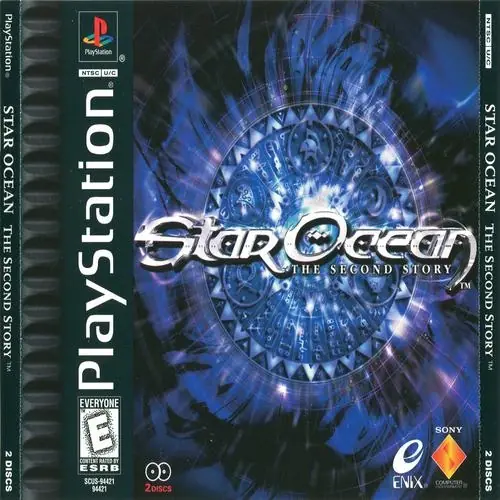
Star Ocean: The Second Story was a commercial success, having sold 1.094 million copies worldwide, with 724,000 copies sold in Japan alone and 370,000 copies sold overseas. It was the 13th best-selling game of 1998 in Japan. The game, however, did not sell enough copies in North America to be re-released in the Greatest Hits range.
The game received favourable reviews on release and was lauded for innovative gameplay elements not previously seen in the genre, while borrowing some of the best features of popular JRPG Final Fantasy VII. While most reviewers gave positive reviews, some considered the game only mediocre. Jeff Lundrigan, reviewing the PlayStation version of the game for Next Generation, wrote that the game has its pluses and minuses, but ultimately called it "average" in his review. Regardless, the game has garnered a cult following and enjoyed various remasters and re-releases over the years.
By August 2008, Star Ocean: Second Evolution had sold 141,218 copies in Japan. Star Ocean: Second Evolution was the 90th best-selling game in Japan in 2008, selling 143,434 copies. By 2011, Second Evolution had sold 159,745 copies in Japan, bringing total worldwide sales of The Second Story and Second Evolution to 1,253,745 units.