The articlegameplay, story, development, reception
Gameplay
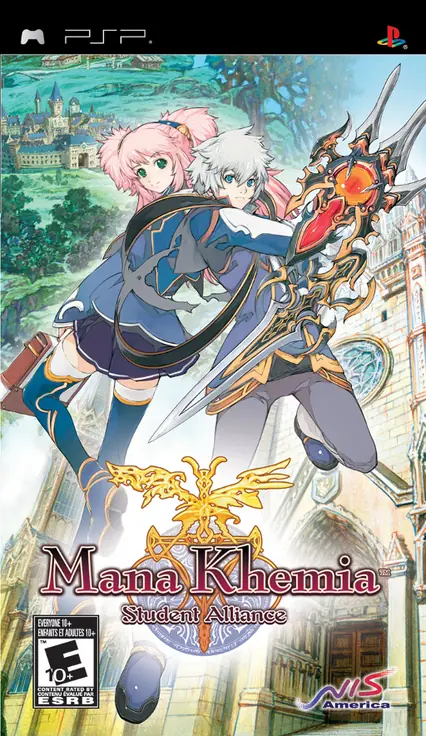
Mana Khemia shares many common elements with its predecessors, the Atelier Iris trilogy.
At the core of the game is alchemy through which the player can create weapons, armor, usable items, and complex ingredients for these recipes. The player is required to gather core materials through field exploration, spoils of combat, or by purchasing them in the shops. Each item carries fundamental properties that include elemental and special abilities, and character stat improvements, that can be infused into equipment. Through the creation of new items, these properties can transfer over into the new item.
A new "alchemy wheel" allows the player to adjust the quality of each ingredient as it is added to the mix, for better or worse, in order to alter the final item's properties as well. Recipes for items are learned over the course of the game by finding or buying recipe books, conversing with characters, or can be extrapolated from existing recipes by altering the ingredients list.
When in the field, the player can opt to avoid encounters with monsters by running and jumping over them, but also may attempt to strike first to go into battle. Mana Khemia uses a turn-based system similar to previous Atelier Iris games. Once the player has more than three characters in the party, he or she can then have up to three characters in reserve; these characters can switch in during a normal turn, or be called in at the end of one character's attack to provide an additional blow, or be called in to replace a character about to be attacked. The swapped out characters require a number of turns to recover before being called in again.
As the player becomes able to inflict more damage, they can activate "Burst Mode" that temporarily increases the damage from each attack; this mode rewards the player with a large number of hits. Additionally, about mid-game, Burst Mode can lead to a "Finishing Burst" that requires the player to meet a certain condition while Burst Mode is activated, such as striking with each team member, or healing a certain amount of damage; this allows for a special powerful finishing move to be unleashed by one of the characters.
Both alchemy and combat are necessary to grow the characters. Unlike typical role-playing games, there are no experience points or characters levels. Instead, through combat, characters earn "action points" which are used in the character-specific "grow book" to unlock new skills, and character bonuses such as additional health or mana points. However, these bonuses are tied to completing the recipes for specific items in that book.
The grow book is presented as a graph of synthesizable items. The bonuses for an item cannot be acquired using action points until an adjacent item on the graph, and the item itself, has been made.
The game is presented as a series of terms at a school. Each term is made up of several weeks, typically starting and ending with an event, ultimately leading to a key battle to be won. In between, the player is generally required to complete two or three courses, earning a grade depending on how well the course was completed. This is then followed by two or three days of free time.
If the player should fail to make a decent cumulative grade by the end of courses, they will need to spend one day of free time in detention, doing required tasks. Once in free time, the player is free to take odd jobs, talk with characters, and perform side quests related to the other members of the party.
Story
The game's main focus is on the lead protagonist, Vayne Aurelius, the son of a legendary alchemist named Theofratus who had disappeared sometime after Vayne's birth. Since then, Vayne has led the life of a hermit, his only companion being a Mana in cat form named Sulpher. Vayne is invited to the Al-Revis Academy for alchemy training by Zeppel, one of the professors. He is quickly indoctrinated into the school by becoming part of an atelier led by Flay Gunnar (an older student who is known as The Defender of Justice) along with two other students, Jess (a clumsy girl who is nevertheless adept at alchemy), and Nikki (an impulsive beastgirl).
They are soon joined by Pamela (the school's resident ghost), Anna (an 11-year-old master swordsman), Roxis (the son of a famous family of alchemists who is quickly forced to join the workshop by Flay), and Muppy (an alien the group discovers on an assignment). The eight of them are able to succeed at completing assignments, learn the skills of alchemy, and allow the workshop to prosper.
Reception
The game received "average" reviews according to the review aggregation website Metacritic. In Japan, Famitsu gave it a score of 31 out of 40.