The articlegameplay, story, development, reception
Gameplay
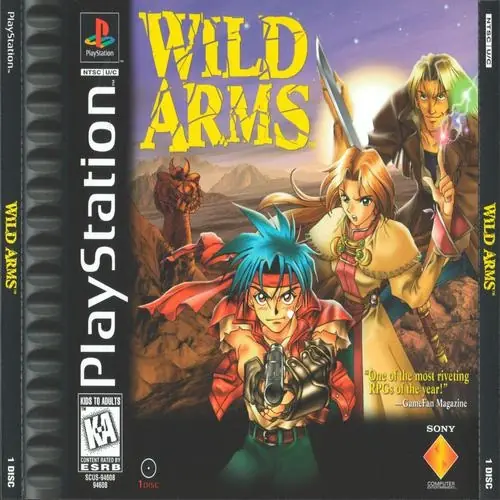
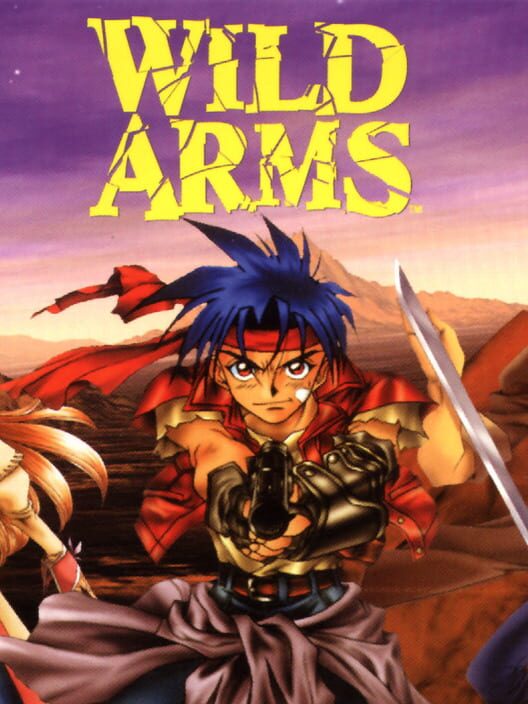
Wild Arms is a role-playing video game. The player controls the party of three characters, Rudy, Jack, and Cecilia, as they explore the world of Filgaia, navigate its environments, battle enemies, and solve puzzles. The game is presented in a top-down two-dimensional fashion where the player has an overhead view of all the action taking place on a particular screen. As the game's story progresses, the player navigates through various dangerous areas filled with randomly appearing enemies, as well as set-piece boss encounters.
Characters progress and grow more powerful by gaining experience points after a battle, finding ARMs (Rudy), discovering crest graphs used for magic spells (Cecilia), and mastering sword techniques prompted by various events in the game (Jack). Players can also find and purchase a variety of equipment, including weapons, armor, and consumable single-use items.
While exploring dungeons, various situations will block progress until they are solved, essentially serving as puzzles. The party finds a variety of devices called "Tools," unique to each character, which are used to solve these puzzles and continue onward. Rudy's bomb tool, for example, can demolish large rocks and other impediments, while Jack's grappling hook allows the party to cross large gaps and chasms while avoiding traps.
Combat is rendered in 3D graphics. Wild Arms employs a turn-based battle system, where the player inputs commands at the start of each round for each character. The order in which each character and enemy performs these actions is based on their "response" (RES) statistic, which denotes how quickly a particular character can act. Actions include attacking with their equipped weapon, performing unique skills, using items from their inventory, and fleeing from the combat. Enemy units are defeated when their hit points, a numerical representation of their vitality, reach zero.
Each of the three playable characters has a unique set of abilities that can be used to defeat enemies or aid party members. Rudy utilizes "ARMs", powerful attacks involving gun-like weapons, but that deplete a limited ammunition supply. Jack's "Fast Draw" sword techniques can damage opponents in various ways. Cecilia's magic has a variety of effects, including restoring hit points to the party, raising or lowering statistics, and damaging enemies with harmful spells.
Additionally, a character can equip special items called "runes," allowing them to summon powerful Guardians to aid them in battle. New ARMs, Fast Draws, and magic spells can be acquired as the main story progresses.
During combat, each character has a "Force Bar" that grows through battle actions such as attacking, dodging, or receiving damage. Characters can spend this accumulated meter on powerful "Force Techniques". Each character eventually gets access to four such techniques. For example, Cecilia's "Mystic" ability allows an item to be used to cast a spell, while Jack's "Accelerator" lets him get a guaranteed first action in the combat round with a slight damage boost. More powerful skills cost more of the Force Bar.
Like normal equipment, Runes can be equipped that improve a character's statistics. Equipping these Runes has the added benefit of allowing a character to summon powerful magic creatures known as Guardians. These effects include attacking all enemies at once or aiding allies with beneficial magic. New runes can be obtained through both dungeon exploration and in certain story events. Most Guardian attacks, like Cecilia's magic, have an elemental designation that is more effective against certain enemies.
Story
Wild Arms takes place in the world of Filgaia, a fantasy world. The technology of the world varies greatly, with some areas resembling medieval Europe, featuring cloistered monasteries and castles, while other areas resemble a frontier loosely akin to the American West. Advancements such as motors are found sporadically. Much of the technology is remnants recovered from the distant past by archaeologists and engineers who refashion it for the present day. Destructive technology such as ARMs (firearms) is seen as a dangerous and therefore forbidden technology that is feared by the general populace.
A thousand years before the main events of Wild Arms, a great war engulfed Filgaia between its original inhabitants, the humans and Elw, and an invading race called the Metal Demons. The Metal Demons had lost their own homeworld and sought to make Filgaia their new home. During the conflict, powerful weapons were developed, including mechanical golems and artificial warriors known as Holmcrosses, which combined metal and flesh. The humans eventually captured the demon's leader, "Mother," and sealed her within a castle in the tundra of Arctica.
However, they were unable to destroy her regenerating body completely. With the aid of the Guardians, the protectors of Filgaia, she was imprisoned within a cocoon. Her heart was removed and torn into three pieces, and the pieces of her heart were placed inside three stone statues which were scattered across the world. The war came to an end, with the majority of the Metal Demons remaining either in seclusion or in their dimension.
However, the conflict had devastated the surface of Filgaia, creating wastelands and leaving scars which still have not yet recovered in the present.
If the title screen is left idle, an introductory scene plays depicting the more recent past. A group of metal demons invade Arctica Castle, kills the inhabitants, and reclaims the inert cocoon of Mother. The only seeming human survivors are two Fenril Knights of Arctica, Garret and Elmina, with Garret escaping.
Wild Arms features three playable characters, each with a brief introduction at the start of the game.
Rudy Roughnight (ロディ・ラグナイト Rodi Ragunaito; "Roughknight" in Alter Code: F) is a 15-year-old boy from a remote village who was orphaned several years prior to the start of the game when his grandfather died. Under the care of the town's mayor, Rudy worked as a farmhand for his neighbor. In his prologue, Rudy finds and rescues a local boy lost in a cave just outside town, yet inadvertently frees a zombie sealed within the cavern. He defeats the zombie and saves the village but alerts the villagers to his forbidden ARM weapon in the process, causing him to be cast out of the village.
He is forced into the life of an adventurer and Dream Chaser. Rudy is a silent protagonist, though he does have one line in the game.
Jack Van Burace (ザック・ヴァン・ブレイス Zakku Van Bureisu) is a treasure hunter and swordsman-for-hire who is searching the world for the "ultimate power" that will allow him to confront his troubled past. In his prologue, Jack discovers an ancient holographic device within the Memory Temple bearing a warning from the lost race of the Elw, who had developed advanced technology. He sets off to the town of Adlehyde to find more information that will point him in the direction of his goal. Jack is accompanied by 'Hanpan,' a "wind mouse" that speaks and understands the human language and often acts as Jack's moral compass.
Cecilia Lynn Adlehyde (セシリア・レイン・アーデルハイド Seshiria Rein Aderuhaido) is a young princess who has spent most of her life studying at the Curan Abbey magic school. Her 17th birthday at the beginning of the game marks her official ascension into the Adlehyde royal family and departure from the school. Before she leaves, however, she is contacted by a mysterious voice who beckons her to a hidden library deep within the abbey. There she confronts and defeats a demon using her fledgling magic skills, and frees a powerful entity known as a Guardian from a sealed book. The Guardian informs Cecilia that her royal blood allows her to be a medium between the real world and the spirit dimension occupied by the avatars of all the world's elemental forces, and that she will be instrumental in securing the future and reconstruction of the barren planet.
There are also various supporting characters and villains. Supporting characters include the scientist and golem-enthusiast Emma; Jane Maxwell, another wielder of ARMs like Rudy; and the sole remaining Elw in Filgaia, Mariel. The main antagonist group is the Quarter Knights, dedicated to the Metal Demon's cause: their leader Zeikfried, the scientist and magician Alhazad, the warrior Belselk, and the swordswoman Lady Harken. Belselk is later replaced by the demon Boomerang, accompanied by the Guardian Lucied. They are on a quest to revive Mother and reclaim a new homeland for the Metal Demons by re-igniting the war that occurred 1,000 years earlier.
The player can choose to play through Rudy, Jack, or Cecilia's prologues in any order. After their prologues, the trio independently makes their way to the city of Adlehyde, where they meet. They help a local engineer, Emma, who is researching ancient technology and believes a remnant of the ancient wars may be inside a nearby tomb. They discover a deactivated robotic creature, a golem.
The three adventurers escort Emma and their discovery back to Adlehyde to exhibit it at the town's Ruin Festival. During the festival, an army of demons led by Belselk of the Quarter Knights attacks Adelhyde, burns the town, and steals the golems. In the fighting, Cecilia's father is mortally wounded. To spare the remaining people of Adlehyde, Cecilia gives Belselk her family heirloom, a pendant called the Tear Drop that has magical properties which can be used as a catalyst for reviving the demon's leader Mother.
The invaders leave, but Rudy, Jack, and Cecilia decide to oppo
Development
Vision. The studio was founded in 1993 by several members of Telenet Japan who had left the Riot division after working on the RPG series Tenshi no Uta for the NEC PC Engine. The idea for the game had been around for some time; it may have been originally intended for the Super Famicom (SFC / SNES) in its earliest stages before plans changed and it became a Sony PlayStation (PSX) game. The game took about 3 years to create and was driven largely by a team of just 10 or so employees, including producer Takashi Fukushima, game designer Akifumi Kaneko, and character designer Yoshihiko Ito.
Vision pursues their concept without meddling or rushing them. Sony's "Japan Studio" team assisted a bit with development. The game was released in Japan in late 1996.
Wild Arms' soundtrack was composed by Michiko Naruke. It is heavily inspired by Spaghetti Westerns, featuring instrumentation from mandolins, acoustic and electric guitars, finger cymbals, trumpets, and whistling. A classical theme is also present in many tracks, with the melody provided by string instruments and deep drums to heighten the mood or increase tension. The game's overworld theme "Lone Bird in the Shire" contains the melody from Ennio Morricone's "The Ecstasy of Gold", originally from The Good, the Bad, and the Ugly. "Into the Wilderness" contains parts from Riz Ortolani's soundtrack to Day of Anger.
The opening video sequence to Wild Arms was created by Japanese animation studio Madhouse, with the accompanying music track "Into the Wilderness" composed by Naruke. The song was arranged by Kazuhiko Toyama and features whistling by Naoki Takao.
Reception
Wild Arms garnered a positive response. It sold over 250,000 copies in Japan during its first two weeks after its release and was positively reviewed by Japanese critics. Game Informer magazine stated that it was "by far one of the best action RPGs of the year", praising the game's use of 3D battle graphics in addition to the colorful 2D graphics of normal gameplay. 5 out of 10.
GameFan's three reviewers scored it 95%, 92%, and 90%, and also awarded it their "Game of the Month" honor. They said it's a spectacular RPG" and, "if not for [Final Fantasy VII], Wild Arms would definitely be RPG of the year so far."
Electronic Gaming Monthly's four reviewers scored it 9, 8.5, 9 and 8.5 out of 10, earning it an "Editor's Choice Silver Award". Crispin Boyer said it is "easily the best PlayStation RPG to date". They gave it their "Game of the Month" award. Electronic Gaming Monthly gave Wild Arms the Runner-Up award for Role-Playing Game of the Year of 1997 behind Final Fantasy VII, while a "Reader's Choice Awards" poll run by GamePro gave Wild Arms the 3rd Place award for Best Role-Playing Game behind Final Fantasy VII and Alundra.
Praise for the game centered on its cutting edge visuals, particularly the detailed polygonal graphics and moving camera of the battle sequences. GamePro added that even the graphics outside of battles were on par with the greatest RPGs, and that the game's graphics alone were "enough to make it one of the season's best titles, no matter what the genre." Next Generation emphasized that "Even with Final Fantasy VII around the corner, Wild Arms still packs a strong visual punch that won't soon be forgotten."
Other commonly applauded aspects of the game included the party dynamic where each of the characters had their own role in solving puzzles and defeating enemies. Boyer wrote it was "one of the best party systems in RPG history." Trent Ward praised the puzzles and exploration in GameSpot, and wrote that "Since all of these options are available to you at all times, the role-playing element never feels constraining."
RPGFan approvingly wrote that Wild Arms is "very well designed and is a lot of fun to play" and concluded that it "has a great English translation, interesting ideas and makes you use your brain to solve puzzles." The game held an average rating of 79% on GameRankings at the time of the site's 2019 closure, aggregating reviews from 14 publications.
The game was a finalist for the "Console Role-Playing Game of the Year" at the Academy of Interactive Arts & Sciences' inaugural Interactive Achievement Awards, which was ultimately awarded to Final Fantasy VII.
Later reviews have generally echoed the contemporary reviews of Wild Arms as a decent RPG if not quite an era-definer like Final Fantasy VII was. Bryan Cebulski particularly praised composer Naruke and character designer Yoshihiko Ito in a 2021 review, saying that their great work both defined and sold the fantasy–Western feel the Wild Arms series would become known for. A 2022 review by Robert Ramsey of the downloadable PSN version for the PS4/PS5 called it a "classic" that was charming and still playable, albeit perhaps a tad slow by later standards.
Legacy
The success of Wild Arms led to a series of sequels and spinoffs. These included 5 other console video games, mobile phone adaptations, a manga, and Wild Arms: Twilight Venom, an anime distributed by ADV Films.