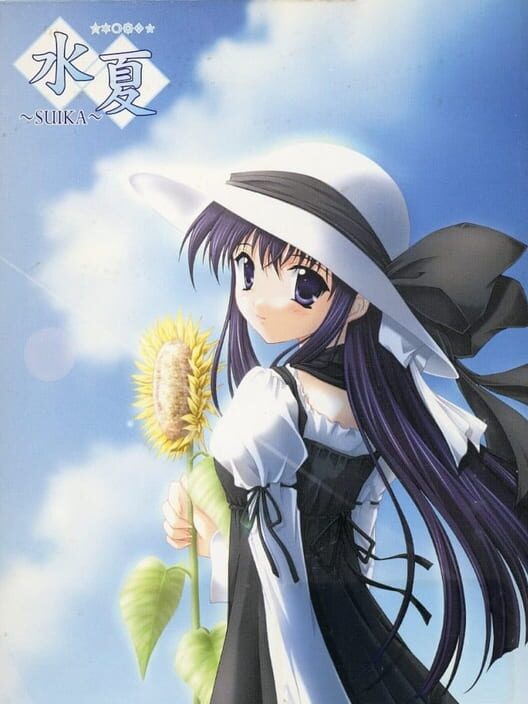
The articlegameplay, story, development, reception
Gameplay
The Suika visual novel is divided into four chapters which contain different stories and characters, though all take place in the same rural town known as Tokiwa Village. In a short prologue upon starting a new game, the player assumes the role of Hiroshi Inaba as he arrives back in town for his annual visit of friends and family. It is here that the two heroines for the two upcoming chapters are seen through his eyes. In the first chapter, the player assumes the role of Akira Kazama and centers around his interaction with the first chapter's sole main heroine Itsuki Minase (voiced by Minami Nagasaki).
In the second chapter, the protagonist is Souji Kamishiro who interacts with the second chapter's two main heroines Sayaka Shirakawa (voiced by Kanon Torii) and Mie Wakabayashi (voiced by Junko Kusayanagi). In the third chapter, the player plays as Yoshikazu Masaki who interacts with two heroines, Akane Masaki (voiced by Yura Hinata) and Touko Kyouya (voiced by Komugi Nishida). In the fourth and final chapter, the player returns to Hiroshi Inaba. ).
Suika's gameplay requires little interaction from the player as most of the game's duration is spent reading the text that appears on the game screen, which represents either dialogue between the various characters or the inner thoughts of the protagonist. After progressing through the text, the player will come to a "decision point" where he or she must choose from multiple options. The time between these decision points varies. Gameplay pauses at these points and depending on which choice the player makes, the plot will progress in a specific direction.
There are five main plot lines the player experiences—one for each heroine. The player must replay the game multiple times and make different choices during decision points to view all five plot lines. One of the goals of the original version's gameplay is for the player to enable the viewing of hentai scenes depicting the given protagonist and one of the heroines having sex.
Development
Suika is the fourth project developed by the visual novel studio Circus, and the second by their Northern subdivision. The producer for Suika was Tororo, president of Circus, who was also one of the two music composers, the other being Kometto Nekono. The planning for Suika was headed by Mikage, and was one of the two scenario writers along with Ichirō Go. Art direction and character design was split between Naru Nanao and Takanon Ikuta.
Programming for the game was provided by Takanori. Tororo, Mikage, and Naru Nanao went on to create titles such as Da Capo, with the latter two later collaborating to help develop Minori's Ef: A Fairy Tale of the Two.
Suika was first available to be public on July 27, 2001, as a CD-ROM for Windows, containing adult content. It was followed by a DVD-ROM release, with various technical improvements, on August 31, 2001. Both versions were released as both a limited edition and a regular edition. The limited edition contained an arrange soundtrack album, a calendar, in addition to a T-shirt included in only the DVD-ROM release; the regular editions did not contain the aforementioned extras.
The next year, the original releases of Suika were followed by two consumer console ports for the PlayStation, renamed as Water Summer, and the Dreamcast. Both versions were published by PrincessSoft, and were released on July 18, 2002 as both a limited edition and a regular edition, with the adult content found in the original release removed. The limited edition of both the PS and the DC version were limited in quantity, with fifteen-thousand units manufactured for the PS version, and twenty-thousand for the DC version. , released on July 25, 2003 for Windows.
S+), was published by Circus in Japan on September 24, 2004 with extended scenario and the adult content found in the original version. S+ Eternal Name) with adult content once again removed. The game was released downloadable on the Internet in English published by the European-based company MangaGamer on April 25, 2009.
Reception
According to a national ranking of bishōjo games based on amounts sold in Japan, the limited edition of Suika's CD-ROM release premiered at the second place out of fifty when it was first listed on the chart, and was then dropped to the fortieth in the next ranking. While it did not appear in the next ranking, it appeared again on the chart one month later, at the forty-eighth place, making its final appearance on the charts. The regular edition of the CD-ROM release premiered on the charts at the seventh place twice since its release, and dropped to the twenty-first in its next and last appearance on the charts. The DVD-ROM release premiered on the charts at the seventh place, before dropping to the forty-eighth place in the next, making its final appearance on the charts. When Suika A.S+ was first released, the limited edition release premiered on the chart at the second place, and did not make any further appearances, while the regular edition release debuted and made its only appearance on the charts at the thirty-seventh place.