
The articlegameplay, story, development, reception
Gameplay
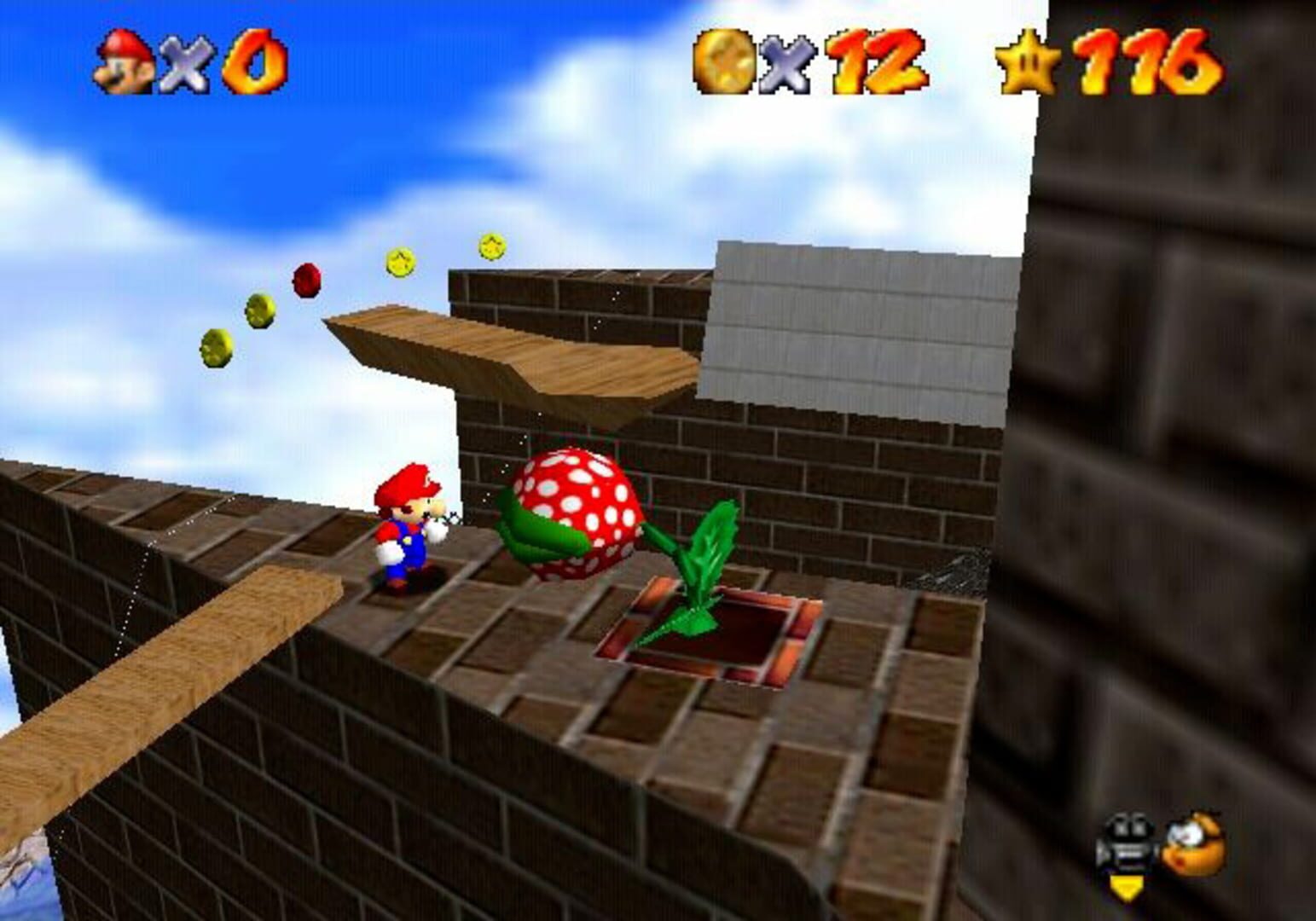
Super Mario 64 has been described as a 3D platformer and action-adventure game in which the player controls the titular character Mario through various courses. Mario's abilities are far more diverse than in previous games. He can walk, run, jump, crouch, crawl, climb, swim, kick, grab objects, and punch using the game controller's analog stick and buttons. He can execute special jumps by combining a regular jump with other actions, including the double and triple jumps, long jump, backflip, and wall jump. The player can adjust the camera—operated by a Lakitu broadcasting Mario—and toggle between first-person and third-person view.
Unlike many of its predecessors, Super Mario 64 uses a health point system, represented by a pie shape consisting of eight segments. If Mario has taken damage, he can replenish his health either by collecting three types of coins—yellow, which replenishes one segment; red, equal to two yellow coins and which replenishes two segments; and blue, equal to five yellow coins and which replenishes five segments, by walking through a spinning heart or by jumping into water. Underwater, Mario's health instead represents how long he can hold his breath, slowly diminishing while underwater and replenishing when he surfaces. Finishing a course grants Mario an extra life for every 50 yellow coins the player collected, and extra life mushrooms are hidden in various places such as trees and poles—they may either chase Mario through the air or fall to the ground, avoiding Mario and disappear shortly if not collected.
Story
Princess Peach invites Mario to come to her castle for a cake she has baked for him. When he arrives, Mario discovers that Bowser has invaded the castle and imprisoned the princess and her servants within its walls using the power of the castle's 120 Power Stars. The Power Stars are hidden in the castle's paintings, which serve as portals to other worlds where Bowser's minions keep watch over the Stars. Mario explores the castle and enters these worlds, gaining access to more rooms as he recovers more Stars.
Mario unlocks three doors to different floors of the castle with keys obtained by defeating Bowser in hidden worlds. After getting at least 70 of the 120 Stars, Mario breaks the curse of the endless stairs that block the entrance to Bowser's final hiding place. After Mario defeats Bowser in the final battle, and Bowser escapes, swearing revenge, he obtains a special Power Star which gives him the Wing Cap, and he flies back to the castle's courtyard. Peach is released from the stained-glass window above the castle's entrance, and she rewards Mario by kissing him on the nose and baking the cake that she had promised him.
Development
In the early 1990s, Super Mario creator Shigeru Miyamoto conceived a 3D Mario design while developing the game Star Fox (1993) for the Super Nintendo Entertainment System. Star Fox used the Super FX graphics chip, which added more processing power; Miyamoto considered using the chip to develop a Super NES game, Super Mario FX, with gameplay based on "an entire world in miniature, like miniature trains". According to engineer Dylan Cuthbert, who worked on Star Fox, Super Mario FX was not a game but the codename of the Super FX chip. Miyamoto reformulated the idea for the Nintendo 64, not for its greater power but because its controller has more buttons for gameplay. At the January 1993 Consumer Electronics Show (CES), where Star Fox made its debut, Nintendo's booth demonstrated a talking 3D polygon animation of Mario's head; this later inspired the creation of the interactive Mario face in the title screen, which was programmed by Giles Goddard.
Production of Super Mario 64 began on September 7, 1994, at Nintendo's Entertainment Analysis & Development division, and concluded on May 20, 1996. According to Miyamoto, the development team consisted of around fifteen to twenty people. Development began with the characters and the camera system; months were spent selecting a view and layout. The camera was programmed by Takumi Kawagoe, who applied what he had learned from working on the camera and cutscenes in Star Fox 2. The original concept involved the fixed path of an isometric game such as Super Mario RPG, which moved to a free-roaming 3D design, with some linear paths, particularly to coerce the player into Bowser's lair, according to Giles Goddard.
Reception
Super Mario 64 received enthusiastic pre-release reception. GamePro commented on the 1995 prototype's smoothness, and how the action "was a blast", despite it being only fifty percent complete. Ed Semrad of Electronic Gaming Monthly agreed, praising the new 3D animation of Mario characters shown in only 2D before. Larry Marcus, a source analyst for Alex. Brown & Sons, recalls Super Mario 64 being the most anticipated game of E3 1996, remembering a field of teenagers "jostling for a test run".
Super Mario 64 received critical acclaim, with a score of 94 out of 100 from review aggregator website Metacritic based on thirteen reviews, and a score of 96% from review aggregator GameRankings, which ranked it the eighteenth best video game of all time based on twenty-two reviews.
Legacy
Super Mario 64 was key to the early success of and anticipation for the Nintendo 64. Lee Hutchinson, a former Babbage's employee, notes how it was spurred by a feverish video game press, and how the success defied the rule that a wide variety of launch games was necessary for broad appeal. Eventually, the Nintendo 64 lost much of its market share to Sony's PlayStation, partly due to its cartridge and controller design decisions, which were reportedly implemented by Miyamoto for Super Mario 64.
In 2012, Super Mario 64 was among the 80 entries in the Smithsonian American Art Museum's The Art of Video Games exhibit.


