
2007 · Intelligent Systems · Adventure · Platformer
Super Paper Mario
Nintendo exclusive
The newest chapter of the Paper Mario story isn't just out of this world... it's out of this dimension. What at first glance appears to be a 2D side-scroller ripped straight from the stylized pages of the Paper Mario universe soon turns into a hilarious dimension-shifting platformer possible only on Wii.
- Released
- 9 April 2007
- Platforms
- WiiWii U
- Genres
- AdventurePlatformerRole-playing
- Developers
- Intelligent Systems
- Publishers
- Nintendo
- Series
- Paper MarioMario
- Modes
- Single-player
- Perspective
- Third personSide view
- Themes
- ActionFantasyComedy
- Country
- Japan
- Age ratings
- ESRB ECERO ACLASS_IND LPEGI 3GRAC ALLACB GUSK 0
- Languages
- English, French, German, Italian, Japanese, Spanish (Spain), Korean, Spanish
- Copies sold
- 2.3 million as of 2008-03-31
- Entry
- #3 in Paper Mario
- Directors
- Ryota Kawade
- Composers
- Chika Sekigawa, Naoko Mitome
About
Super Paper Mario is a 2007 action role-playing game developed by Intelligent Systems and published by Nintendo for the Wii. It is the third installment in the Paper Mario series following Paper Mario: The Thousand-Year Door (2004), and the first Mario game on the Wii. The game follows Mario, Peach, Bowser, and Luigi as they attempt to collect Pure Hearts and stop Count Bleck and his minions from destroying the universe.
Whereas preceding Paper Mario games are turn-based, Super Paper Mario has elements from RPGs and side-scrolling platformers; some critics described it as a hybrid of the two genres. The main feature is Mario's ability to "flip" between 2D and 3D perspectives. Most of the game is played in a 2D perspective, with the 3D perspective being used to solve puzzles and access previously unreachable areas. Peach, Bowser, and Luigi also have unique abilities, and additional abilities can be gained through acquiring partner characters known as "Pixls".
›Story
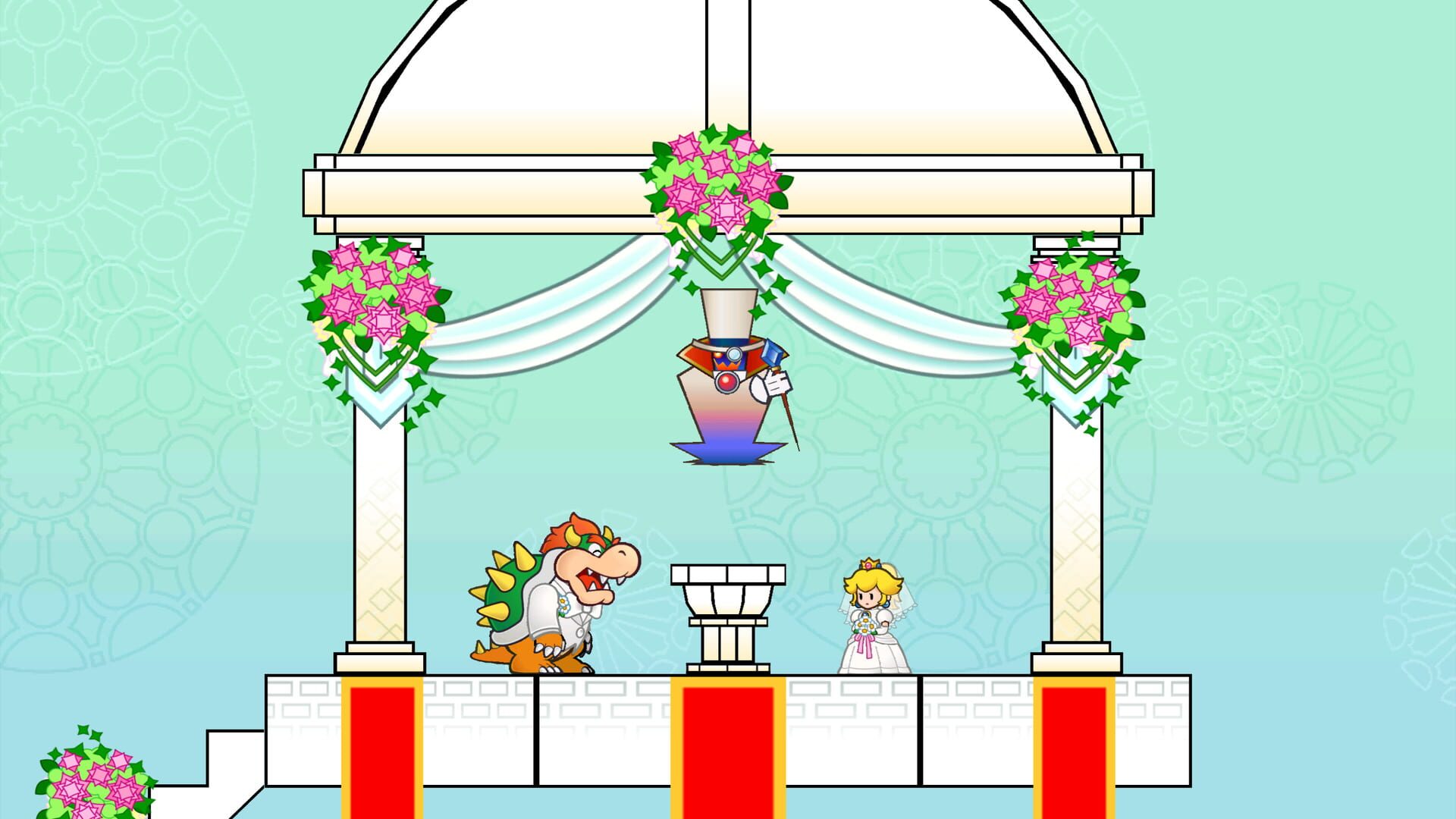
Mario and Luigi are enjoying a lazy afternoon at their house when they hear the terrible news: Princess Peach has been kidnapped. The two Mario brothers head straight for Bowser's castle to get her back, but Bowser is just as surprised about Peach's kidnapping as they are. At that moment, a strange top-hatted villain warps in and abducts everyone but Mario. The mysterious villain then forces Peach and Bowser to get married, creating a rift of dark energy that threatens to tear the universe apart. Only Mario can save the day, but he can't do it alone.
Keywords
- ghosts
- gravity
- samurai
- mascot
- parody
- death
- 2.5d
- side-scrolling
- multiple protagonists
- undead
- princess
- alter ego
Media
The articlegameplay, story, development, reception
Gameplay
Super Paper Mario is a platform game with action role-playing elements, differentiating itself from previous games in the series. Like its predecessors, the graphics consist of 3D environments and 2D characters which look as if they are made of paper. The player controls Mario and various other characters, overcoming linear platforms as in other Mario games. The player's goal is to collect the eight Pure Hearts and defeat the main antagonist Count Bleck.
The player can talk to non-player characters (NPC), defeat enemies, or interact with the environment. Unlike previous Paper Mario games which used a turn-based battle system outside the overworld, in Super Paper Mario all combat is in real-time. Experience points are gained after defeating enemies and allow the player to level up to increase their stats. Mario can temporarily "flip" between dimensions, where the camera rotates 90 degrees to reveal a 3D perspective of the stage, revealing elements hidden in the regular 2D perspective, and can be used to maneuver around obstacles impassable in 2D.
Story
Super Paper Mario opens with Count Bleck abducting Bowser and Princess Peach and forcing the two to marry. Their union, as foretold by the Dark Prognosticus, summons the Chaos Heart. Bleck takes control of the Chaos Heart and uses it to open the Void, a slowly expanding inter-dimensional rift, in order to destroy the flawed universe and create a perfect one in its place. Mario is teleported to Flipside by Tippi and is tasked by Merlon to collect the eight Pure Hearts, which are necessary to undo the destruction. Mario, after learning the ability to flip between dimensions, starts his journey with Tippi at his side, traveling to the different worlds to collect them.
During the adventure, Mario reunites with Peach and Bowser, who join him in the quest. Bleck sends his minions, Dimentio, Mimi, and O'Chunks, as well as a brainwashed Luigi known as "Mr. L", to attack Mario's group and slow their progress. Luigi eventually recovers his memories and is the last to join Mario's group. Mario succeeds in collecting all eight Pure Hearts, but not before the Void grows large enough to obliterate one of the worlds.
Development
Intelligent Systems developed the series' previous games and Super Paper Mario. Director Ryota Kawade changed the traditional concept of previous games with the intention of surprising fans with a new concept. While creating game concepts, he implemented switching through dimensions; he differed the combat from previous game entries to fit with the idea of dimension swapping. When presented to producer Kensuke Tanabe, they both agreed the game would work better in the style of an action-adventure video game, though he asked the staff to keep a role-playing game plot.
Kawade found it difficult to "create a harmonic relationship between the worlds of 2D and 3D", and noted that the process consisted of trial and error. He said how creating one level "required the efforts of creating two levels", as they aimed for adding secrets in 3D that were not visible in 2D.
Reception
According to the review aggregator website Metacritic, Super Paper Mario received "generally favorable reviews" with a score of 85 out of 100, based on 57 critics; it has the sixth-highest score among Wii games released in 2007.
The dimension-flipping mechanic received generally positive reviews. Gamasutra described the game as a "landmark Wii release" and a "hit with critics". The dimension-flipping mechanic, puzzles, creativity, and writing received praise from critics, and most criticism was directed at its inability to please those looking for a pure RPG or platforming game. Its story also received praise, although some criticism was directed at the large amount of text.
Awards
Releases by platformdates and regions as published
Title IDsone per regional release, with its latest update
Decompilations and portscommunity projects that rebuild or port the game
- spm-decomp ★ 106
Decompilation · 2% complete · Active · On gameport
- New Super Paper Bros. ★ 191
Static recompilation · Active · On gameport
In the same series
 Nintendo exclusive84
Super Mario Bros.
1985 · Apple IIGS, Arcade +14
Nintendo Entertainment Analysis & Development
 Nintendo exclusive89
Paper Mario
2000 · Nintendo 64, iQue Player +2
Intelligent Systems
 Nintendo exclusive91
Paper Mario: The Thousand-Year Door
2004 · GameCube, Browser +1
Intelligent Systems
 Nintendo exclusive80
Super Mario Land 3: Wario Land
1994 · Game Boy, Nintendo 3DS
Nintendo Research & Development 1
 Nintendo exclusive89
Super Mario Bros. 3
1988 · Arcade, NES +4
Nintendo Entertainment Analysis & Development
 Nintendo exclusive74
Paper Mario: Sticker Star
2012 · Nintendo 3DS
Nintendo
 Nintendo exclusive74
Super Mario Land
1989 · Game Boy, Nintendo 3DS
Nintendo Entertainment Analysis & Development
 Nintendo exclusive96
Super Mario Advance 2
1990 · Arcade, Nintendo 3DS +4
Nintendo Entertainment Analysis & Development
 Nintendo exclusive70
Paper Mario: Color Splash
2016 · Wii U
Intelligent Systems
 Nintendo exclusive77
Mario & Luigi: Brothership
2024 · Nintendo Switch
 Nintendo exclusive81
Super Mario Land 2: 6 Golden Coins
1992 · Game Boy, Nintendo 3DS
Nintendo Research & Development 1
 Nintendo exclusive79
Paper Mario: The Origami King
2020 · Nintendo Switch
Intelligent Systems
 Nintendo exclusive80
Mario Party Superstars
2021 · Nintendo Switch
Nintendo Cube
 Nintendo exclusive78
Super Mario Party Jamboree – Nintendo Switch 2 Edition + Jamboree TV
2024 · Nintendo Switch, Nintendo Switch 2
Nintendo
 Nintendo exclusive93
Super Mario Odyssey
2017 · Nintendo Switch, Nintendo Switch 2
Nintendo
 72
Donkey Kong
1981 · Amstrad CPC, Apple II +34
Nintendo Research & Development 1
 72
Donkey Kong Jr.
1982 · Arcade, Atari 2600 +14
Nintendo
 Nintendo exclusive72
BS Dr. Mario
1990 · Arcade, Game Boy +3
Nintendo Research & Development 1
 Nintendo exclusive58
Mario & Wario
1993 · SNES
Game Freak
 Nintendo exclusive
Mario Clash
1995 · Virtual Boy
Nintendo Research & Development 1
 Nintendo exclusive67
Super Princess Peach
2005 · Nintendo DS
Tose Co.
 Nintendo exclusive73
Mario Sports Mix
2010 · Wii, Wii U
Square Enix
 70
Mari0
2012 · Android, Linux +2
 Nintendo exclusive81
Captain Toad: Treasure Tracker
2014 · Nintendo 3DS, Nintendo Switch +1
EAD Tokyo Group No. 2
Games like this
 Nintendo exclusive88
New Super Mario Bros.
2006 · Nintendo DS, Wii U
Adventure · Platformer
 Nintendo exclusive86
Mario & Luigi Superstar Saga
2003 · Game Boy Advance, Wii U
Adventure · Role-playing
 Nintendo exclusive85
Mario & Luigi: Partners in Time
2005 · Nintendo DS, Wii U
Adventure · Role-playing
 Nintendo exclusive93
Mario & Luigi: Bowser's Inside Story + Bowser Jr.'s Journey
2009 · Nintendo DS, Wii U
Adventure · Role-playing
 Nintendo exclusive93
Super Mario Galaxy 2
2010 · Nintendo Switch, Wii +1
Adventure · Platformer
 Nintendo exclusive86
Super Mario Sunshine
2002 · GameCube
Adventure · Platformer
- Nintendo exclusive93
Mario & Luigi: Bowser's Inside Story
2009 · Nintendo DS
Adventure · Role-playing
 Nintendo exclusive79
Mario & Luigi: Dream Team
2013 · Nintendo 3DS
Adventure · Platformer
Collections9 collections
Platform libraries
- Wii gamesGames
- Wii games on Wii U eShopGames
Series and characters
- Mario role-playing gamesPaper Mario series
- Mario role-playing gamesPaper Mario series
- Games featuring MarioList
Technology
Reception and records
- Recalled gamesList
Publishers
Development status
Description adapted from its source, CC BY-SA 4.0.