The articlegameplay, story, development, reception
Gameplay
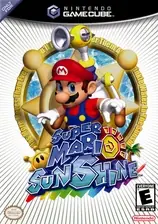
Super Mario Sunshine is a platformer and action-adventure game. It shares many gameplay elements with its predecessor, Super Mario 64, while introducing several new features. Players control Mario as he collects 120 Shine Sprites to bring light back to Isle Delfino and prove his innocence after Bowser Jr. disguises himself as Mario, steals the Shine Sprites, and covers the island in toxic slime.
Players start off in the hub world of Delfino Plaza and access various worlds via portals which become available as the game progresses. Like Stars in Super Mario 64, players obtain Shine Sprites by clearing selected missions with specific objectives. Unlike its predecessor, these missions have a more strictly linear order and most mission Shine Sprites cannot be collected until previous missions are completed. There are also various hidden areas and challenges across Isle Delfino where more Shine Sprites can be obtained.
Story
Mario visits the tropical Isle Delfino for a vacation with Princess Peach, her steward Toadsworth, and several other Toads. At Delfino Airstrip, they discover a mass of paint-like goop. ), a water cannon created by Professor E. Gadd, Mario defeats a slime-covered Piranha Plant that emerges from the goop.
However, evidence incriminates Mario of vandalizing the island with graffiti, causing the source of the island's power, Shine Sprites, to disappear and the island to be covered in shadow. Despite evidence contrary to the situation, and Peach and Toadsworth serving as Mario's defense team, the judge for the kangaroo court finds Mario guilty. Mario is later given a community service assignment: cleaning up the island and tracking the real criminal.
Development
A sequel to Super Mario 64 had been in development for several years; the canceled games Super Mario 64 2/Super Mario 128 were some ideas Nintendo had for a direct sequel. Super Mario Sunshine was first shown at Nintendo Space World 2001. The game was later shown again at E3 2002. It was developed by Nintendo EAD.
The game was the first lead directing role for Nintendo designer Yoshiaki Koizumi following a ten-year-long apprenticeship working on various other games. Super Mario creators Shigeru Miyamoto and Takashi Tezuka served as producers. It was the first Nintendo first-party game after Satoru Iwata became president of Nintendo, succeeding Hiroshi Yamauchi. Developing a Mario game for the GameCube was the last request Yamauchi gave the team before resigning.
Reception
Super Mario Sunshine was critically acclaimed by game critics and fans. Particular praise went towards the graphics, music, story, gameplay and the addition of F.L.U.D.D. IGN praised the addition of the water backpack for improving gameplay, and GameSpy commented on the "wide variety of moves and the beautifully constructed environments". The game received a perfect score from Nintendo Power, who wrote that the game has "superb graphics, excellent music, clever layouts, funny cinema scenes and ingenious puzzles".
Super Mario Sunshine won GameSpot's annual "Best Platformer on GameCube" award. GamePro gave it a perfect score, stating that the game was "a masterpiece of superior game design, infinite gameplay variety, creativity, and life." The American-based publication Game Informer said that the game is arguably "the best Mario game to date." Computer and Video Games also mentioned the game is "better than Super Mario 64."
Legacy
Super Mario Sunshine introduced several elements that were carried over into subsequent Mario games and other related media. Many of the bosses appear in Mario spin-offs that followed on the GameCube, such as in Mario Kart: Double Dash!! and Mario Golf: Toadstool Tour.
Bowser Jr. became a major recurring character in the franchise, appearing in many mainline and spin-off games,, as well as the Super Smash Bros. series and The Super Mario Galaxy Movie. The characters Petey Piranha, King Boo, and Toadsworth would also become recurring characters.