The articlegameplay, story, development, reception
Gameplay
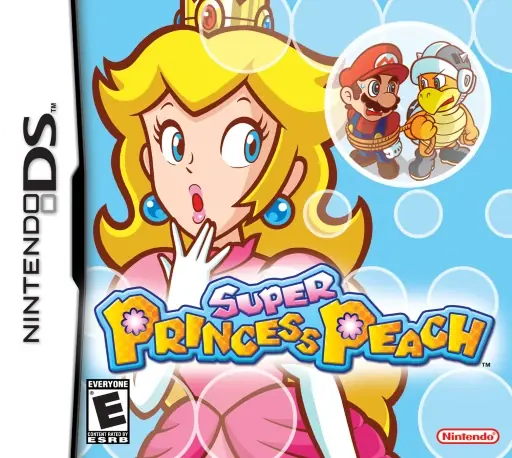
Super Princess Peach plays similarly to traditional platformers. Players guide Princess Peach through Vibe Island, composed of eight worlds, each of which contains five standard levels and a boss battle level that leads the player to the next world. Three captive Toads are hidden throughout each level, with the first six boss battles holding a single Toad hostage in a bubble. In the seventh and penultimate boss battle, Luigi appears in place of the usual Toad.
To access the final battle with Bowser and save Mario, Peach must rescue all of the Toads and Luigi. After beating Bowser for the first time, Peach unlocks extra levels in the first world; replaying the other boss battles unlocks further extra levels in subsequent worlds. There are 24 total extra levels to unlock. Replaying the battle with Bowser doubles the times he must be hit to be defeated in his giant form.
Story
Bowser hears of a legendary emotion-controlling artifact called the Vibe Scepter, hidden on an island near the Mushroom Kingdom called Vibe Island, and builds a summer getaway home there in hopes of using it to his advantage. After his second-in-command, Army Hammer Bro, finds the Scepter for him, Bowser hatches a plan to capture the Mario Brothers. Army Hammer Bro entrusts the scepter to a Goomba and sends it into Princess Peach's castle. With the residents of the castle under the influence of the scepter, Army Hammer Bro and his troops successfully capture Mario, Luigi, and many Toads, imprisoning them all across the island. Returning to Bowser's Villa, the Goomba becomes influenced by the scepter and begins swinging it around, causing Bowser and his minions to lose control of their emotions before Bowser seizes it.
Meanwhile, Princess Peach and Toadsworth return to her castle after a short walk, only to find the residents in emotional disarray and a note from Bowser saying that he has captured Mario and Luigi. Outraged but determined, Peach decides to go to Vibe Island to save the Mario Bros. and the Toads. Shortly before her departure, Toadsworth, reluctant to see Peach travel on her own, gives her a sentient parasol named Perry to help her on her journey.
Development
Super Princess Peach was first announced by Nintendo in October 2004 with the exclusion of a posted release date. It was first released in Japan on October 20, 2005. It later came out in North America and Europe on February 27 and May 26, 2006, respectively.
When discussing Peach's portrayal in the game, Shigeru Miyamoto, creator of the character and the Mario franchise, stated that it was important for Nintendo for Peach to be "Peach-like", meaning that she evokes the "free optimism of a Princess." He explained that she has never seen herself as being "protected" by Mario, and that their intended image of her is an image of strength, due to many Nintendo developers being used to a matriarchal figure at home.
Reception
Super Princess Peach received generally positive reviews from critics, it currently has an average rating of 76.60% on GameRankings, and of 75% on Metacritic.
By July 2007, 1.15 million copies of Super Princess Peach have been sold worldwide. It is one of the best-selling Nintendo DS video games.
Legacy
From February 2006 to March 2007, the magazine Famitsu DS+Gamecube+Advance published a comical manga based on the game called Peach no Daiboken!? created by Kazumi Sugiyama. Like the original game, the story deals with Peach, traveling with Perry and joined by Toadsworth, to save her friends abducted by Bowser.
In the manga Super Mario-kun, Peach used her vibe powers and appeared with Perry.