The articlegameplay, story, development, reception
Gameplay
Following 1980's Space Panic, Donkey Kong is one of the earliest examples of the platform game genre, even prior to the term being coined; the U.S. gaming press used "climbing game" for games with platforms and ladders. As the first platformer game to feature jumping, Donkey Kong requires the player to jump between gaps and over obstacles or approaching enemies whilst Donkey Kong throws barrels at the player, setting the template for the future of the genre. With four unique stages, Donkey Kong was the most complex arcade game of the time, and one of the first arcade games with multiple stages, following games such as 1980's Phoenix and 1981's Gorf and Scramble.
In addition to the goal of saving Pauline, the player has a score. Points are awarded for the following: leaping over obstacles; destroying objects with a hammer power-up; collecting items such as hats, parasols, and purses; removing rivets from platforms; and completing each stage according to a steadily decreasing bonus counter. The player starts with three lives with a bonus life awarded at 7,000 points. A life is lost when Mario touches Donkey Kong or any enemy object, falls too far, or lets the bonus counter reach zero. The game ends when all lives are lost.
Each of the four single-screen stages represents 25 meters of the structure Donkey Kong has climbed: 25, 50, 75, and 100 meters. Stage one involves Mario scaling a construction site made of crooked girders and ladders while jumping over or hammering barrels and oil drums tossed by Donkey Kong. Stage two involves climbing a five-story structure of conveyor belts, each of which transport cement pans. The third stage involves the player riding elevators while avoiding bouncing springs.
The final stage requires Mario to remove eight rivets from the platforms supporting Donkey Kong; this causes Donkey Kong to fall and the hero to be reunited with Pauline. These four stages combine to form one level.
After each level, the stages repeat with increased difficulty. For example, Donkey Kong begins to hurl barrels faster and sometimes diagonally, and fireballs speed up. The victory music alternates between levels 1 and 2. The fourth level consists of five stages with the final stage at 125 meters.
The first stage of level 22, the 130th stage overall, is colloquially known as the kill screen because of a programming error that kills Mario after a few seconds, effectively ending the game. In January 2025, a glitch was discovered via a tool-assisted superplay which sometimes allows climbing straight to the top of the kill screen from the starting point. This allows continuing the game until the 135th stage. Due to the limits of the joystick used, it is impossible to perform this trick on an actual Donkey Kong arcade machine within the stage's time limit.
Story
Donkey Kong is the earliest video game with a storyline that visually unfolds on screen. Set on a construction site in New York City, the eponymous Donkey Kong character is the de facto villain. The hero is a carpenter originally unnamed in the Japanese arcade release, later called Jumpman, then Mario. Donkey Kong kidnaps Mario's girlfriend, originally known as Lady and later renamed Pauline.
The player takes the role of Mario to rescue her. This is the first occurrence of the damsel in distress scenario used in countless video games released after.
The game uses graphics and animation for characterization. Donkey Kong smirks upon Mario's demise. ". Mario, depicted in red overalls and a red cap, is an everyman character, a type common in Japan.
Graphical limitations and the low pixel resolution of the small sprites prompted his design. A mustache implies a mouth, a cap obviates the animation of hair, and colored overalls distinguish his arm movements. The artwork of the cabinets and promotional materials make these cartoon-like character designs even more explicit. Pauline, for example, is disheveled like King Kong's Fay Wray in a torn dress and stiletto heels.
Like Pac-Man (1980), Donkey Kong has cutscenes, but innovates by advancing a complete plot. The game opens with the gorilla climbing a pair of ladders to the top of a construction site, accompanied by a variation on the musical theme from Dragnet. He drops Pauline and stomps his feet, warping the steel beams. He moves to his final perch and sneers.
A melody plays, and the level starts. This sequence sets the scene and adds background to the gameplay—a first for video games. At the end of the stage, a heart appears between Mario and Pauline, but Donkey Kong grabs her and climbs higher, causing the heart to break. The narrative concludes when Mario reaches the end of the rivet stage, when he and Pauline are reunited.
Development
Nintendo of America was founded in 1980 with minor success at importing its parent's arcade cabinets from Japan. In early 1981, its president Minoru Arakawa bet the small startup company on a major order of 3,000 Radar Scope games. Its poor reception in America filled a warehouse with 2,000 unsold Radar Scope machines, so Arakawa requested that the parent company president (and his father-in-law) Hiroshi Yamauchi send a conversion kit of new game software. Yamauchi polled the company's entire talent pool for fresh game design concepts to save the distressed startup. This yielded Shigeru Miyamoto's debut as lead game designer of his Donkey Kong concept, and Yamauchi appointed head engineer Gunpei Yokoi as project supervisor with a budget of $267,000 (equivalent to $946,000 in 2025) according to Miyamoto.
The conception of Donkey Kong can be traced back to early 1980, when Miyamoto made three A4-size sheets briefly explaining the game's content and characters, about five game screen sketches, and a one-sheet diagram of the final animation. Ikegami Tsushinki was subcontracted for most of the development, heavily involved in the game's creation and concept, and to provide "mechanical programming assistance to fix the software created by Nintendo". Nintendo instructed Ikegami to produce a program according to its instructions and put it onto read-only memory (ROM) chips on printed circuit boards. This later led to mutual lawsuits in 1983, as Ikegami asserted ownership over Donkey Kong which Nintendo denied as Ikegami was a subcontractor who had already been paid.
Game Machine called it "simply a nuisance tactic" on the part of Ikegami. Production on Donkey Kong began in January 1981 and lasted between 4–5 months, as Miyamoto was focused on developing it for a global market rather than just for Japan.
The game was originally designed to have Mario escape from a maze, and jumping was not yet implemented, making platforming too difficult. The four screens were also supposed to make up a single long stage, but this idea was scrapped due to the inability to implement vertical scrolling. By late March 1981, Nintendo was also pursuing a license to make a game based on the Popeye comic strip, tentatively titled Popeye's Beer Barrel Attack Game. In this iteration of the game, the player, as Popeye, would attempt to rescue Olive Oyl from Bluto in a similar manner to the final game, with the first level being completed by having the player use a jack to bend the top girder upwards, causing the barrels to roll back towards Bluto.
After experiencing difficulty portraying the Popeye characters within the limits of the game hardware, Nintendo elected to replace Bluto with a newly created gorilla character before ultimately deciding to make the rest of the game's cast original, reserving the Popeye IP for future use. Miyamoto came up with many characters and plot concepts, but he settled on a love triangle between a gorilla (originally envisioned as a man in a gorilla suit), a carpenter with a large hammer, and a girlfriend, mirroring the original rivalry between Bluto and Popeye for Olive Oyl. The ape that had originally replaced Bluto would evolve into the titular Donkey Kong, which Miyamoto said was "nothing too evil or repulsive". He would be the pet of the main character, "a funny, hang-loose kind of guy".
Miyamoto has named "Beauty and the Beast" and the 1933 film King Kong as influences. Although its origin as a comic strip license played a major part, Donkey Kong marked the first time that the storyline for a video game preceded the game's programming rather than simply being appended as an afterthought. An unrelated Popeye game was released by Nintendo for the Game & Watch the following month, as well as a game called Popeye for arcades in 1982.
Full-scale development began in early April 1981 when then-manager Masayo Oka instructed Minoru Iinuma, Mitsuhiro Nishida, Yasuhiro Murata, and Hirohisa Komanome to stop what they were working on and assemble together in a meeting room for a new project. He explained that the purpose of this development was to use up the large amount of leftover PCB inventory and create a new game that made the most of the hardware capabilities. They were scheduled to complete the game in mid-June of that year. Yamauchi wanted primarily to target the North American market, so he mandated that the game be given an English title, as with many previous Nintendo games.
The story of how "Donkey Kong" received its name varies. Several sources cite Miyamoto as the one who named the character; it is claimed that Miyamoto looked in a Japanese-English dictionary for something that would mean "stubborn gorilla", or that "Donkey" was meant to convey "silly" or "stubborn"; "Kong" was common Japanese slang for "gorilla". A rival claim is that the name came from Nintendo's export manager, Shinichi Todori, who was tasked to localize the game in America. Todori picked "Donkey Kong" out of a list containing twenty potential names, with "Donkey" being meant to represent "stupid and goofy".
A false urban myth also claimed that the name was originally meant to be "Monkey Kong", but was misspelled or misinterpreted due to a blurred fax or bad telephone connection. In 2001, Miyamoto stated that he thought the name would convey the thought of a "stupid ape". Other potential names for the game included Big Kong, Giant Kong, Mad Kong, Kong on the Run, Kong Chase, Steel Kong, Funny Kong, City Kong, Heart & Kong, Lady & Kong, Attack the Kong, Kong Attacker, Build On, and Family Kong.
Miyamoto had high hopes for his new project. He was not a programmer, so he consulted technicians for feasibility. He wanted to make the characters different sizes, and have different movements and reactions. Yokoi thought Miyamoto's original design was too complex, though he had some difficult suggestions, such as using see-saws to catapult the hero across the screen which was eventually found too hard to program. Miyamo
Reception
Upon release in arcades, Computer and Video Games compared it favorably with King Kong and predicted that it would likely become a success. In his 1982 book Video Invaders, Steve Bloom described Donkey Kong as "another bizarre cartoon game, courtesy of Japan" and said it was one of the "most exciting variations" on Pac-Man's maze theme along with Sega's Frogger due to how players need to "scale from the bottom of the screen to the top" which make them "more like obstacle courses than mazes" since "you always know where you're going — up". In January 1983, the 1982 Arcade Awards gave it the award for the best single-player video game and the Certificate of Merit as runner-up for Coin-Op Game of the Year.
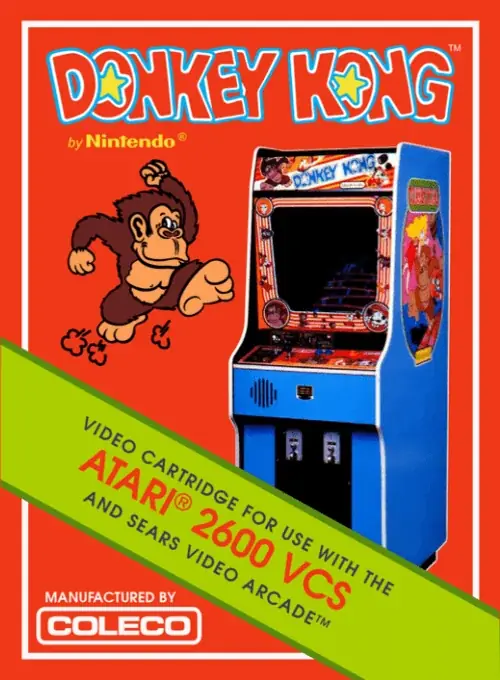
In September 1982, Arcade Express reviewed the ColecoVision port and scored it 9 out of 10. Creative Computing Video & Arcade Games in 1983 stated that "Coleco did a fabulous job" with Donkey Kong, the best of the console's first five games and "the most faithful adaptation of the original video game I have seen". The magazine's Danny Goodman stated that of Coleco's three console versions, the one for the ColecoVision was the best, followed by Atari and Intellivision. Computer and Video Games reviewed the ColecoVision port in its September 1984 issue and scored it 4 out of 4 in all four categories of Action, Graphics, Addiction and Theme.
Ed Driscoll reviewed the Atari VCS version of Donkey Kong in The Space Gamer No. 59. Edwards commented that the game is near perfect and that anyone can be caught in Donkey Kong "fever".
Donkey Kong was popular worldwide, garnering a positive reaction from consumers, and was a significant commercial success for Nintendo, pulling them out of financial troubles. After the game's initial 2,000 arcade cabinets sold out, more orders were made. Arakawa began manufacturing the electronic components in Redmond because waiting for shipments from Japan was taking too long. The game's success led to Arakawa expanding Nintendo of America.
By October, Donkey Kong was selling 4,000 units a month, and by June 1982, Nintendo had sold 60,000 Donkey Kong machines in the United States, earning $180 million. Judy and Stone, who worked on straight commission, became millionaires. Donkey Kong appealed to both sexes; How to Win Video Games (1982) estimated that half of its players were women, while 95% of Defender players were men. Arakawa used Nintendo's profits to buy 27 acres (11 ha) of land in Redmond in July 1982.
Nintendo earned another $100 million on the game in its second year of release in America, totaling $280 million in US cabinet sales by 1982 (equivalent to $990,000,000 in 2025).
In Japan, the annual Game Machine charts listed Donkey Kong as the highest-grossing arcade game of 1981, then the sixth highest-grossing arcade game of 1982. Game Machine later listed the game as the 20th most successful table arcade cabinet of September 1983. In the United States, Donkey Kong topped the Play Meter arcade charts in October 1981, setting a weekly earnings record, and it was later listed by RePlay as the highest-grossing arcade game of 1982. It was also among the thirteen highest-grossing arcade games of 1983 in the United States.
According to Electronic Games in June 1983, the home versions contributed to the arcade version's extended popularity, compared to the four to six months that the average game lasted. It remained Nintendo's top seller into mid-1983, with steady sales in Japan. A total of 65,000 arcade units were sold in Japan, and 67,000 arcade units in the United States, for a total of 132,000 arcade units sold in Japan and the United States.
Nintendo's Game & Watch handheld version of Donkey Kong released in 1982 sold 8 million units. Coleco had sold 6 million Donkey Kong cartridges for home consoles, grossing more than $153,000,000 (equivalent to $510,000,000 in 2025) and earning Nintendo more than $5 million in royalties; the bundled ColecoVision version sold 2 million units, while the Atari 2600 version sold 4 million units in 1982 for $100 million, making it one of the best-selling Atari 2600 games. It was also one of the earliest cartridges available for video game rental at certain stores in 1982. Atari's 1987 re-release for the Atari 2600 sold a further 180,523 units for $1,258,282 by 1990.
Coleco's Mini-Arcade tabletop versions of Donkey Kong, along with Pac-Man, Galaxian, and Frogger, had combined sales of three million units. In Japan, 840,000 units of the Famicom version were sold; the Famicom Mini version for the Game Boy Advance later had a further 160,000 units sold, for a total of 1 million units sold in Japan. The Atari 8-bit computer version sold 25,502 units in 1986 and 1990. This totals 15,206,025 units sold worldwide for the Game & Watch, ColecoVision, Atari and Famicom ports.
4 billion in revenue.
Legacy
In 1996 Next Generation listed the arcade, Atari 7800, and cancelled Coleco Adam versions as number 50 on their "Top 100 Games of All Time", commenting that even ignoring its massive historical significance, Donkey Kong stands as a great game due to its demanding challenges and graphics which manage to elegantly delineate an entire scenario on a single screen. In February 2006, Nintendo Power rated it the 148th best game made on a Nintendo system. In 2017, The Strong National Museum of Play inducted Donkey Kong to its World Video Game Hall of Fame. Today, Donkey Kong is the fifth most popular arcade game among collectors.
Donkey Kong spawned a number of other titles with a mix of running, jumping and vertical traversal, a novel genre that did not match the style of games that came before it. S. gaming press adopted the term "climbing games", and eventually the genre came to be known as platform games. The game was also a milestone in terms of video game storytelling and cutscenes.
While there were earlier games that either told a story or used cutscenes, Donkey Kong combined both concepts together to introduce its own new concept: using cutscenes to visually advance a complete story. It also had multiple, distinct levels that progressed the storyline.
Donkey Kong was also one of the first Japanese games brought to Western regions that introduced a surreal concept using cute artwork, a representation of typical Japanese fantasy but unusual to Western audiences. For that reason, Donkey Kong and similar games that followed were briefly called "novelty games" by Western gaming press. Donkey Kong and other such games helped to acclimate Western audiences to Japanese approaches to game design, narrative, and abstraction that would become key elements in the decade that followed with the release of the NES.
Computer and Video Games called Donkey Kong "the most momentous" release of 1981, as it "introduced three important names" to the global video game industry: Nintendo, Shigeru Miyamoto, and Mario. These three figures went on to play a significant role in video game history. Donkey Kong paved the way for the NES, known as the Famicom in Japan. Following the success of Donkey Kong, Nintendo began developing the Famicom, the hardware of which was largely based on the Donkey Kong arcade hardware, with the goal of matching the system's powerful sprite capabilities in a home system. Nintendo wanted the Famicom to match the Donkey Kong arcade hardware, so they took a Donkey Kong arcade cabinet to semiconductor chip manufacturer Ricoh for analysis, which led to Ricoh producing the Picture Processing Unit (PPU) chip for the NES.
The 2007 documentary The King of Kong follows the efforts of Steve Wiebe and Billy Mitchell to break the world record for high scores in Donkey Kong. It sparked a resurgence of interest in competitive play, and there has been a string of record breaking Donkey Kong scores since the documentary was released.
The NES version was re-released as an unlockable game in the first Animal Crossing, both through its Nintendo Space World 2000 demo as well as the final game. It was also released on the Virtual Console for the Wii in 2006 worldwide with a South Korean release in 2008, the Wii U in 2013, and the Nintendo 3DS in Japan in 2012, North America and Europe in 2013, and in South Korea in 2016. The Wii U version is also the last game that was released to celebrate the 30-year anniversary of the Japanese version of the NES, the Famicom. The original arcade version of the game appears in the Nintendo 64 game Donkey Kong 64, and it must be beaten to finish the game.
Nintendo released the NES version on the e-Reader in 2002, and for the Game Boy Advance as part of the Classic NES Series in 2004. , and Mario Bros. The original arcade version was re-released by Hamster Corporation as part of their Arcade Archives series for Nintendo Switch on June 14, 2018, and the NES version was re-released as one of the launch titles for the Nintendo Classics service on September 19.
Donkey Kong: Original Edition is an update of the NES version that reinstates the cement factory stage and includes some animations absent from the original NES version, and has only ever been released on the Virtual Console. It was preinstalled on 25th Anniversary PAL region red Wii systems, which were first released in Europe on October 29, 2010. In Japan, a download code for the game for the 3DS Virtual Console was sent to users who purchased New Super Mario Bros. 2 or Brain Age: Concentration Training from the Nintendo eShop from July 28 to September 2, 2012.
In North America, a download code for Original Edition for the 3DS Virtual Console was sent to users who purchased one of five select 3DS games on the Nintendo eShop and registered it on Club Nintendo from October 1, 2012, to January 6, 2013. In Europe and Australia, it was released for purchase on the Nintendo 3DS eShop in September 2014.
Donkey Kong was widely influential and resulted in direct clones and games with similar elements and themes in the early 1980s. The Giant List of Classic Game Programmers lists 17 different Donkey Kong clones released for various home platforms. There were so many games with multiple ladder and platforms stages by 1983 that Electronic Games described Nintendo's own Popeye game as "yet another variation of a theme that's become all too familiar since the success of Donkey Kong". That year Sega released Congo Bongo in arcades, which puts the structure of Donkey Kong into an isometric perspective; coconuts rolled by an ape are Congo Bongo's analog of barrels. Coconuts—tossed by a monkey this time—are also the primary obstacles in the platform levels of Taito's Zoo Keeper from the same year.
Crazy Kong was officially licensed from Nintendo and manufactured