Ludography
47/100
Players20 ratings

Where to get it

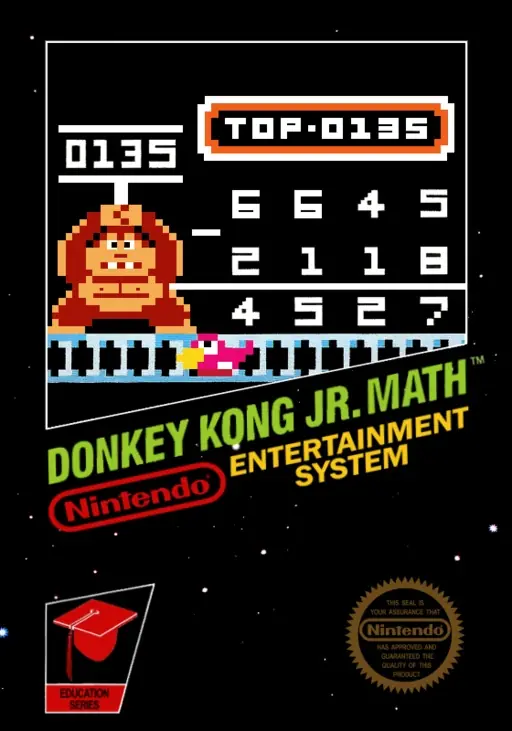
Donkey Kong Jr. Math cover

1983 · Nintendo Research & Development 2 · Educational entertainment · Mathematical education

Donkey Kong Jr. Math

Nintendo exclusive

The game features one and two player modes, both of which are single screen. In the first mode, the objective is to enter math answers in order to receive points. These questions include addition, subtraction, multiplication, and division.

In the two player mode, two players control two characters as they race to create a math formula to reach the number shown by Donkey Kong, incorporating platform gameplay. The mechanics are similar to Donkey Kong Junior; players climb vines to reach higher areas in order to collect numbers scattered around the area. In order to complete mathematics problems, players must collect at least three things: the first number, the symbol necessary to reach the number shown by Donkey Kong, and the second number. When the game features a high number, such as 66, players must collect multiple numbers and mathematics symbols in order to reach this.

For example, players could choose a nine, a multiplication symbol, and a seven, followed by an addition symbol and a three to reach the number 66. The two player game have two different levels, Calculate A and Calculate B. Calculate B is more challanging, not only the goal is a negative number, but giving players the set number.

Also known as
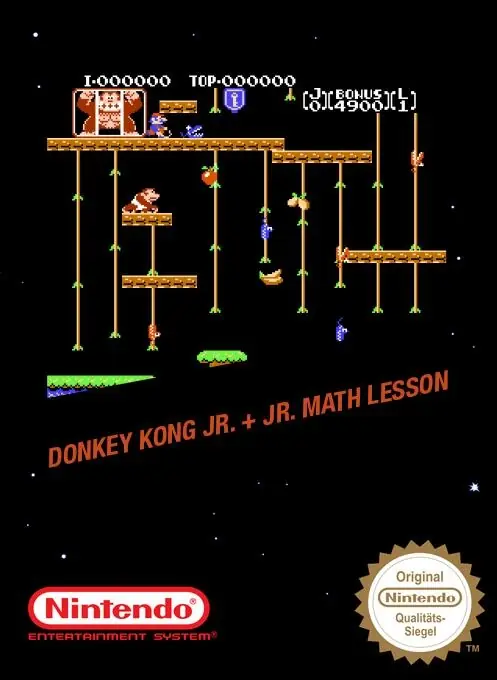
DK Jr. Math · Donkey Kong Junior Math · Donkey Kong Junior no Sansū Asobi · Donkey Kong Jr.'s Math play · Donkey Kong Jr. no Sansuu Asobi · Donkey Kong Jr. + Jr. Math Lesson · Donkey Kong Jr. + Jr. Lesson
Released
12 December 1983
Platforms
NESWiiWii U
Genres
Educational entertainmentMathematical educationPlatformer
Developers
Nintendo Research & Development 2Nintendo
Publishers
NintendoSharp
Series
Donkey Kong
Modes
MultiplayerSingle-player
Perspective
Side view
Themes
ActionEducational
Country
Japan
Age ratings
CLASS_IND LPEGI 3ESRB ECERO A
Languages
English

About

Donkey Kong Jr. Math is a 1983 edutainment platform video game developed and published by Nintendo for the Nintendo Entertainment System. It is a spin-off of the 1982 arcade game Donkey Kong Jr. In the game, players control Donkey Kong Jr. as he solves math problems set up by his father Donkey Kong.

It is the only game in the Education Series of NES games in North America, owing to the game's lack of success. It was made available in various forms, including in the 2002 GameCube video game Animal Crossing and on the Virtual Console services for Wii and Wii U in 2007 and 2014 respectively, and in 2024 for the Nintendo Classics service. Donkey Kong Jr. Math was a critical and commercial failure. It has received criticism from several publications including IGN staff, who called it one of the worst Virtual Console games.

Bruce Lowry, Nintendo of America’s vice president of sales from 1981 to 1986, referred to it as “the worst game we ever sold.”

Keywords

  • math
  • edutainment
  • kid friendly
  • high score
  • climbing
  • digital distribution
  • gorilla
  • virtual console
  • launch titles
  • descendants of other characters
  • young protagonist
  • single-screen level

Media

The articlegameplay, story, development, reception

Gameplay

The game features two modes, one single-player and the other allowing for one to two players. Its mechanics are similar to its predecessor, Donkey Kong Jr. The Calculate mode has Donkey Kong hold up a number, which players must attempt to reach by collecting a combination of digits and arithmetic symbols to eventually reach that number. Players must climb vines to reach these figures. The +−×÷ Exercise requires players to solve fixed math puzzles by climbing chains to reach the correct numbers and arithmetic symbols to do so.

Development

Donkey Kong Jr. Math was developed by Nintendo Research & Development 2 and designed by Toshihiko Nakago. It was published by Nintendo for the Family Computer (Famicom) and Nintendo Entertainment System (NES). It reuses its engine, assets, and gameplay from Donkey Kong Jr.

It was a part of the Educational Series on the NES, a series that was originally supposed to have three entries, including music game Donkey Kong's Music Play [ja], but was the only one released under that line. A lack of success by the game was attributed by a Nintendo spokesman to be the reason Nintendo did not make more educational titles. It was the first spin-off title Nintendo made.

The game was first released in Japan on December 12, 1983, and was released shortly after together with Donkey Kong Jr. as a licensed multicart (released in a bundle together with Sharp's C1 Famicom TV). In August 1995, the Sharp multicart was re-released separately from the C1 Famicom TV. The game has been released on other platforms, including the video game Animal Crossing, which featured several NES games.

Donkey Kong Jr. Math was re-released on the Wii's Virtual Console in Japan on March 27, 2007, Europe and Australia on April 20, and in North America on September 3. It was re-released again for the Wii U's Virtual Console in North America on August 28, 2014, in Europe on January 22, 2015, and in Japan on April 15.

Reception

Donkey Kong Jr. Math was met with negative reviews from the press. Despite this negative reception, the magazine Joystick felt Nintendo was worthy of praise for its attempt at making an educational game. The game was also a commercial failure, with a Nintendo spokesperson noting its lack of success as being due to poor reception.

Donkey Kong Jr. Math performed better in Japan but was forgotten in the United States. Its poor sales contributed to it becoming a rare and expensive collector's item.

Jeremy Parish of Polygon called it the worst Donkey Kong video game, suggesting that it was a "half-finished game" to have a larger launch lineup on the Famicom. , while Skyler Miller of AllGame found this reuse creative. com called Donkey Kong Jr. Math the worst NES launch window title, criticizing it for its lack of value and sluggish movement.

The game had a poor reception from IGN, with Lucas M. Thomas finding its controls and execution poor, while Cam Shea regarded it as one of the worst Virtual Console games and criticized it for a lack of value. Dan Whitehead of Eurogamer similarly could not justify the asking price for the Virtual Console version. Frank Provo of GameSpot felt that its math problems were either too easy for young children or too boring for older ones.

Damien McFarren of Nintendo Life criticized the game for "shoehorning" education into this game and for poor controls. Author Jeff Ryan referred to the game as a "dud". While noting that it "reinforced math fundamentals", he called the gameplay "fun" but "challenging".

Donkey Kong Jr. Math has received criticism for its qualities as an educational game. Elizabeth Sweedyk, associate computer science professor at Harvey Mudd College, felt that Donkey Kong Jr. Math was too realistic an educational game to be fun. Kevin Gifford of 1UP.com felt that it lacks appeal for children, while Frank Caron for Ars Technica felt it inferior to other educational games like Brain Age and Math Blaster.
Releases by platformdates and regions as published

Releases by platform
PlatformReleasedRegions
NES12 December 1983Japan · North America 1 June 1986 · Europe 31 December 1986
WiiEarly Access27 March 2007Japan · Australia 20 April 2007 · Europe 20 April 2007 · North America 3 September 2007
Wii U28 August 2014North America · Europe 22 January 2015 · Japan 15 April 2015

Title IDsone per regional release, with its latest update

Title ids and disc serials by release
PlatformTitle IDRegionLatest update
NESHVC-CAJapan—
Wii U0005000010174500Europe—
0005000010174400North America—

Box artone per regional release we hold art for

Editions and related releases

Included in
Donkey Kong Jr. + Jr. Sansuu Lesson

In the same series

Games like this

Collections9 collections

Platform libraries

Years

Series and characters

Publishers

Description adapted from its source, CC BY-SA 4.0.