
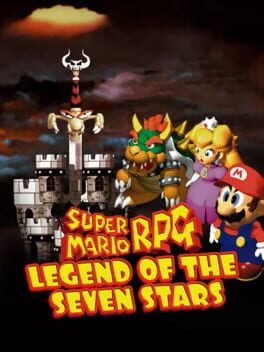
1996 · Square · Action role-playing · Adventure
Super Mario RPG
Nintendo exclusive
A JRPG entry in the Super Mario franchise in which Mario meets many unlikely allies in order to jump and fight his way through the Mushroom Kingdom and collect stars to repair the Star Road, the pathway that grants people's wishes, which was destroyed by Smithy, the otherworldly entity that hijacked Bowser's castle and threw the Kingdom into disarray.
- Released
- 9 March 1996
- Platforms
- Nintendo SwitchSNESSuper NES Classic EditionWiiWii U
- Genres
- Action role-playingAdventureRole-playingTurn-based Japanese role-playing
- Developers
- Square
- Publishers
- Nintendo
- Series
- Mario role-playing games
- Modes
- Single-player
- Perspective
- Bird view / Isometric
- Themes
- ActionFantasyComedyKids
- Country
- Japan
- Age ratings
- CLASS_IND LESRB EPEGI 3CERO A
- Languages
- English, Japanese
- Copies sold
- 2.1 million
- Time to beat
- 10hmain story15hwith extras20hcompletionist
- Directors
- Chihiro Fujioka, Yoshihiko Maekawa
- Composers
- Yoko Shimomura
About
Super Mario RPG: Legend of the Seven Stars is a 1996 role-playing video game developed by Square and published by Nintendo for the Super Nintendo Entertainment System (SNES). It was the final Mario game for the SNES, and was directed by Chihiro Fujioka and Yoshihiko Maekawa, produced by Shigeru Miyamoto, and scored by Yoko Shimomura.
Super Mario RPG's story focuses on Mario and his friends as they seek to defeat the Smithy Gang, who have crashed into their world and scattered the seven star pieces of Star Road. It is the first RPG in the Mario franchise, drawing from major elements of Square's RPG franchises such as Final Fantasy. The main form of fighting enemies is turn-based combat with a party of up to three characters. It is also the first game in the Mario franchise to have gameplay within an isometric 3D environment, allowing for a new variety of the exploration and platforming elements reminiscent of the Super Mario series. The game features many new characters, such as Mallow and Geno.
›Story
Set in the Mushroom Kingdom and featuring its cast of well-known characters, this adventure RPG begins with a familiar scenario: Mario must rescue Princess Toadstool from Bowser. However, a mysterious new enemy named Smithy soon appears, and Mario and Bowser are forced to fight as allies for the first time in their long history. In the quest to defeat their powerful new foe, they’ll journey across a wide variety of locations and tackle a mix of obstacles requiring both expert timing and strategy to overcome. Along the way, they’ll gain experience and grow more powerful, while also meeting new characters whose unique abilities will be needed to take on Smithy and his gang.
Keywords
- dinosaurs
- 3d
- minigames
- 16-bit
- turn-based
- turn-based combat
- boss fight
- battle
- cameo appearance
- temporary invincibility
- villain turned good
- conversation
Media
The articlegameplay, story, development, reception
Gameplay
Super Mario RPG contains token similarities to other Square-developed video games, such as the Final Fantasy series, along with a story and gameplay based on the Super Mario series of platform games. Like most traditional JRPGs, the two main sections of the game are adventuring and turn-based battle sequences. Much of Super Mario RPG's gameplay is outside monster battles and plays like an isometric 3D platformer, in which traditional Mario elements, such as punching floating question blocks from below, are prominent. There are no random encounters, and as such, enemies are visible in the field; a battle ensues only if Mario comes in contact with one. This allows the player to evade unnecessary battles.
The player's party initially begins with only Mario and grows to five characters. Mario and up to two other members participate in battles, who can be swapped in and out while the player explores the overworld. Each of the five characters has a unique set of attacks and techniques. For example, Princess Peach's abilities are primarily healing techniques, whereas Geno and Bowser have offensive attacks that deal high amounts of damage.
Story
The game world is set in a geographically diverse land, which includes mountains, forests, and bodies of water. Each region has distinct characteristics held by its inhabitants; Mushroom Kingdom is inhabited by Toads, Moleville is inhabited by moles, Monstro Town is populated by reformed monsters, Yo'ster Isle is where Yoshi and his eponymous species reside, and Nimbus Land is an area inhabited by cloud people. Bowser's Castle is another prominent location and, during the events of the game, holds the portal to the Smithy Gang's homeworld.
As in most Super Mario games, the main protagonist is Mario, whose initial goal is to rescue Princess Peach from Bowser. Soon after the start of his journey, the Smithy Gang, the main antagonists of the game, invades Mario's world. While attempting to stop the group, Mario is joined by Mallow, a cloud boy who thinks he is a tadpole; Geno, a doll possessed by a celestial spirit from the Star Road; Bowser, whose armies have deserted him out of fear of the Smithy Gang; and Princess Toadstool, who was lost in the turmoil that occurred when the Smithy Gang arrived. The Smithy Gang is led by Smithy, a robotic blacksmith from another world with aspirations of world domination.
Development
According to Yoshio Hongo of Nintendo, Super Mario RPG came out of Mario creator Shigeru Miyamoto's desire to make an RPG using Mario, as well as Square's desire to develop an RPG that could do better outside of Japan than their previous games. Development began in early 1994 after a business meeting between Nintendo and Square. The first phase was spent on deciding a basic system, while the isometric view was chosen to help bring the world to life. The game was originally conceived with weapons in mind, but as meetings with Miyamoto progressed, the development team realized that they did not fit with the Mario franchise, and left them out.
An exception was the hammer, which Miyamoto insisted on keeping. One of the main concerns of the development team was they did not want to make a "normal RPG that simply substituted in Mario characters." To help the game fit with the Mario series, it was made to be more action- and movement-focused compared to Square's other RPGs, using concepts such as jumping and dashing. Development began in earnest during the second quarter of 1995, when the programming, story events, and graphics data were being implemented.
Reception
Super Mario RPG received positive reviews. Though its battle system and characters were criticized by a few critics, it garnered praise for its graphics and for humor in particular. Nintendo Power's review commented that the "excellent" 3D graphics helped the game appeal to a much wider audience than most traditional RPGs. In March 1997, Nintendo Power nominated the game for several awards, including "Best Graphics", in a player's choice contest, though Super Mario 64 won "Best Graphics".
Electronic Gaming Monthly praised the graphics, stating that they are "the best seen on the Super NES". Scary Larry of GamePro gave the game a perfect 5/5 in all four categories (graphics, sound, control, and fun factor), and praised the rendered enemies, cinematics, and spell animations.
Legacy
Super Mario RPG appeared on reader-selected "best game of all time" lists, such as 30th at IGN, and critic-selected "best games of all time" lists, such as 26th in Electronic Gaming Monthly.
Super Mario RPG does not have a direct sequel but it established conventions for its thematic and spiritual successors, the Paper Mario series and Mario & Luigi series. Nintendo announced a game titled Super Mario RPG 2 for 64DD, which was renamed Paper Mario before its release on the Nintendo 64. Themes shared with the original include the use of Flower Points as a shared party resource instead of each character having their own pool of Magic Points, timed action commands during battles, and the collection of seven stars.
Releases by platformdates and regions as published
Title IDsone per regional release, with its latest update
Editions and related releases
- Included in
- Super NES Classic EditionNintendo Classic Mini: Super Famicom
- Derivative works
- Super Mario RPG
- Remade as
- Super Mario RPG
- Built on it
- Super Mario RPG
In the same series

Games like this
 80
Dragon Quest III
1988 · Android, NES +4
Adventure · Role-playing
 Nintendo exclusive69
Fossil Fighters: Frontier
2015 · Nintendo 3DS
Role-playing · Turn-based japanese role-playing
 84
Dragon Quest IV
1990 · Remake · Android, NES +2
Adventure · Role-playing
- Nintendo exclusive84
Dragon Quest IV: Chapters of the Chosen
2007 · Remake · Nintendo DS
Adventure · Role-playing
 90
Deltarune, Chapter 2
2021 · Episode · PlayStation 4, Nintendo Switch 2 +4
Adventure · Role-playing
 85
Octopath Traveler II
2023 · Nintendo Switch, Nintendo Switch 2 +5
Adventure · Role-playing
 59
Steven Universe: Save the Light
2017 · Nintendo Switch, PlayStation 4 +3
Adventure · Role-playing
 PlayStation exclusive92
Fate/Grand Order
2015 · Android, PlayStation VR +1
Adventure · Role-playing
Collections12 collections
Platform libraries
- Virtual Console games for Wii U (Japan)Titles › Super Famicom
- Virtual Console games for Wii U (North America)Super Nintendo Entertainment System
- Virtual Console games for Wii U (PAL region)Titles › Super Nintendo Entertainment System
- Nintendo Switch games (Q–Z)List
Years
- Games released in 2023List › October–December
Series and characters
- Mario role-playing gamesStandalone games
- Mario role-playing gamesStandalone games
- Mario role-playing gamesRemakes
- Mario role-playing gamesRemakes
- Games featuring MarioList
- Games featuring MarioList
Publishers
- Virtual Console games for WiiTitles › Super Nintendo Entertainment System / Super Famicom
- Best-selling Nintendo Switch gamesList
- Best-selling Super Nintendo Entertainment System gamesList
- Nintendo home gamesSuper NES/Super Famicom
- Nintendo hybrid console gamesNintendo Switch
Description adapted from its source, CC BY-SA 4.0.