The articlegameplay, story, development, reception
Gameplay
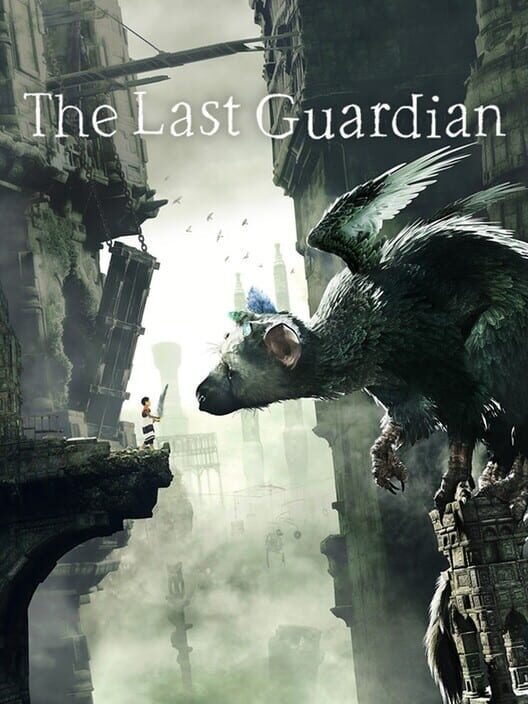
Like its predecessors Ico (2001) and Shadow of the Colossus (2005), The Last Guardian is a third-person game that combines action-adventure and puzzle elements. The player controls an unnamed boy who must cooperate with a half-bird-half-mammal creature to solve puzzles and explore areas. The name of the creature, Trico (トリコ, Toriko), can be taken to mean "prisoner" (虜, toriko), "baby bird" (鳥の子, tori no ko), or a portmanteau of "bird" (鳥, tori) and "cat" (猫, neko).
The boy can climb on structures, carry objects such as barrels, and operate mechanisms such as levers. Trico's size and agility allow it to reach areas that the boy cannot reach alone, and fight off guards who attempt to capture the boy. Conversely, certain obstacles, such as gates, or glass eyes that frighten Trico, prevent Trico from progressing, and must be removed by the boy. The boy must locate barrels to feed Trico when it is hungry, pet Trico to calm it after a battle, and remove spears thrown at Trico by enemies.
Though the player initially has little command over Trico, the boy learns to command Trico to leap onto ledges or head in a certain direction, among other actions. Although players are encouraged to train Trico to move in the right direction, new areas can be discovered by letting Trico wander independently. At various points, the boy wields a reflective mirror that summons lightning from Trico's tail, which can be used to break certain objects.
The player is returned to the last checkpoint if the boy is captured by guards, or if he falls from too great a height. Multiple playthroughs unlock additional costumes based on previous Ueda games.
Story
The Last Guardian's story is framed as a flashback told by an older man (voiced by Hiroshi Shirokuma) recounting his experience as a boy.
The boy (voiced by Tatsuki Ishikawa) awakens in a ruined castle in a deep valley known as the Nest. He discovers an enormous creature called a Trico, chained and wounded. Though Trico is hostile, after the boy removes the spears from its body and feeds it, it begins to accept him. The boy unchains Trico and they explore the area, discovering a mirror-like shield that summons lightning-like energy from Trico's tail. The pair make their way through the castle ruins, evading the ghostly soldiers, and Trico's broken horns and wings slowly regrow.
In a flashback, Trico flies to the boy's village and steals him from his dormitory. It flies back to the Nest, but is struck by lightning and chained up by the soldiers. In the present, Trico resuscitates the boy after a cave collapse. After fending off an attack from a second, armored creature, Trico and the boy enter a mysterious tower and discover a malevolent force, the "master of the valley", which manipulates creatures and soldiers.
It summons several creatures of the same kind as Trico, which regurgitate stolen children into the tower and savage Trico, tearing off the end of its tail. The boy uses the mirror to summon energy from the severed tail segment and destroy the master of the valley, causing the creatures to plummet from the sky.
Wounded, Trico takes the boy, near-death, and flies to his village. When the terrified villagers attack him the boy instructs Trico to leave. Years later, the boy, now grown, discovers the shield and raises it to the sky, sending a beam of light to the Nest, where Trico resides and appears to have had a child since.
Development
In his previous game, Shadow of the Colossus, director Fumito Ueda had intended to create an emotional interaction between Mono, the character that Wander wants to save, and the colossi that Wander must fight to save her. He was surprised and inspired to find players felt a stronger connection between Wander and his horse Agro. Ueda wanted to make the relationship between a human and a beast the central concept for his next game.
Ueda found that people were drawn to games with lifelike creatures, and felt The Last Guardian needed something similar to attract a broad audience. He wanted to create a virtual creature that behaved as realistically as possible, avoiding the unnatural behavior of other virtual animals. He based much of Trico's behavior on his childhood experiences growing up in a home full of animals. The final version of Trico is an amalgam of several creatures; the design was "deliberately unbalanced because looking strange was important", according to Ueda.
The team wanted to avoid making the animal cute, and instead focused on realistic-looking behavior with "animal-like expressions". Trico's ears react with a cat-like "twitch" if they touch ceilings or other tall features, using mesh-based collision detection. The team added the ability to summon lightning from Trico's tail to have players understand Trico's "force and ferocity". Ueda described Trico as "adolescent", allowing the developers to add humor through its actions.
The team used programmed key frame animations instead of more common motion capture techniques, allowing them to capture subtleties that would be difficult using live animal subjects.
As Trico functions similarly to the colossi the player climbs in Shadow of the Colossus, journalists have described The Last Guardian as a combination of Ico and Shadow of the Colossus; Ueda stated there was "a bit of each of those [games] in there". He described the relationship between the boy, Trico, and the guards as a game of rock-paper-scissors that changes throughout the game; at times, the boy needs Trico to protect him, while at others the situation is reversed. Though Ico and Shadow of the Colossus have a similar changing connection between pairs of characters, Ueda said there was more "dynamic range" in The Last Guardian.
The Last Guardian is the first Team Ico game to use voice-over narration. As much of the game relies on non-verbal communication between the boy and Trico, Ueda felt the voice-over helped immerse the player in the mindset of the boy. It also provided a way to provide gameplay hints and other context to the player.
Whereas the team had designed the areas of previous games for the characters they had designed in advance, for The Last Guardian they made Trico as flexible as possible, allowing them to create levels and have Trico adapt to them. The size difference and interactions between the boy and Trico were informed by the limitations of the PlayStation; if the characters were of the same size, the team would have needed to determine the animation interactions for both, whereas Trico's size meant the boy's animations would not need to affect him much.
Although the boy is less detailed than Trico, he was animated via key frame animation. He places hands on nearby walls, and reaches to pet Trico without player interaction. Ueda felt these animations were necessary to help convince the player of the game world. The animation system uses layers of animation that mimic real-life physics, taking advantage of the greater processing power of the PlayStation 4. The team considered making the player character a girl, but felt it would not be realistic that a female character would have enough stamina to climb Trico.
To create the art and architecture, the team used the same "design through subtraction" method they had used to develop Ico and Shadow of the Colossus, removing elements they felt distracted from the core experience. Music is used sparingly to highlight key emotional moments, such as when Trico uses his tail to catch the boy as he falls from a collapsing platform. The game uses vertical space to emphasize the boy's small size.
The Last Guardian game engine builds on the team's previous development of A.I. processing from Ico and transformative collisions from Shadow of the Colossus. It is the first Team Ico game to use a full physics engine, Havok. According to Ueda, the effect of wind was modeled separately for each of Trico's feathers. Yasuhide Kobayashi, vice president of Japan Studio, stated that the title The Last Guardian was chosen to appeal to the larger demographic markets in the United States and Europe for the PlayStation 3, hoping to avoid the cultural problems in title and artwork blamed for Ico's low sales in western countries.
In August 2019 interview Fumito Ueda mentioned that Trico they were creating on PlayStation 3 actually had more motion patterns than the PlayStation 4 version did, as they were unable to transfer everything due to transition time issues.
Ueda had ideas for The Last Guardian around 2005 after completing Shadow of the Colossus. it entered active development in 2007, a year after the release of the PlayStation 3. The working title was Project Trico, revealed to the public due to a leaked video posted at PlayStation Lifestyle in 2008 that showed the current "Target Render" of the game at that time. Ueda had long considered the development time for Ico and Shadow of the Colossus, and had anticipated being able "to create something good in a short period of time" with The Last Guardian at the onset.
By 2009, the development team had completed enough of the game for it to be showcased during the E3 2009, using an improved render of the same set pieces previously seen in the Target Render and later provided a short vertical slice of the game to the press for the Game Developers Conference in early March 2011. Ueda had considered including this demo on the then-upcoming remastered The Ico & Shadow of the Colossu
Reception
The Last Guardian received "generally favorable" reviews, according to the video game review aggregator website Metacritic. Most reviewers praised the environment and story as some of its strongest elements, while the realism of the animal behavior that Trico exhibits was praised by some critics, yet others felt that the realism also hampered the gameplay causing impatience and frustration due to lack of immediate action by Trico when giving commands.
GameSpot's Pete Brown praised the characters, their relationship and the story as important aspects, noting interactions with Trico and acting very independently at times by not knowing "if it's a concerted effort to test your patience for a lovable-yet-stubborn creature". However Brown felt that it added personality to Trico and "sympathy for both characters" in addition to their development within the story and for the player, "culminating in an enrapturing series of revelations that cements your attachment to their personalities". Tom Senior of GamesRadar called Trico "the greatest AI companion in games", in addition to the subtle use of visual and audio cues to add more character and its effect on the gameplay itself.
Reviewing for The Guardian, Simon Parkin praised the design of Trico and its interactions with the world and puzzles, adding further emotional investment. He likened Trico to an "abuse survivor" due to being scared and imprisoned at the start of the game and the thoughtfulness and relationship development of its characters making it "a game, as much as anything, about rehabilitation through kindness and companionship". Chris Carter of Destructoid felt that the detail and realistic behavior of Trico and the boy were "emotive in a way that most developers wouldn't even attempt", potentially being the reason behind the long development, praising the effort put in by Fumito Ueda and the developers nonetheless. US Gamer's Jermey Parish believed that Trico as an in-game character with its own apparent volition was revolutionary in character design, and that the emotional relationship between Trico and the boy was something that could only be effectively done with the interactivity of a video game.
In contrast, Marty Sliva of IGN was critical of Trico's behavior during puzzles combined with camera controls making sections more frustrating, particularly during interiors due to the cramped nature of certain levels and the size of Trico detracting from the experience, calling it "rare to even have to think about the camera in a third-person game in 2016, but I found myself constantly being pulled out of the experience trying to wrestle with my point of view". Sliva however still felt that the game succeeded in the attachment with its characters and delivered memorable moments despite its issues. Game Revolution's James Kozanitis found that there were moments that Trico would continue with traversing the environment and performing tasks even without player input, making the act of controlling Trico at times "ineffective and unnecessary".
Reviewers also noted performance problems on default PlayStation 4 hardware. Eurogamer's Digital Foundry determined that the game ran into rendering issues and framerate drops on the PlayStation 4, while running at 1080p on the newer PlayStation 4 Pro provided a stable framerate. Philip Kollar of Polygon compared technical aspects to its predecessors release on the PlayStation 2 due to the long development across multiple generations of Sony consoles, stating that the game at times did take advantage of the PlayStation 4 hardware while in others, such as framerate and control issues made its age more noticeable. Sam Byford of The Verge commented that while framerate drops were common in Shadow of the Colossus, they were more acceptable based on the PlayStation 2 hardware of the time and the extent the game maximized out the console's hardware, while such issues on PlayStation 4 for The Last Guardian were less forgivable, making it feel like "a PS3 game that never really came together until the brute force of new hardware allowed the team to ship"; he contrasted this to Final Fantasy XV which had the game's engine rebuilt after its target platform was switched to eighth-generation consoles.
The game was named on several year-end Game of the Year lists, including The New Yorker, Engadget, GameSpot, VG247, and Polygon. A 2023 poll conducted by GQ which surveyed video game journalists across the industry listed the title as the 88th best video game of all time.
Because of the development delays in The Last Guardian and lack of updates from Sony, The Last Guardian was considered to have been in development hell over its eight-year development period. Ueda and Yoshida would regularly report progress, but the title was notably absent from major video game conventions, including E3 and the Tokyo Game Show.
Journalists also expressed concern about the potential release when The Last Guardian trademark had hit some critical milestones. In August 2012, about three years after the trademark had been filed in the United States, Sony had yet to produce a viable product under trademark law, and in February 2015, Sony failed to renew the North American trademark for The Last Guardian. Sony re-registered the trademark, noting that lack of a renewal was an administrative oversight, and the game was still in development.
Prior to the reintroduction in 2015, some journalists expressed concern if The Last Guardian would be as much a landmark game as initially seen. Evan Narcisse for the website Kotaku opined that the lengthy delay of The Last Guardian's release since the 2009 reveal may have been harming the game's relevance on the contemporary market. Narcisse considered that the landscape of games had vastly changed since 2009, during which "by-the-numbers racers, shooters and action-adventure games dominated" the market and the expected emotional impact of The Last Guardian would have made it a stand-out game. Since