
The articlegameplay, story, development, reception
Gameplay
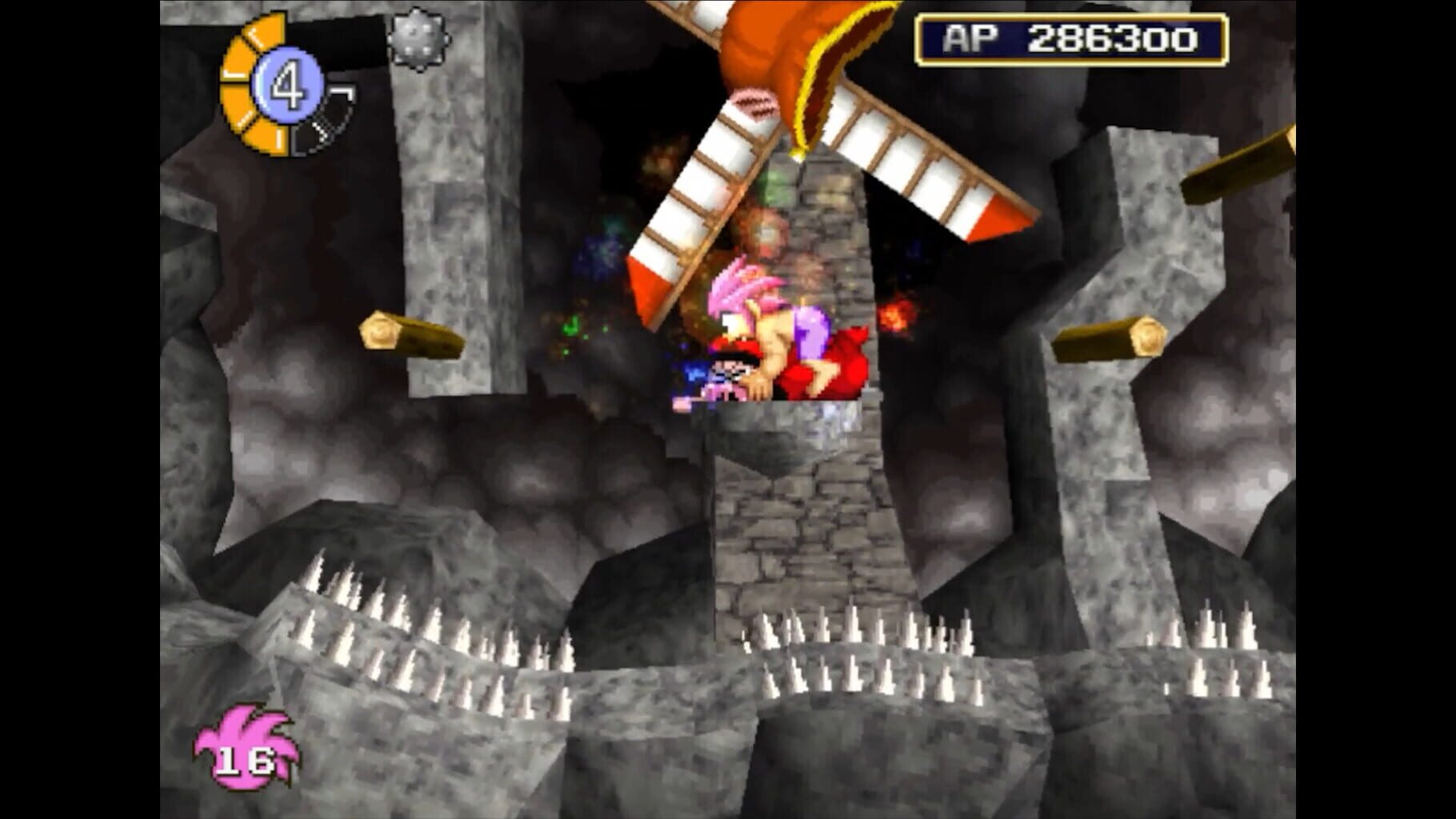
Tomba! is an open world Metroidvania game with RPG elements. The player controls the titular character Tomba, who must explore his home island, defeat the evil Koma Pigs and recover his grandfather's golden bracelet. Most of the game takes place in a side-scrolling perspective.
However, Tomba can occasionally climb over walls to move between the foreground and background as separate areas. Some areas allow the player to explore them in an isometric view. Along with the ability to jump, Tomba can attack enemy characters by leaping onto and biting into their back before tossing them in a straightforward trajectory. Tomba can also attack enemies by obtaining various weapons, such as flails and boomerangs.
Signposts scattered throughout the environment state how to use the game's controls and abilities, while a select few can be used to save the player's progress.
When Tomba interacts with a certain character or environmental element, an "event" may be initiated, in which Tomba is given a task to accomplish or an obstacle to overcome. Such events may consist of finding a lost item, rescuing a stranded character or clearing a blockade in the imminent path. Upon completing an event, the player is rewarded with "Adventure Points", which can be used to access additional events and unlock specifically marked chests. Multiple events can be undertaken at once and often do not require being cleared in any specific order.
The game features an inventory system that displays the player's current collection of items and events. The game includes a total of 130 events.
The player begins the game with a maximum of four "vitality points" that are represented as a series of yellow bars on the upper-left corner of the screen. Tomba loses a vitality point if he is hit by an enemy, touches a sharp object, or falls into deep water. Vitality points can be restored by eating fruit. When all vitality points are depleted or if Tomba falls down a bottomless chasm, the player loses a life. If all lives are lost, the game is over.
Story
Years ago on an uncharted archipelago, a group known as the Seven Evil Pigs appeared and used their magical powers to tarnish the land. Their underlings, the Koma Pigs, began terrorizing the populace with their mischievous pranks. Years later, a curious and energetic boy named Tomba diligently protects his grandfather's grave and wears a gold bracelet as an heirloom. One day, Tomba's bracelet is stolen following a confrontation with a group of Koma Pigs.
He pursues them to a nearby village, where he is directed to the 100-Year-Old Wise Man. The Wise Man tells the story of the Seven Evil Pigs' rise to power, and reveals that the Koma Pigs are stockpiling gold. He advises Tomba to find his bracelet by hunting the seven Evil Pigs hiding throughout the land. He also describes the Evil Pig Bags that could reveal the Pigs' hiding places, and suggests learning more from the Dwarf Elder in the next village.
The Dwarf Elder gives Tomba a blue Pig Bag and tells him that the Bags can reveal the entrance to an Evil Pig's hideout if Tomba approaches it. However, he warns that the individual Evil Pigs do not hide in the same area where they have cast their spell. Tomba explores the continent and gathers the rest of the Pig Bags. In the midst of his travels, an older Wise Man informs Tomba that the gold being hoarded by the Seven Evil Pigs is the source of their power.
After Tomba captures the Seven Evil Pigs and lifts their spells over the land, an eighth Evil Pig Bag manifests within his possession and reveals the lair of the Evil Pigs' creator and leader, the Real Evil Pig. After defeating the Real Evil Pig in his trove of gold, Tomba recovers his bracelet and leaves it resting upon his grandfather's grave.
Development
Tomba! was created by Tokuro Fujiwara, who left Capcom in December 1995 after 13 years as an employee. Fujiwara's motivation stemmed from a desire to create new and original games, which he felt he was unable to do within Capcom. Upon exhausting his accumulated vacation days, Fujiwara resigned immediately following the release of Resident Evil. Fujiwara soon established the independent development studio Whoopee Camp, and became the director, producer and lead designer of the studio's debut game Tomba!.
Fujiwara chose to make a side-scrolling game as he believed this fundamental experience would excite players in a straightforward way. To distinguish Tomba! from other action games, Fujiwara designed a non-linear event system, as well as Tomba's gradual growth in abilities and resources. Tomba!'s score was composed by Fujiwara's longtime Capcom collaborator Harumi Fujita, who eagerly approached Fujiwara for a position upon learning of Whoopee Camp's establishment. The game's Japanese version features the song "Paradise" by Tokyo Channel Q as its opening theme, and "Que Serã Serã" by Fumitaka Fuchigami as the ending theme.
Reception
Tomba! received favorable reviews according to the review aggregation website GameRankings. In Japan, Famitsu gave it a score of 31 out of 40.
The events were praised for their variety, quantity, and non-linearity. Mark Cooke of GameRevolution noted that Tomba! was the first platform game to grant such freedom, following attempts by RPGs like The Elder Scrolls II: Daggerfall. S.
PlayStation Magazine warned that the overlapping events may easily result in players getting sidetracked. The side-scrolling segments were considered reminiscent of platform games from earlier generations, particularly Fujiwara's past titles Ghosts 'n Goblins and Ghouls 'n Ghosts. Cooke, however, felt that the lack of innovation made the gameplay "a little too tired". Several reviewers praised the responsiveness of the controls.
Rybicki cited the high amount of load times as a negative point, and John Broady of GameSpot criticized the limited save system as a "chore", suggesting that a system which saves the game after each event would have been more logical.
The game's visuals were lauded for their bright and colorful presentation, smooth character animation, and combination of 2D character sprites and 3D polygonal environments. Crispin Boyer of Electronic Gaming Monthly compared the game's visuals to Klonoa: Door to Phantomile, particularly in the "almost perfect marriage" of its disparate graphical elements. Cooke described the hand-drawn cutscenes as endearing and humorous, and regarded the introduction to be the game's best feature. All four reviewers for Electronic Gaming Monthly appreciated the eccentric and lightly humorous tone, as did Rybicki, who found the game refreshing after a glut of post-apocalyptic three-dimensional third-person shooters at E3 1998.
Erik Engström of Hardcore Gaming 101 saw influences by various anime from the late 1970s and early 1980s; he compared the game's rural and fantastical setting and occasional scatological references to Akira Toriyama's Dr. Slump, and compared the Koma Pigs to the Yatterman character Odate Buta.
Reactions to the audio were more mixed. Some were impressed by the soundtrack and considered it catchy, with Cooke declaring that the game "may set a new high water mark for platformers." Others were more apathetic, with Bro Buzz of GamePro finding the sound effects "minimal to an extreme" and claiming that the music was "limited to one catchy but repetitive, goofy tune".


