The articlegameplay, story, development, reception
Gameplay
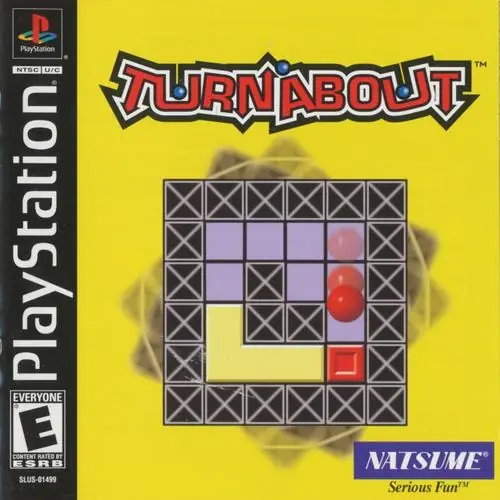
Turnabout is a puzzle game. Each round consists of one or more stationary and non-stationary objects enclosed within a bordered stage. Gameplay involves rotating the stage 90 degrees either clockwise or counterclockwise, causing all the unfixed objects to fall downward due to gravity. The goal is to rotate the stage in order to remove certain elements.
These include colored balls, which are dynamic, and colored blocks, which are stationary. When a ball collides with another ball or block of the same color, they both disappear. This repeats until the player makes all colored pieces disappear or cannot make a move, requiring the level to be restarted. There is no time limit.
Development
Turnabout was developed for the PlayStation by Artdink. It was directed, programmed, and designed by Shinichi Senoo, who devised a number of its stages as well. He had previous credits on PlayStation such as PaRappa the Rapper, Um Jammer Lammy, Robot × Robot, and Segare Ijiri. Senoo would go on to be the main creator and project lead on the puzzle game Kowloon City.
Artdink self-published Turnabout in Japan on April 6, 2000. An overseas localization was handled by Natsume Inc. in North America on March 31, 2003, and distributed by Zoo Digital Publishing in Europe late that same year. In Japan, the game was re-released for download via the PlayStation Network first on the PlayStation Portable on December 21, 2006, and then on the PlayStation 3 on May 31, 2007.
Reception
Upon release in Japan, a panel of four reviewers from Famitsu gave Turnabout a cumulative score of 23 out of 40, while the magazine's PlayStation-centric spin-off publication, Famitsu PS, scored it slightly lower at 21 out of 40. Dengeki PlayStation gave the game an overall rating of 85 out of 100. Press coverage of Turnabout was seemingly more limited in other regions. S.
PlayStation Magazine, who noted its addictive gameplay and challenge. He thought highly of its Edit Mode and soundtrack, proclaiming the latter as "sometimes jazzy, sometimes trancey" and that it "never gets too repetitive or intrusive." He felt that the game, being a budget title, lacked certain appealing features like a two-player mode and variety in its stage graphics.