
The articlegameplay, story, development, reception
Gameplay
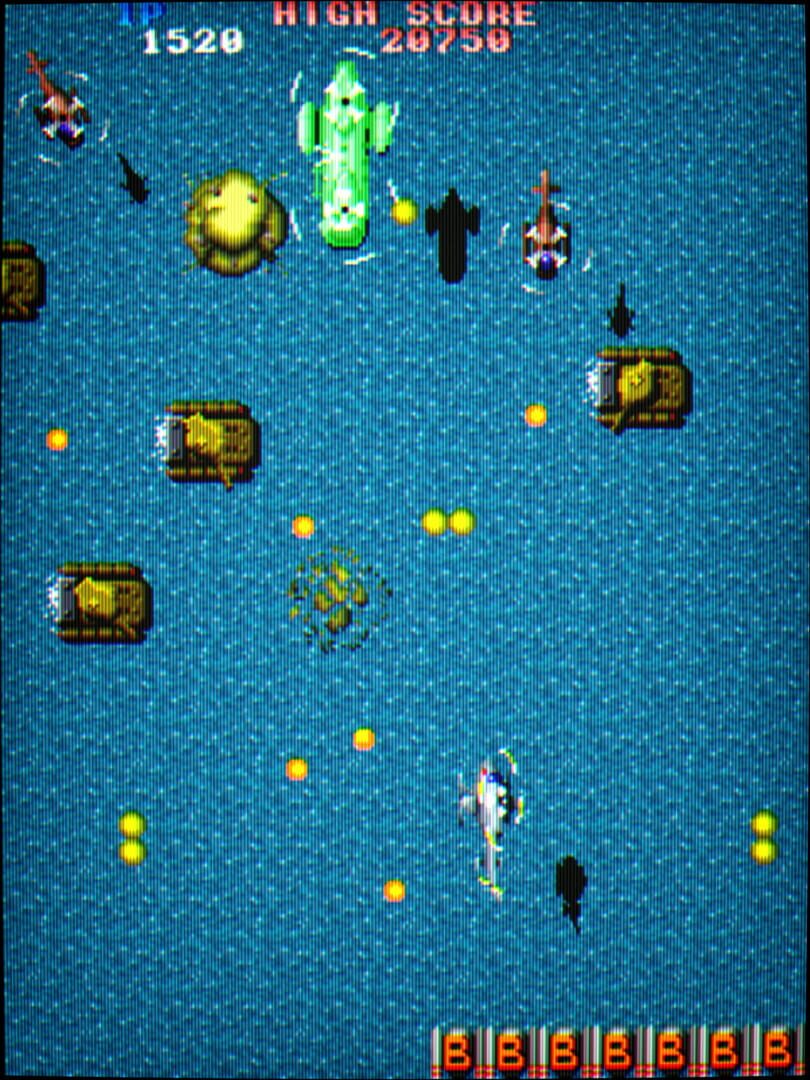
Twin Cobra is a military-themed vertically scrolling shoot 'em up game, in which players take control of the titular attack helicopter through ten increasingly difficult levels, each with a boss at the end that must be fought before progressing any further, in order to defeat an assortment of military enemy forces like tanks, battleships, and artillery as the main objective. The title initially appears to be very standard, as players control their craft over a constantly scrolling background and the scenery never stops moving until a helipad is reached. Players have only two weapons at their disposal: the standard shot that travels a max distance of the screen's height and three bombs.
The bombs are powerful weapons capable of obliterating any enemy caught within its blast radius and collecting "B" icons adds an extra bomb stock. A new gameplay addition compared to its predecessor are power-up items that appear via enemy carriers; There are four types of weapons in the game that can be switched between after destroying incoming carriers by picking up color-changing icons ranging from red, blue, green and yellow, while "S" icons increases the helicopter's firepower. Other items scattered throughout the levels such as 1-ups and star-shaped gold medals, which grants a 3000-point bonus by collecting them, can also be picked up along the way. Players are given two lives initially and bonus lives are awarded at certain point thresholds and every point threshold thereafter.
Development
Twin Cobra's creation process and history was recounted through various Japanese publications by composers Masahiro Yuge and Tatsuya Uemura, both of which collaborated with the soundtrack using guitar and marked the second time Toaplan made use of FM synthesis. Yuge stated that the basic structure for the game was already decided during development of Slap Fight by pursuing the excitement of shooting and dodging, settling on the bomb and shot system, claiming that firing a bomb relieved stress from players, as they wanted to make a game that was fun by looking at and get passionate about it. Yuge also claimed that the word "Kyūkyoku" for its Japanese title derived from a translation of Going for the One, the eight studio album by English progressive rock band Yes, as it was not a popular word at the time and although the Japanese title was initially rejected by then-president of Toaplan, he was determined to implement it. The concept of using a bomb came up during development of Tiger-Heli, where the team questioned how to make a shoot 'em up game more engaging for players but it was never intended for defensive purposes according to them, as the mechanic was instead implemented to provide an aggressive feeling against enemies on difficult situations, however enemies were made tougher to keep gameplay balance.
Twin Cobra was also, alongside Slap Fight, one of the earliest projects Toaplan made use of game design documents, with both Uemura and Yuge stating that ideas by the team were first written in text using A4 paper before reading it during meetings. Several features were integrated into the project by diverse factors such as items swirling around the screen, which was inspired by a donburi bowl, while the slow speed of the helicopter was due to make the title akin to puzzle games and require a level of strategy. Yuge stated that cooperative gameplay was originally not developed but were requested in doing so after completing the single-player version due to simultaneous two-player titles being "a big trend" in overseas regions and being conscious of the American market, as the game had a realistic war setting. Around five members collaborated with the project on a six-month development period including Uemura and Yuge acting as programmers, as well as three designers.
Reception
According to Masahiro Yuge and Tatsuya Uemura, Twin Cobra proved to be a popular hit for Toaplan, though Flying Shark was "the biggest" hit for them. In Japan, Game Machine listed it on their 1 January 1988 issue as being the fourth most-successful table arcade unit of the month, outperforming titles such as Thundercade and Rainbow Islands: The Story of Bubble Bobble 2. It went on to become Japan's highest-grossing arcade conversion kit of 1988.
Computer and Video Games reviewer Clare Edgeley gave an overall positive outlook to the arcade original.
Legacy
A sequel, Twin Cobra II, was originally under development by Toaplan but the studio closed down in 1994 until Taito allowed Toaplan offshoot Takumi Corporation to finish work on the project as their first release in 1995, before being ported to Sega Saturn in 1997 under the name Kyukyoku Tiger II Plus. Former Seibu Kaihatsu artist Toshinobu Komazawa claimed that Seibu borrowed ideas from Twin Cobra when developing Raiden. Artist Perry "Gryzor/Rozyrg" Sessions cited Twin Cobra as one of the main influences for Super XYX. The rights to Twin Cobra and many other IPs from Toaplan are now owned by Tatsujin, a company named after Truxton's Japanese title that was founded in 2017 by former Toaplan employee Masahiro Yuge, and is part of Embracer Group since 2022.


