The articlegameplay, story, development, reception
Gameplay
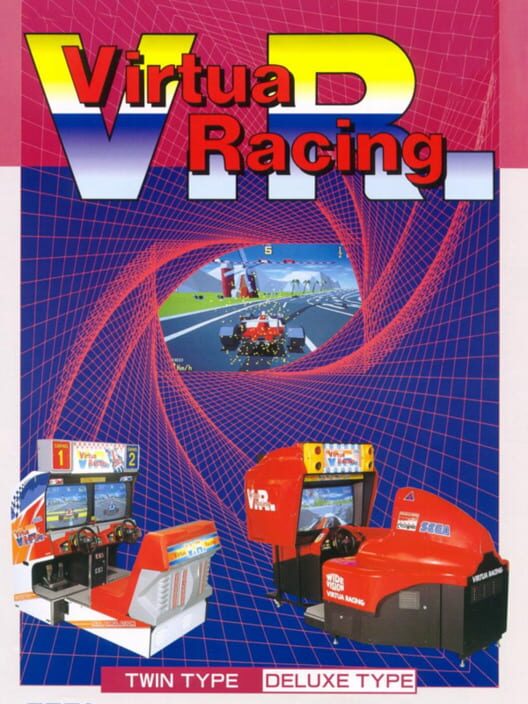
The original arcade game has three circuits, designated into difficulties. Beginner is Big Forest, intermediate is Bay Bridge and expert is Acropolis. Each level has its own special feature, for example the amusement park in "Big Forest", or the "Bay Bridge" itself, or the tight hairpin of "Acropolis". When selecting a car, the player can choose different transmission types.
R. View System" by allowing the player to choose one of four views to play the game. This feature was then used in most other Sega arcade racing games (and is mentioned as a feature in the attract mode of games such as Daytona USA).
Development
Virtua Racing was developed alongside the Sega Model 1 arcade system, originally called the "CG Board" system prior to completion. The game was directed by Yu Suzuki and designed by Toshihiro Nagoshi.
The origins of Virtua Racing, along with the Model 1, date back to the development of the Mega Drive/Genesis console prior to its launch in 1988. The console was a major leap forward for home video game systems, allowing them to come closer to arcade quality. For Sega's arcade games to remain profitable, they needed to maintain a wide gap between arcade and home video games. At a meeting held during the console's development, Sega decided to begin development on an arcade system capable of producing 3D polygon graphics.
This led to the development of the Sega Model 1, along with Virtua Racing, by the early 1990s. They had arcade competitors (Namco and Atari Games) who predated Sega in the use of 3D polygon graphics, displaying up to 2,000 polygons per frame, so Sega increased their Model 1 system's capabilities significantly beyond that to 6,500 polygons per frame.
In 1989, Sega of America's Tom Petit mentioned that Sega was "hiring 400 new engineers to research and develop new technology" and that they "have innovative, revolutionary graphics display systems to come" which would make even Super Monaco GP (their latest arcade racer at the time) "seem like the yesterday of technology." The Sega Model 1 system was developed internally at Sega between 1990 and 1991. In 1991, Petit stated that, "next year, you will see a new trend of technology that will be instrumental in providing new vitality for our industry" and that it could "have as much impact on the business as" Hang-On "did to influence our last growth market" back in 1985.
Reception
The arcade game was a major worldwide commercial success upon release, surpassing Sega's expectations and with high demand exceeding production output. The Deluxe and Twin cabinets were both selling very well, with the expensive Deluxe version selling about a fifth as many units as the less expensive Twin version during 1992. In Japan, Game Machine listed it as the most successful upright/cockpit arcade cabinet of October 1992. In the United States, it debuted at the top of the RePlay arcade earnings chart for deluxe cabinets in October 1992.
It remained at the top for the rest of the year and much of the following year, from February 1993 to July 1993, until it was dethroned by Sega AM1's Stadium Cross (with Virtua Racing at number two) in August 1993. Virtua Racing remained at number two in October 1993, below Suzuka 8 Hours. Virtua Racing was America's third top-grossing arcade game during Summer 1993, with weekly earnings averaging 1,500 tokens per unit. The game was also a major commercial success in Europe.
Virtua Racing was one of the top ten highest-grossing arcade games of 1992 in Japan and the United States. The following year, it was the highest-grossing dedicated arcade game of 1993 in Japan, and one of America's top five highest-grossing arcade games of 1993.
The arcade game was well received by critics upon release. Electronic Gaming Monthly called it a "racing masterpiece" and said its "lifelike racing sensations are extremely impressive and exciting". They called it "one of the most realistic racing games ever" and concluded that it leaves "all other racing games eating its technological dust". Computer and Video Games reviewed Virtua Formula in early 1994, stating that it is "one of the most exciting" arcade driving games and praising the "hydraulic control" of the cabinet.
They concluded that, while its graphics are not as "drop-dead stunning" as the more recent Ridge Racer, Virtua Racing still has a greater "heart-pumping sense of speed". Brazilian magazine Ação Games gave the game 4/4 on all four categories, and called it the most complex racing game on Earth.
At Japan's 1992 Gamest Awards, it was nominated for Best Action, Best Direction, and Best Graphics, but lost to Street Fighter II′: Champion Edition, Art of Fighting, and Xexex, respectively. At North America's 1993 AMOA Awards, held by the Amusement & Music Operators Association (AMOA), Virtua Racing won the award for Most Innovative New Technology.
GamePro named the Genesis/Mega Drive version the best Genesis game shown at the 1994 Consumer Electronics Show, commenting: "While obviously a great deal of graphic clarity, detail, and color was lost, the game play is stunningly faithful to the coin-op. ... this is the best version [of Virtua Racing] you'll see until Sega's mystery 32-bit home system leaves orbit". In their later review, they complimented the game on its inclusion of all the elements of the arcade version aside from the support for up to eight players, and remarked that though the graphics are not as good as the arcade version, they feature faster-moving polygons than any other cartridge game.
They criticized the audio and low longevity but nonetheless concluded "VR is the best 16-bit racer yet". The four reviewers in Electronic Gaming Monthly criticized the audio but held that the game, though not as good as the arcade version, was the best racer yet seen on cartridge-based systems. Famitsu magazine scored the Mega Drive version of the game 33 out of 40, calling it a "groundbreaking" port; Diehard GameFan stated that "the speed, graphic intensity and addictive gameplay that made the arcade game a major hit are all included in this awe inspiring release". Mega placed the game at number 4 in their Top Mega Drive Games of All Time.
GamePro gave the 32X version a highly positive review, stating that it successfully addressed the Genesis version's longevity problem with its new cars and new tracks. They also praised the improved graphics, details, and controls, and the retention of on-the-fly view switching even in two-player split-screen mode. Next Generation reviewed the 32X version of the game, Virtua Racing Deluxe, and stated that "VR Deluxe is a near-perfect conversion of a game that's still fun to play".
The two sports reviewers of Electronic Gaming Monthly gave the Saturn version scores of 8 and 7 out of 10, with the first reviewer praising the added content and overall improvement over the previous home ports, and the second reviewer saying that the game is enjoyable but doesn't fully use the graphical capabilities of the Saturn. GamePro similarly remarked: "This version not only looks better than both the Genesis and 32X versions, it also has a ton more options". They remarked that the graphics are not as good as Daytona USA, but that the game has better music and is more fun to play. A reviewer for Next Generation felt that Virtua Racing was antiquated by this time, particularly with the imminent release of Sega Rally Championship on the Saturn.
However, he acknowledged that the game had enough historical impact to draw its share of loyalists, and said the Saturn version "is not only arcade-perfect, it also contains crucial features not present in the original". Rich Leadbetter of Sega Saturn Magazine praised the additional tracks and cars as giving the game more depth than an arcade racer, but countered that what most gamers wanted was a straight conversion of the coin-op Virtua Racing, not a home-oriented remake. He concluded that the Saturn version is good on its own terms, but completely overshadowed by the Saturn conversion of Sega Rally Championship, which was to be released just a few weeks after. Maximum made the same comments but were more vehement in their criticism of the fact that the Saturn version is not a straight conversion of the arcade game.
Legacy
In 1994, it appeared at 4th place on Mega's list of Top Mega Drive Games of All Time. In 1995, Flux magazine rated the arcade version 36th in its "Top 100 Video Games." In 1996, the arcade, 32X, and Saturn versions (but not the Genesis version) appeared at 11th place on Next Generation's list of Top 100 Games of All Time. They noted that their ranking it higher than any other racing game on the list (including Sega Rally Championship and Daytona USA) was deliberate, since Virtua Racing "drives better".
In 1996, GamesMaster ranked the arcade version 32nd on their "Top 100 Games of All Time." In 1998, Saturn Power listed the game 92nd in its Top 100 Sega Saturn Games. they felt that Virtua Racing is "not as arcade perfect as it should’ve been."
In France, Virtua Racing was featured on the television programme Télévisator 2, broadcast on France 2 from 1993 to 1994. Presenter Cyril Drevet used an arcade cabinet to compete against young members of the studio audience. Drevet later recalled that he personally selected Virtua Racing for the feature because of his familiarity with the game, after which the programme obtained a cabinet from an arcade distributor.
Virtua Racing was credited with having an impact on both the arcade industry and the subsequent development of three-dimensional video games. In January 1993, RePlay reported that Sega credited the game with having a major effect on the coin-operated amusement market and with helping turn the driving simulator category into a growth sector. Sega of America executives Tom Petit and Ken Anderson stated that the game's technology and word-of-mouth appeal were attracting customers who did not ordinarily visit arcades, including players outside the traditional young male audience.
Although polygonal racing games such as Namco's Winning Run (1988) and Atari Games' Hard Drivin' (1989) preceded it, Virtua Racing was subsequently credited with helping popularize real-time polygonal graphics with a wider audience. In 2001, GameSpot included it among its 15 most influential video games, citing its contribution to the development of subsequent 3D racing games. Next Generation similarly wrote in 1995 that the game's release helped make polygonal graphics a major focus of the video game industry.
The game's selectable camera system was also influential on subsequent racing games. In 2015, IGN ranked Virtua Racing third on its list of the ten most influential racing games, behind Pole Position and Gran Turismo. Luke Reilly highlighted its detailed 3D models, complex environments and frame rate, as well as the ability to switch between four viewpoints, describing selectable chase and first-person cameras as a feature that became difficult to imagine modern racing games without. In 2019, Ken Horowitz of Nintendo Life described Virtua Racing as one of the most influential arcade games of all time.
Technology and techniques developed for Virtua Racing also contributed directly to the creation of Virtua Fighter. Yu Suzuki later explained that after successfully representing the movement of cars in three dimensions, he wanted his next project to focus on human movement. The polygonal pit crew in Virtua Racing was used to experiment with animating human figures in 3D. Suzuki initially considered developing a football or rugby game, but contemporary hardware could not efficiently animate the number of characters required for a team sport. He therefore focused on a concept involving only two human characters, leading to the development of a fighting game.
In 1992, Sega applied for a Japanese patent involving an innovative feature they developed for Virtua Racing: changing the 3D camera viewpoint with the press of a button. Sega also used the feature in later games such as Daytona USA. It took five years for the patent to process before the patent was successfully granted to Sega in 1997. By that time, camera change buttons had become a common feature in 3D video games. This would mean Sega could earn royalties from 3D video games that used a camera change button feature.
Due to being a common feature used in many 3D video games, Sega received royalties from other companies using the feature in their games, both in Japan and internationally. Atari, for example, paid Sega royalties for using the feature in Atari Jaguar games. Sega also successfully took legal action against Nintendo, among other companies, for using the feature in their games. In the late 1990s, Nintendo and Sony Computer Entertainment decided to work together to challenge Sega's patent in Japanese courts.
M Software (later called Mindware) for the X68000 computer and released exclusively for the Japanese market in 1991. That game's development was led by Mikito Ichikawa, who attended court to testify. Sega's patent was eventually revoked as a result of Ichikawa's testimony, but Ichikawa himself never received any compensation from Nintendo or other companies. M Software for the X68000 and released exclusively for the Japanese market in 1991.