
The articlegameplay, story, development, reception
Gameplay
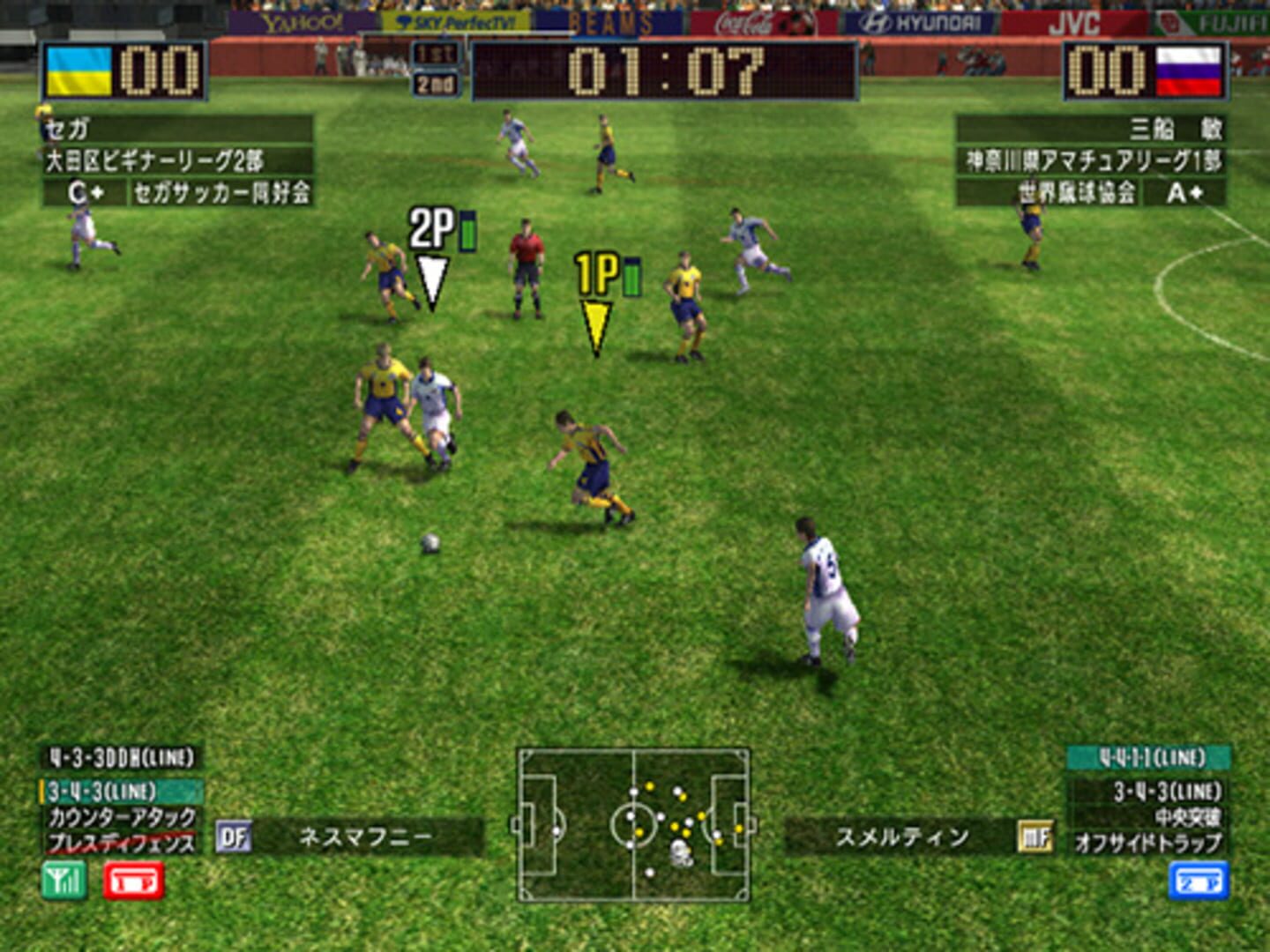
There are 18 teams available to choose from before the start.
Denmark
Development
As one of many series under Sega AM2's Virtua banner, the genesis of Virtua Striker can be traced back to Yu Suzuki, who presented the idea to Satoshi Mifune, with whom he had worked on previous Sega arcades such as Space Harrier and After Burner, and whom Suzuki knew to be a football fan. Mifune, however, originally did not have the same faith in the project, doubting a smooth transition, to the point of expressly declaring that, if the game was a failure, he would not try his hand at the genre again. The simple, three-button control layout resulted of a combination of factors: the lack of popular titles to provide a standard, the need to focus on the game's program, and for an accessible experience to players. In a June 1995 interview with Saturn Fan, Sega AM2 developer Satoshi Mifune explained that realistic dribbling had been the starting point for Virtua Striker.
He wanted the ball to behave independently of the players rather than remain at a fixed distance from their feet, as he felt was common in earlier football games. Ball movement was calculated according to physical principles, while the pitch was modelled on the dimensions of a World Cup football field. Mifune also explained that the height of shots could be controlled by the duration of the shoot button press. Both the players and backgrounds used texture mapping, although an attempt to animate the spectators was abandoned because their movements appeared unnatural from certain camera angles.
Reception
In Japan, Game Machine listed Virtua Striker on their July 15, 1995 issue as being both the second most-successful arcade game and the most-successful dedicated arcade game of the month.
A critic for Next Generation applauded the original Virtua Striker as both "excellent to play and watch". He cited the smooth and accurate control, realistic player moves, camera which consistently zooms in or out to the perfect frame at every moment of play, "gorgeous" texture-mapped players and backgrounds, and realistically strong defense. He gave it four out of five stars.


