The articlegameplay, story, development, reception
Gameplay
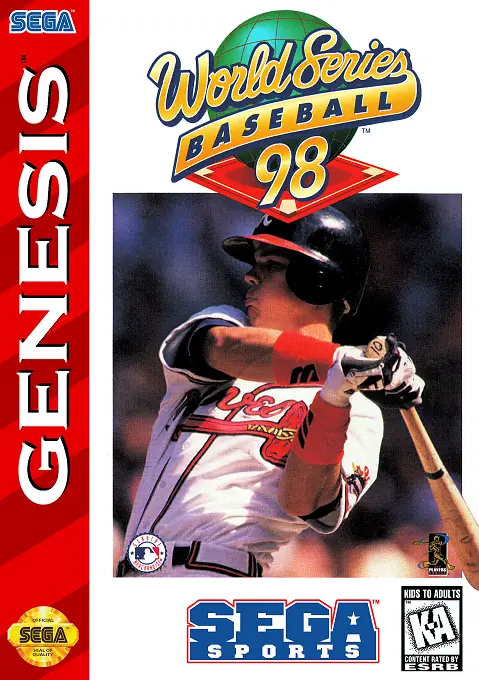
World Series Baseball '98 is a baseball simulation in which players control batting, pitching, fielding and baserunning. The Saturn version uses a four-part batting system based around the strike zone. Each batter has areas in which they are comparatively strong or weak, and before a pitch the player can select one of four quadrants corresponding to buttons on the controller. Correctly anticipating where the pitch will enter the strike zone increases the likelihood of solid contact, while selecting the wrong quadrant can result in weaker contact. Players can also decline to select a quadrant in order to concentrate on making contact rather than hitting for power.
Pitchers have individual pitch repertoires based on their real-life counterparts, with the player choosing pitch type and location while attempting to exploit a batter's weaker areas. Next Generation described the pitcher–batter contest as requiring the batter to anticipate pitch type and location while the pitcher varies speed and placement and avoids the hitter's stronger zones. Fielding ability also varies between players; stronger defensive players can make more accurate throws, while pitcher effectiveness declines with fatigue. The game additionally includes injuries, errors and rain delays. Both fielding and baserunning can be controlled manually or left to the computer.
The game contains four modes of play, including a full 162-game season, playoff play and a Home Run Derby. Its season mode follows the 1997 Major League Baseball schedule and incorporates interleague play, which had been introduced to Major League Baseball that season. Player statistics can be stored and tracked across more than 20 categories.
The Japanese release also featured an expanded team-editing system, allowing players to create their own teams by selecting names, home grounds and uniform colours. Players could customise individual athletes' appearances, physical attributes, positions and abilities, while existing professional players could be recruited through one-for-one trades.
Development
For the Saturn version, Sega introduced a new 3D polygon-based graphics engine and used motion capture to reproduce the movements of professional baseball players. Sega also implemented artificial intelligence intended to emphasize baseball strategy rather than purely arcade-style play. In a February 1997 interview with Saturn Fan, members of the Japanese development team explained that they had incorporated feedback from players of earlier Greatest Nine games, particularly concerning the interaction between pitchers and batters. They sought to reproduce the strategic elements of real baseball while improving player animations and expanding the ability to create customised teams.
The Japanese version, Pro Yakyū Greatest Nine '97, featured 11 baseball stadiums, including the Tokyo Dome, Nagoya Dome, Koshien Stadium and Yokohama Stadium. It also featured all 12 teams from Nippon Professional Baseball's Central League and Pacific League, with player rosters based on the 1997 season.
An updated version of the Japanese release, titled Pro Yakyū Greatest Nine '97: Make Miracle, was released for the Sega Saturn in Japan on September 25, 1997. It incorporated updated player data and introduced a "1997 Pennant" mode reflecting events from that year's Japanese baseball season. The revised edition also featured gameplay adjustments and special teams incorporating retired professional baseball players.
The North American version was licensed by both Major League Baseball and the Major League Baseball Players Association and included the 1997 MLB schedule, player rosters and statistics, as well as the newly introduced interleague play. More than 20 statistical categories could be recorded during a season.
All 30 major-league ballparks were represented, with the development team using photographs of the real stadiums as reference material. Newly built or developing venues represented in the game included Turner Field, Tropicana Field and Bank One Ballpark, while changes to the Oakland–Alameda County Coliseum were also incorporated.
The game was among five Sega Saturn games promoted through Sega of America's $25 million "Hard Stuff" advertising campaign, developed by Foote, Cone & Belding. Announced in September 1997, the campaign included television commercials scheduled to begin airing on MTV on 6 October, alongside print advertising and other promotional activities. The game was also advertised on the back cover of the October 1997 issue of GamePro, with an illustration depicting a scraped forearm.
In September 1997, Kama Entertainment signed an official agreement with Sega to distribute Saturn hardware and software in South Korea. World Series Baseball '98 was selected as one of the first new Saturn titles to accompany Kama's renewed push for the console in the Korean market, with a release planned for early October. Although initially scheduled for early October, the game was released in South Korea in late November 1997, with Kama holding the exclusive domestic distribution rights.
Reception
The Genesis version was released at the end of the console's lifespan and was largely ignored by the press. A brief review in GamePro criticized that the only improvements over World Series Baseball '96 are updated rosters and interleague play, making it only worth buying for those who do not yet have a baseball game for the Genesis.
The Saturn version of World Series Baseball '98 received mostly positive reviews. The series' transition to polygonal graphics was generally approved of, particularly since the game still runs as fast as its predecessors, though multiple reviewers criticized that the bats are grossly out-of-proportion, saying they look like two-by-four lumber planks. Most also commented on the inability to trade players. However, the batting/pitching quadrant system was highly praised.
Next Generation, in particular, argued that in conjunction with the deep fielding controls and management strategies, the quadrant system makes World Series Baseball '98 a genre-redefining game comparable to the likes of Doom and NFL GameDay 97. The reviewer stated, "Clearly, this is the new standard for baseball games, and there are no current games that even come close. Saturn may not have much, but it's got baseball." Other critics were more moderate, though still positive.
GamePro concluded that the fast, fun nature of the game overrides its issues with graphics and sounds, and compared it favorably to contemporary baseball games on the Saturn such as Grand Slam. Kraig Kujawa and Dean Hager both said that it is inferior to MLB '98, but still very good, and Hager added, "I'll say for sure it's the best baseball game for the Saturn."
Japanese magazine Sega Saturn Magazine awarded the game's Japanese release, Pro Yakyū Greatest Nine '97, individual reviewer scores of 8, 9 and 8 out of 10. The reviewers praised its realistic player animations, batting mechanics and extensive customisation options, with one particularly recommending its two-player mode. However, they also noted the difficulty of some fielding controls and questioned whether every feature enhanced the gameplay experience. In the final Sega Saturn Magazine reader rankings, subsequently compiled in the 2000 book Saturn no Game wa Sekai Ichi!, Pro Yakyū Greatest Nine '97 ranked 165th among 945 rated Saturn games, with an average reader score of 8.6683 out of 10.
During the inaugural Interactive Achievement Awards, the Academy of Interactive Arts & Sciences nominated the Saturn version for "Console Sports Game of the Year", which was ultimately awarded to International Superstar Soccer 64.
Legacy
The game was later credited with influencing subsequent baseball titles. In a 2000 retrospective, GameSpot described many of the ideas introduced in World Series Baseball '98 as sufficiently innovative that competing games adopted them and spent approximately two years catching up.
World Series Baseball '98 influenced Sega's subsequent baseball games on the Dreamcast. During the development of World Series Baseball 2K1, Sega producer David Perkinson said that the team had learned from the World Series Baseball games on the Saturn and Genesis and intended to carry their strongest elements into the Dreamcast game, including their balance between simulation and arcade-style gameplay. Perkinson later described World Series Baseball '98's transition to polygonal characters and three-dimensional rendering as a major evolution for the Saturn series which helped set the direction for its subsequent development on Dreamcast.
In a 2021 retrospective of the greatest baseball games on each major console, Bleacher Report chose World Series Baseball 98 for the Sega Saturn and noted that "it represented a massive step forward relative to previous baseball games in terms of making the batter/pitcher matchup the focal point of the game."