
The articlegameplay, story, development, reception
Gameplay
The goal of Zoo Tycoon is to create a thriving zoo by building exhibits to accommodate animals and keeping the guests and animals happy. Exhibit-building is one of the primary goals of Zoo Tycoon. To keep the guests and animals happy, exhibits should be suitable to the animal. For example, a lion is best suited to a savanna environment.
Choices in rocks, terrain, foliage, shelters, fences, toys and the presence of zookeepers all contribute to the suitability of an exhibit and the happiness of the animal. Guest happiness is dependent on animal choice, animal happiness, buildings, and scenery. Buildings include attractions, bathrooms, restaurants and food stands, gift shops, animal houses, such as insect houses, primate houses, reptile houses, nocturnal houses and aviaries, plant houses, petting zoos, and entertainment buildings like movie theaters. Scenery involves aesthetics that raise guest happiness slightly, such as topiary art, light posts, and benches.
Keeping both animal and guest happiness high allows the player to gain monetary awards and maintain a steady income. To help manage the expanding zoo, the player can employ maintenance workers, zookeepers and tour guides. If the animals escape from their enclosures, they can attack and possibly kill guests and employees. Each of the animals have a predefined set of other species they can attack.
If both incompatible animal species are placed in the same exhibit, the attacker will immediately run towards and attack the victim, a cloud of dust will appear shortly, and the animal will get killed. This behavior is not limited to carnivores, as some large herbivores are also able to kill other animals. Baby animals, with an exception for some dinosaurs, will normally not attack other animals. Fences decay over time, so the player will have to replace them to prevent animals from escaping.
If the player has poor zoo maintenance and receives too many complaints about unhappy animals, they must fix their habitats or they will not adopt any more of them.
There are three modes in Zoo Tycoon: Tutorial, Scenario, and Freeform. Tutorial teaches the player how to build exhibits and keep guests happy. Scenario mode tasks the player with completing a series of objectives under restrictions. These objectives may include achieving a certain guest and animal happiness, achieving a certain exhibit suitability, displaying a certain number of animals, or breeding a certain animal.
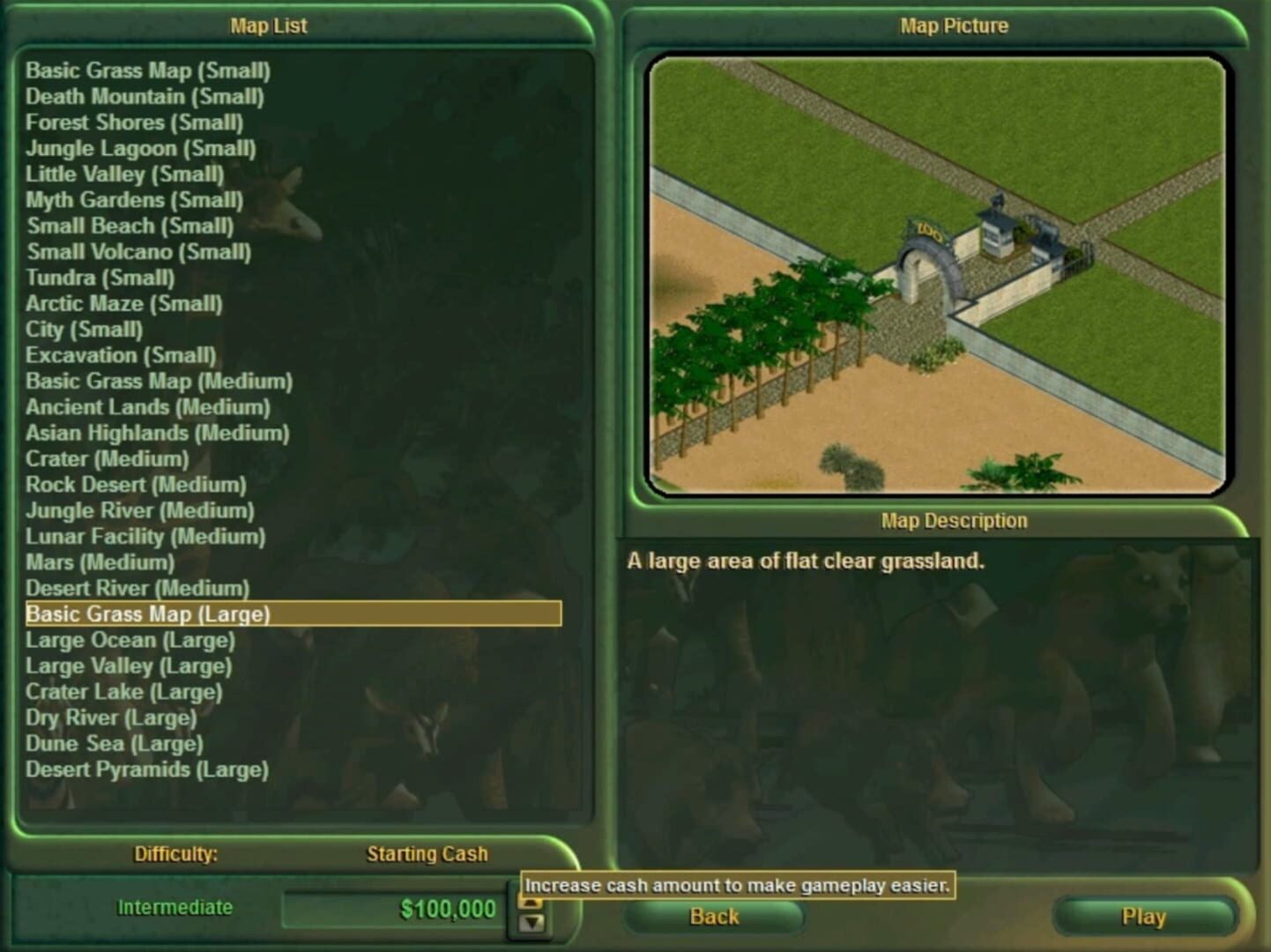
Freeform allows the player to choose the amount of money and the map with which they start. They are presented with an open lot and a limited selection of animals, buildings, and scenery available for purchase. As the game progresses, more animals and items become playable. Additional animals and items may be researched, where money is invested to make them playable.
Development
Blue Fang Games originally considered making a simulation game where the player would manage an airport, before the idea was dismissed by CEO Hank Howie, citing that compared to places like theme parks, airports are not "fun". The team then pivoted to a zoo building game, and quickly began research on animal care and behavior, sending artists, animators and developers to zoos in and around the Boston area, as well as flying a team out to the San Francisco Zoo. The team learned how zoos work in order to figure out where they were allowed to take creative liberties, citing that during the development for the Marine Mania expansion, the team gave dolphins the ability to do tricks which were not completely realistic because they thought it was more fun. The development team also tried to strike a balance between teaching players about conservation and entertainment, citing the educational efforts put forth in real zoos.
Reception
Zoo Tycoon was received with mixed to positive reviews, gaining an average 68 out of 100 at Metacritic. GameZone gave the game a score of 8 out of 10. Eric Bratcher reviewed the PC version for Next Generation, rating it three stars out of five, and stated that "A pleasant diversion, but it's about as deep as a puddle, and frustratingly finicky." Zoo Tycoon and its compiled Complete Collection garnered several awards and accolades, gaining the Bologna New Media Prize in 2002. Zoo Tycoon: Complete Collection received the Parents' Choice Foundation Gold Award - 2003, the AIAS Computer Family Game of the Year Interactive Achievement Award - 2004, the Scholastic Parent & Child Teacher's Pick – 2004, and the Children's Software Revue All Star Award – 2004.
Zoo Tycoon was a commercial success. Within a year of release, the game rose above 1 million copies in sales. By October 2003, its global sales had surpassed 2.5 million copies, or 3 million when grouped with its expansion packs. The NPD Group declared it the eighth-best-selling computer game of 2002, and the 11th-best-selling of 2003. NPD proceeded to rank the game's Zoo Tycoon: Complete Collection bundle 10th for 2004, 16th for 2005 and 12th for 2006.
In the United States alone, Zoo Tycoon sold 1.1 million units and earned $28.2 million by August 2006. It was among the country's 15 highest-selling computer games ever by July 2004, and Edge ranked it as the country's fifth-best-selling computer game released between January 2000 and August 2006. Zoo Tycoon also received a "Gold" sales award from the Entertainment and Leisure Software Publishers Association (ELSPA), indicating sales of at least 200,000 copies in the United Kingdom; and a "Gold" certification from the Verband der Unterhaltungssoftware Deutschland (VUD), for sales of at least 100,000 units across Germany, Switzerland and Austria.
The Zoo Tycoon series, including the original Zoo Tycoon, surpassed 4 million copies in global sales by July 2004. Over 2 million copies of the series were sold in the United States alone by that date. Series sales in the country rose to 2.9 million units by August 2006.