The articlegameplay, story, development, reception
Gameplay
13 Sentinels: Aegis Rim is a video game where players take control of thirteen different characters, who interact with each other to build a larger narrative. The gameplay is split into three sections. They are Remembrance, with exploration and dialogue taking priority and advancing the narrative; Destruction, where characters equip mecha and engage in battles against enemies called Kaiju; and Analysis, a glossary which documents event scenes and important items and characters.
During the adventure game-style Remembrance segments, the player explores two-dimensional (2D) side-scrolling environments, interacting with elements of those environments in a non-linear manner. Several elements move in real-time regardless of the player's actions, and choices can be made which alter the outcome of some scenes. Keywords spoken by characters and obtained items are added to a Thought Cloud database, which can be accessed to trigger both internal monologues and initiate new dialogue. Once learned, keywords are carried over into other earlier or parallel scenes, which in turn unlock further story routes and options.
The character stories are tracked with a flowchart, with players able to jump between scenes to try different keywords from the Thought Cloud. If a wrong choice is made during one section, the game rewinds back to the beginning of the day so players can select the right choice. To reach that point faster, events the player has already seen can be fast forwarded.
The battle system of the Destruction mode takes the form of a real-time strategy scenario, with up to six chosen characters using Sentinels to fight off waves of Kaiju defending a terminal. The terminal's health is determined by which units are in place, and if all units are defeated, the hub is overwhelmed and the game ends. Gameplay can be paused, allowing for Sentinels to be moved and actions such as combat and support abilities to be carried out. The section is completed when the hub is successfully defended against all waves.
Battles pit Sentinels against Kaiju with differing strengths and abilities such as flight or extra defense, requiring one of the four Sentinel types; some Sentinels are strong against flying enemies, while others do better against large ground-based forces. They also have different attack ranges and movement speeds. Sentinels have at least one basic attack that costs nothing, and additional abilities that cost a resource called EP; EP can be recovered by defending. After acting, each Sentinel has a cooldown timer before it can act again.
Damage can be repaired by Sentinel pilots, but this requires leaving the Sentinel and leaving them vulnerable to attack. The player can also trigger limited-use "Terminal Commands", special field-wide abilities such as an EMP which use up a dedicated energy gauge. Characters level up with experience points and gain passive bonus effects, while Sentinel abilities and attributes can be raised using Meta-chips gained during battles.
Analysis takes the form of an index where event scenes and information on people, items and concepts are archived. Mystery Points, earned through Destruction mode, are used to unlock new index entries in Analysis. As the player advances, character narratives are locked off until something else has taken place in another section of the game. These unlock conditions can include unlocking entries in Analysis, advancing stories in Remembrance, or tackling particular battles in Destruction.
Story
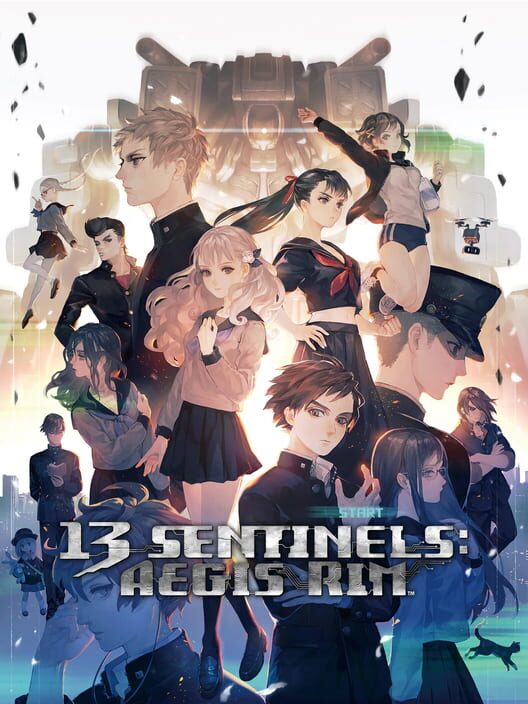
13 Sentinels is primarily set during a fictionalized version of 1985 in the Shōwa period, but also jumps between 1945 during the later years of World War II, 2025, 2065, and the distant future of 2105. The story follows the perspective of thirteen characters. While several characters are native to the 1980s period, several come from either the future or the era of World War II. The storyline is split between these characters, and by following each the player aims to avert a disastrous future for mankind.
A recurring location is Sakura High School, which multiple characters attend across different time periods. The story is told using nonlinear narrative, switching both between different protagonists and the events of the final battle against an army of Kaiju, otherwise known as the "Deimos", giant monsters who arrive in 1985 and attack Japan. Each of the thirteen protagonist's arcs culminate in summoning a Sentinel, a mecha designed to fight the Deimos which also has the ability to travel between different eras.
The thirteen protagonists are Juro Kurabe, an otaku who is troubled by strange dreams; Iori Fuyusaka, an outgoing student who likewise has dreams similar to Juro; Ei Sekigahara, an amnesiac young man pursued by a mysterious organization; Keitaro Miura, a young man from World War II-era Japan; Takatoshi Hijiyama, Miura's upperclassman from the same time period; Nenji Ogata, a good-hearted delinquent; Natsuno Minami, a track team member fascinated by the occult and UFOs; Yuki Takamiya, a notorious sukeban (delinquent girl) and childhood friend of Natsuno; Shu Amiguchi, a playboy with a kind heart who discusses his dreams with Juro and Iori; Tomi Kisaragi, a girl from 2025 sent to 1985; Megumi Yakushiji, another girl from 2025 who is in love with Juro; Ryoko Shinonome, a sickly girl from 2065 tasked with pursuing an escaped prisoner dubbed "426"; and Renya Gouto, a stern young man from 2065 who ultimately leads the Sentinel pilots.
There are several notable supporting characters. Chihiro Morimura is both the school nurse and the teacher for Kurabe and Fuyusaka's class. Tsukasa Okino is a genius student with deep knowledge of the Sentinels, who frequently cross-dresses as a girl. Chihiro is a mysterious girl who Miura considers his sister but who later accompanies Gouto during several sections.
Kyuta Shiba is one of Juro's best friends, but possesses a hidden agenda. Erika Aiba is a student who tags along with Takamiya as they solve mysteries surrounding the Sentinels. Tamao Kurabe is a woman from the 1940s who closely resembles Aiba. Tetsuya Ida, while ostensibly a part-time instructor, is the chairman of the covert Special Investigations Unit (SIU) in 1985.
The small robot BJ accompanies Natsuno on her journeys through time. Fluffy, a talking cat, strikes a deal with Megumi to save Juro. Miyuki Inaba is a famous idol within the 1980s period.
In 1985 Japan, Kurabe, Fuyusaka, and Amiguchi experience shared dreams, either of themselves fighting previous wars against the Kaiju or of what appear to be older versions of themselves in the future. They are later seen by Morimura, who Kurabe learns is administering an unknown medication to some students; Kurabe is referred to in Morimura's notes as "Juro Izumi", an identity he cannot remember. Takamiya is blackmailed by SIU member Ida into monitoring students at Sakura High School. Takamiya's friend Minami finds a robot called BJ; assumed to be an alien, BJ is an AI robot from 2105 searching for its Sentinel.
Yakushiji, from 2025, is approached by Fluffy, who says he can bring back "Izumi" if she shoots select people with a special gun. Gouto and Shinonome both work for the SIU, recruiting Kisaragi from 2025 after the Deimos attack her time period. At a later point, an amnesiac Sekigahara wakes up next to the murdered Morimura, ending up pursued by SIU operatives. In 1945; Miura and his little sister Chihiro live with Tamao Kurabe, and are friends with Hijiyama and newcomer "Kiriko Douji", later revealed to be the cross-dressing Okino.
Shortly after Okino takes Hijiyama to 1985, the Deimos attack 1945. Tamao vanishes upon being "killed", Gouto kidnaps Chihiro, and Miura accidentally travels to 1985 using a Sentinel. Each playable character has dedicated intertwining story arcs, revealing more about individual pieces of the plot.
It is gradually revealed that rather than time periods, the protagonists inhabit five different areas, or "Sectors", which replicate a specific era. In the real-world 2188, a nanomachine virus ravaged the Earth, leaving only fifteen survivors in a space colony; the thirteen protagonists, as well as Okino and Tamao. The survivors initiated Project Ark, sending their DNA and records of their history to a new planet where they would restart humanity. The events of the game are happening in the far future on a distant terraformed planet and the simulation housing and training their minds is otherwise populated by human-like AIs.
Project Ark and its population are managed by Universal Control, an AI which erases inconsistencies and falsifies information to preserve the simulation. The 2188 Shinonome, disillusioned with humanity, secretly implemented the Deimos Code; this would cause Shikishima, a mega-corporation that exists in all Sectors, to produce the Deimos. Once the Deimos invades all five Sectors, the simulation resets to sixteen years prior to protect Universal Control, with the fifteen humans losing their memories of the events, trapping them in an endless loop. Some characters survive loops with their memories intact using "Sector 0", a non-spatial area at the system's core.
Some key plot threads are scattered through each character's narrative. Ida, an earlier version of Amiguchi, seeks to perpetuate the loops in an attempt to restore an earlier version of his lover Kisaragi, who exists in the current world as Inaba. He loses hope and is killed after learning that Sector 0 will be erased in the next reset. Ju
Development
13 Sentinels was developed by Vanillaware, a Japanese game developer who also worked on Odin Sphere, Dragon's Crown and Muramasa: The Demon Blade, notable for their usage of 2D art in an industry predominated by the usage of 3D graphics. Vanillaware founder George Kamitani, who also directed Odin Sphere and Dragon's Crown, returned to serve as director for the game while handing the character design duties to Yukiko Hirai and Emika Kida. The game was produced by Akiyasu Yamamoto of Atlus, a role he had fulfilled for Odin Sphere. It was the team's first game to use a contemporary or science fiction setting, as all their previous projects had used high fantasy settings.
The concept originated in 2013 following the completion of Dragon's Crown. Tired of spending so long in fantasy worlds, Kamitani wanted to create a science-fiction story set in the time of his youth in the 1980s. He also wanted something on a much smaller scale, as Dragon's Crown was a huge project for him.
The game was originally pitched to an unnamed media company on the basis that it would be used as a basis for a toyline, with the marketing focused exclusively on Japan and having a small budget and low sales margins. As part of the initial pitch, Kamitani created mechas with hulking designs inspired by Robot Jox, then created a "gap in expectations" by having a setting and characters inspired by shōjo manga. He was about to push forward with the project in this form when he remembered Atlus had been given right of first refusal as part of their contract to fund Dragon's Crown. Frustrated with the other company's demands and uncertain that Atlus would approve of the concept, Kamitani nevertheless showed it to them.
Atlus, who was searching for a game to market internationally, immediately accepted it without the need to incorporate the toy line marketing. Despite these changes, the overall story concept remained intact and the final scene was unchanged from the original draft.
Full production began in the summer of 2015 following the completion of remakes of Muramasa (Muramasa Rebirth) and Odin Sphere (Odin Sphere Leifthrasir). The entire production period, including early concept work, lasted six years. The game was originally in production for PlayStation 4 (PS4) and PlayStation Vita (Vita). At the time of its announcement, the game had only just entered full development and there were very few assets to show.
The game was originally scheduled for release in 2018, but in November of that year Atlus delayed the game and cancelled the Vita version due to the longer time needed for development. In response to this, so players would experience what to expect from the game's characters and narrative, a demo-type release called 13 Sentinels: Aegis Rim Prologue was developed. Based on feedback from Prologue, the development team were able to make adjustments and additions to the main game. Kamitani described the game as "truly, recklessly ambitious".
He referred to the project as the culmination of his work and skills up to that point.
The concept for a story featuring multiple protagonists was drawn from the long-running television series Chūgakusei Nikki. Kamitani's original concept had seven or eight characters, but as the first artwork for the concept was published in 2013, he decided to increase the number to thirteen; this exponentially increased the company's workload. Prior to incorporating mechas, the story revolved around young people with superpowers inspired by the TV drama series Night Head. Due to lacking excitement and overt science fiction elements, he rewrote the premise.
Kamitani based the narrative on the original video animation Megazone 23. He was originally planning to use the Jules Verne novel Two Years' Vacation as inspiration. In the final product, the characters Gouto and Yakushiji are based respectively on the novel's characters Gordon and Cross. The narrative structure also drew inspiration from Western thriller fiction.
In contrast to his work on Odin Sphere, where he had created the overall story while other writers worked on the game scenario, Kamitani wrote the entire scenario of the game himself both in and out of office hours over the course of three years. Kamitani chose to set the game in 1980s Japan due to his own experience; his knowledge of the modern Japanese school system was limited, and the lack of mobile phones in that era allowed for more face-to-face conversations between characters in-game.
The original scenario timeline ran from the 1940s to the 1980s, but when Atlus took over the project Kamitani expanded the scope into the near and distant future. Kamitani wanted to create a mecha-themed story for a modern audience, as many of the most memorable genre works (Mobile Suit Gundam, Neon Genesis Evangelion) were by that time several decades old. At one point, each of the thirteen protagonists had twelve possible story paths, making for a total of 165 possible variations. Due to the production timeline and the need to reveal the story mysteries, Kamitani had to cut a lot of planned optional comedic and bonding scenes between characters. Several of the surviving routes went through extensive revisions, with some planned scenes such as a coffee shop location being cut, but a key surviving theme that came with its shōjo manga inspiration was romance.
Each protagonist's storyline drew inspiration from a particular outside source, ranging from Japanese anime and manga to Western movies and classic works of science fiction. Sekigahara's route originally had a shōjo-style romantic choice between Fuyusaka and Shinonome, but this was changed to make Fuyusaka the only choice. One of the core mysteries were the characters of Fuyusaka, Morimura and Chihiro, who were different incarnations of the same character, with her designs and portrayal showing the alternating charms of different ages. This section of the plot, which was a key part of Gouto's scenario, underwent major revisions late in pr
Reception
13 Sentinels: Aegis Rim received "generally favorable" reviews according to review aggregator website Metacritic. Fellow review aggregator OpenCritic assessed that the game received "mighty" approval, being recommended by 97% of critics. The narrative and characters were universally praised for their complexity and compelling nature, though a few found it difficult to follow or overly reliant on jargon, or cited uneven character writing and occasional pacing issues. The gameplay was met with generally positive comments, though the RTS sections were seen as the weaker part of the experience.
The visuals were also met with general praise, though the battle displays were faulted compared to the adventure segments. The music was also met with praise, while the localization saw positive responses from Western reviewers.
Japanese magazine Famitsu lauded the game's presentation and narrative, with two of the four reviewers giving it a perfect score. Destructoid's CJ Andriessen lauded the game as intriguing, feeling that only the RTS battle sections held the game back from being Vanillaware's best game to date. Malindy Hetfeld of Eurogamer compared the attention to detail in its worldbuilding to the work of Hideo Kojima and generally enjoyed the game although she faulted the lack of central plot and portrayal of both straight and LGBT romance. Joe Juba, writing for Game Informer, praised the narrative delivery and art style of the adventure sections despite finding the RTS sections weaker in both gameplay and presentation. Heidi Kemps of GameSpot called it an unforgettable experience and "a unique, genre-mixing experiment", lauding its narrative and art style while again faulting the RTS gameplay as weaker overall.
IGN's Matt Kim called the RTS gameplay style "commendable", but cited the storytelling and adventure art style as the main reasons for buying the game. Robert Ramsey of Push Square gave the title a near-perfect score, lauding the experience overall despite pacing issues with the narrative. Alex Fuller, writing for RPGamer, enjoyed the game's combat and felt that the narrative, while enjoyable, was not interactive enough and took up too much of the gameplay. Alana Hagues of RPGFan—referencing a 2009 interview with Kamitani on his ideal game—felt that Kamitani and Vanillaware had "have achieved their ultimate goal", lauding the overall game design and strength of narrative. Josh Torres of RPG Site gave the game a perfect score, lauding it as a new landmark in video game storytelling and praising the overall package despite its RTS elements appearing weaker.
In an update to the original review, Kemps noted that very little was graphically lost in the transition from the PlayStation 4 version to the Nintendo Switch version, calling the port "superb". Mitch Vogel of Nintendo Life, while finding the combat repetitive and some of the story delivery confusing, generally lauded the game as enjoyable and strongly recommended it for genres fans and players of visual novels. RPGFan's Cory Tischbein, while echoing general praise of the narrative and graphics while noting the weaker combat system, said the game stood as one of the strongest gaming experiences on the Switch. Nathan Lee of RPG Site gave the game a perfect score, citing it as a great port and praising it as being additionally pretty to look at on the Switch's OLED model.
In Japan, during its opening week, all retail versions of the game sold just over 34,200 units, debuting in fifth place in the charts. These low sales were blamed by Kamitani on the game's blend of genres, difficult production, and releasing alongside other popular titles. While initial sales were low, positive word of mouth from both players and other industry figures caused sales to increase, resulting in stock shortages. It remained in the top 30 best-selling titles into January, with total physical sales of over 59,000 units on PS4.
By this point, physical and digital sales had reached 100,000 units. In their fiscal report, Atlus said that 13 Sentinels: Aegis Rim exceeded their sales expectations. Following its worldwide release, the game had sold over 300,000 copies by January 2021. By August 2023, physical shipments and digital sales reached one million copies.
The game won the awards for "Best Scenario" and "Best Adventure Game" at the Famitsu/Dengeki Game Awards 2019, and it was nominated for "Game of the Year", "Best Graphics", and "Best Rookie Game". It received a nomination in the "Media" category for the 51st annual Seiun Awards in 2020, the only video game nominee that year. The game was also nominated for "Best Narrative" at The Game Awards 2020. In IGN's "Best of 2020", 13 Sentinels: Aegis Rim was one of the nominees in their "Best Adventure/Puzzle" and "Best Video Game Art Design" categories.
E. Awards, the Academy of Interactive Arts & Sciences nominated 13 Sentinels: Aegis Rim for "Outstanding Achievement in Story".