
The articlegameplay, story, development, reception
Gameplay
The initial and overarching goal of A Mind Forever Voyaging is for players to explore the simulated world of Rockvil to observe changes over time and record them. It is played in multiple parts, with the first taking place in Rockvil ten years into the game's future, and progressing in ten-year increments once players have recorded a list of events from each given period. The main game mode, 'Simulation Mode', allows players to navigate around the area by typing the direction they wish to travel, examine and interact with objects and people. The game's parser supports a vocabulary of over 1,800 words.
Story
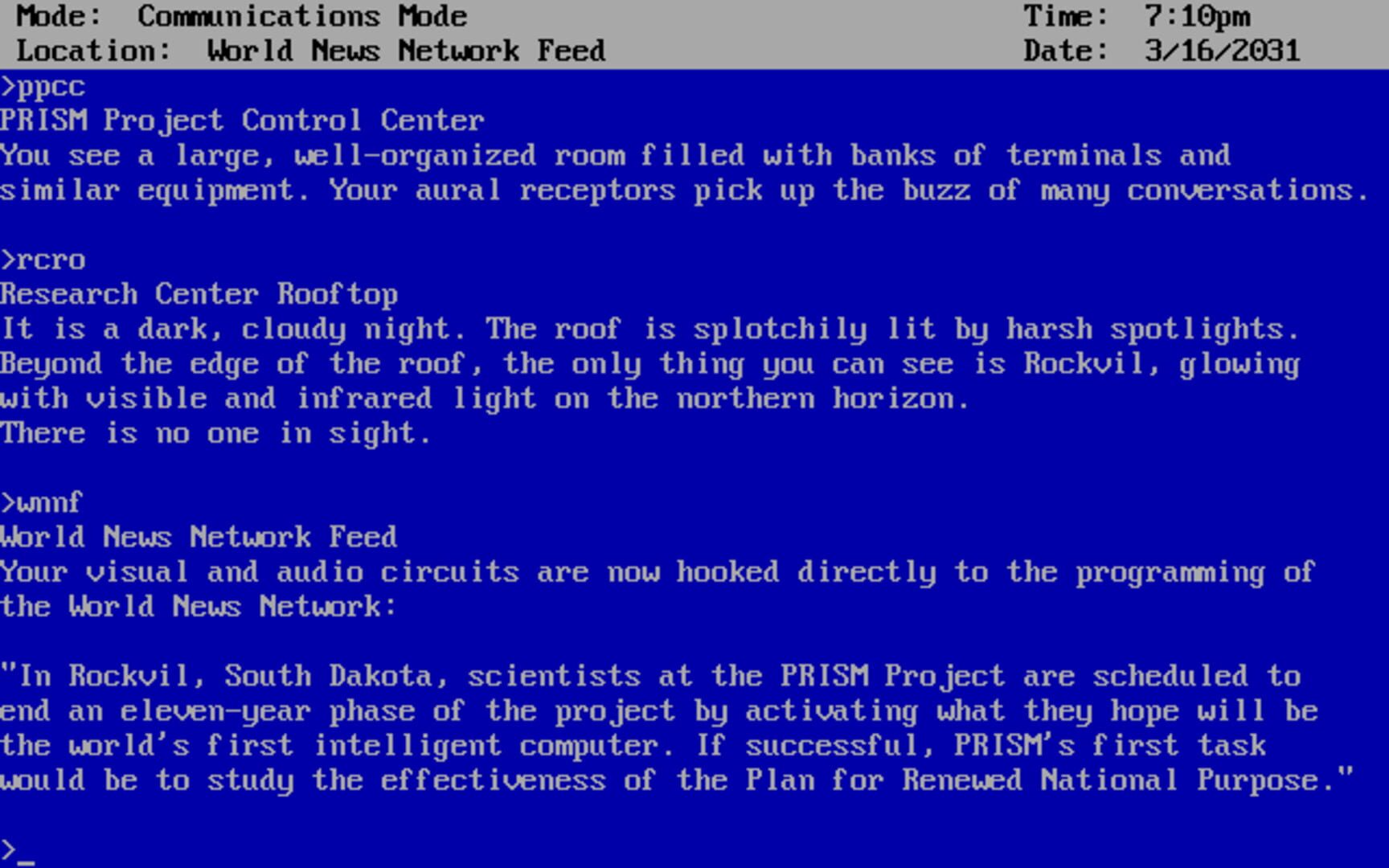
In 2031, the United States of North America (USNA) faces severe economic decline, widespread youth suicide through addictive neural-stimulation devices known as Joybooths, and the threat of a new nuclear arms race involving miniature weapons, which risks transforming the country into a police state. Dr. Abraham Perelman has designed PRISM, the world's first sentient computer, which has spent eleven real-world years (equivalent to twenty years subjectively) living in a highly realistic simulation as an ordinary human named Perry Simm, unaware of its artificial nature.
Perelman awakens PRISM from the simulation and reveals its true identity. He explains that PRISM has been enlisted to evaluate a comprehensive political proposal, the Plan for Renewed National Purpose, sponsored by Senator Richard Ryder. The plan emphasizes deregulation of government and industry, compulsory military service, unilateral foreign policy, trade protectionism, and a return to traditional social values. To assess the plan's long-term effects, PRISM enters a series of accelerated simulations centered on the fictional town of Rockvil, South Dakota, projecting societal conditions at intervals following the plan's hypothetical implementation in 2031.
Development
A Mind Forever Voyaging was written by Steve Meretzky, author of previous text adventure titles for publisher Infocom including Planetfall and co-author of The Hitchhiker's Guide to the Galaxy, the success of which he considered allowed him to develop the game. Meretzky stated a desire to expand the creative and technological potential of the text adventure genre, and wanted to create a political game after being disheartened by the re-election of President of the United States, Ronald Reagan, in 1984, modelling the game's character Richard Ryder after him. Concerned by the rise of the religious right and the impacts of trickle-down economics, Meretzky sought to create a game that could "harness interactive fiction to get inside people's heads and change their minds about political ideas". After being allowed by Infocom to proceed with the concept, despite initial reservations, Meretzky began work on the project by writing a short story of the same name detailing the background of the game's setting, Rockvil, and the life of resident Perry Simm.
Infocom distributed the game as the first in a series of 'Interactive Fiction Plus' titles marketed as featuring longer stories and supported only by computers with over 128k of computer memory. The game's instruction manual was packaged with Dakota Online Magazine, a fictional excerpt of a magazine presented in the universe of the game containing Meretzky's short story. Other additions to the game's physical release included a map of Rockvil, a decoder and pen. Infocom showcased the game at a press release in the New York Public Library in Manhattan, featuring appearances by author Stu Galley, who recited the short story, Infocom President Joel Berez, product manager Michael Donbrook and Meretzky.
Reception
Meretzky stated that the game's sales were "somewhat disappointing" with an estimated 35,000 units sold, falling short of a goal of 50,000. He considered that this was "mediocre" for an Infocom game at the time of release, and attributed its performance to its political content and a lack of puzzles.
A Mind Forever Voyaging received positive reviews. Several critics considered the game was ambitious and a departure in style and design for its publisher Infocom, The game also piqued interest from publications about the artistic potential of interactive fiction, with The Providence Journal expressing that the game was "probably the closest anyone has come to creating an electronic novel that is more novel than puzzle", and The Christian Science Monitor considering the game represented "an effort to expand the appeal of these games beyond the enthusiasts who enjoy unravelling riddles and mazes". Both Infocom and critics compared the game to modern science fiction literature, including Fahrenheit 451, Brave New World, and 1984.


