
The articlegameplay, story, development, reception
Gameplay
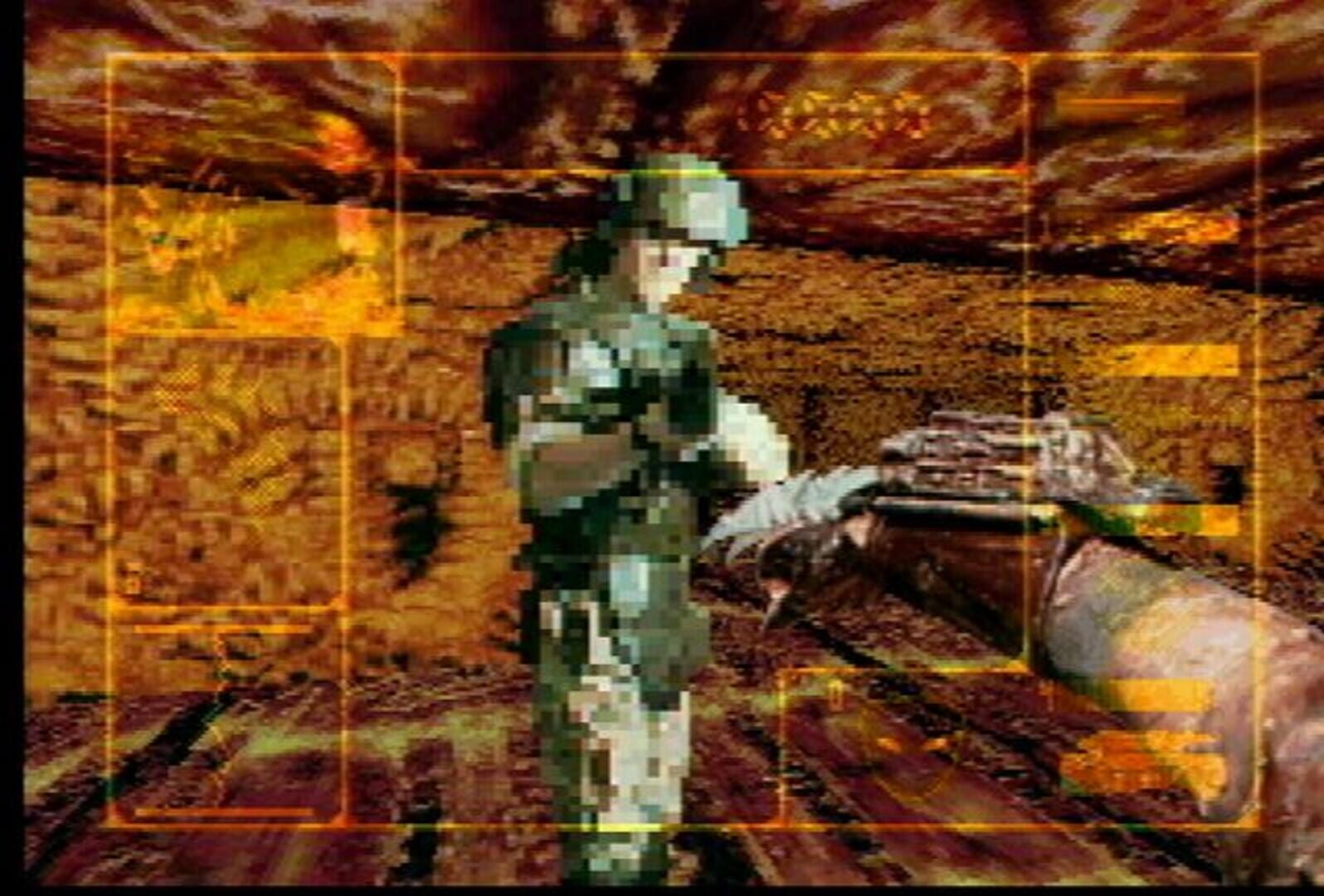
Alien vs Predator is a first-person shooter game. The premise unfolds in a simulation depicting Golgotha, a Colonial Marines training base that was overrun by two extraterrestrial species. The player can choose one of three character scenarios, assuming the role of an Alien, a Predator, or a human from the Colonial Marines. Each character has different objectives, weapons, and abilities, as well as distinct advantages and disadvantages. The player is introduced to the base, which consists of five sublevels interconnected by elevators and air ducts, as well as the docked Alien and Predator ships.
Playing as an Alien, the objective is to rescue the Alien queen held captive on the Predator ship. The player kills enemies using the Alien's claw, retractable jaw, and tail. The Alien is fast but unable to heal itself, and can only survive by turning Marines into cocoons. The player must use a combination of claw-tail-claw attacks to infect up to three Marines with an embryo and turn them into Alien eggs by walking over their bodies.
Development
In the 1980s, 20th Century Fox released the Alien and Predator films, and Dark Horse Comics began publishing licensed Aliens vs. Predator (AVP) comics. AVP for the Atari Jaguar originally started as a project for the Atari Lynx handheld. Atari's Chicago office, which handled production of most Lynx titles, had acquired a sub-license of the Super Nintendo Entertainment System (SNES) video game through Activision prior to its release, and commissioned Images Software to develop a Lynx port of the game.
James "Purple" Hampton, who previously worked as a tester at Lucasfilm Games, joined Atari in 1992 as a producer for several Lynx titles that Atari wanted to release before the Jaguar's launch, AVP being one of them. Hampton felt that the direction the SNES game took did not do justice to the Alien and Predator characters, so Images Software agreed retooling the project into a first-person shooter where the player could control a human, an Alien, or a Predator. However, production was suspended when Atari closed its Chicago office and focused its efforts on the Jaguar. Hampton later worked as a producer and designer for Trevor McFur in the Crescent Galaxy, before serving as a producer for AVP on the Jaguar.
Reception
Alien vs Predator (AVP) on the Atari Jaguar received generally favorable reception from critics. The character selection feature was almost unanimously praised, in that unlike most games with a selection of player characters, the characters have not only different abilities but different objectives and play styles. GamePro ventured to say that it would take the entire length of their two-page review to go over all the gameplay differences between the characters. Many reviews said the environments are impressively vast, giving players an abundance of area to explore. Most critics were also impressed by how the game makes the player experience a sense of dread and occasionally terror, with The Electric Playground's Victor Lucas calling it "landmark video game immersion".
However, even the most positive reviews also levied a share of criticisms against the game. One of the most common was that there are occasional uneventful stretches. Many also found the controls overly complex and difficult to manage; Electronic Games' Steven L. Kent elaborated, "Jaguar's game pads have 17 buttons, and players still need to memorize button combinations to play this game.
Legacy
Alien vs Predator (AVP) was Rebellion Developments' first work with the license and one of four projects for the Atari Jaguar. Others include Checkered Flag II (a Virtua Racing-style game programmed by Robert "Rob" Dibley), Cyberpunk City (a combat flight simulation game), and Dungeon (a Ultima Underworld-style game). Checkered Flag II would later be called Redline Racing before being changed and released in 1994 under its final title, Checkered Flag. Cyberpunk City would later be called Hammerhead before being changed to its final title, Skyhammer.
Facing financial difficulties due to the Jaguar's commercial failure, Atari cancelled the release of Skyhammer and never paid Rebellion for having finished the game. Skyhammer was eventually released in 2000 after Rebellion licensed it to publisher Songbird Productions. Dungeon would later be titled Legions of the Undead and was intended to use an improved version of the AVP engine. However, Rebellion slowed down the game's production to finish AVP, and Atari ultimately cancelled it in 1995.


