
The articlegameplay, story, development, reception
Gameplay
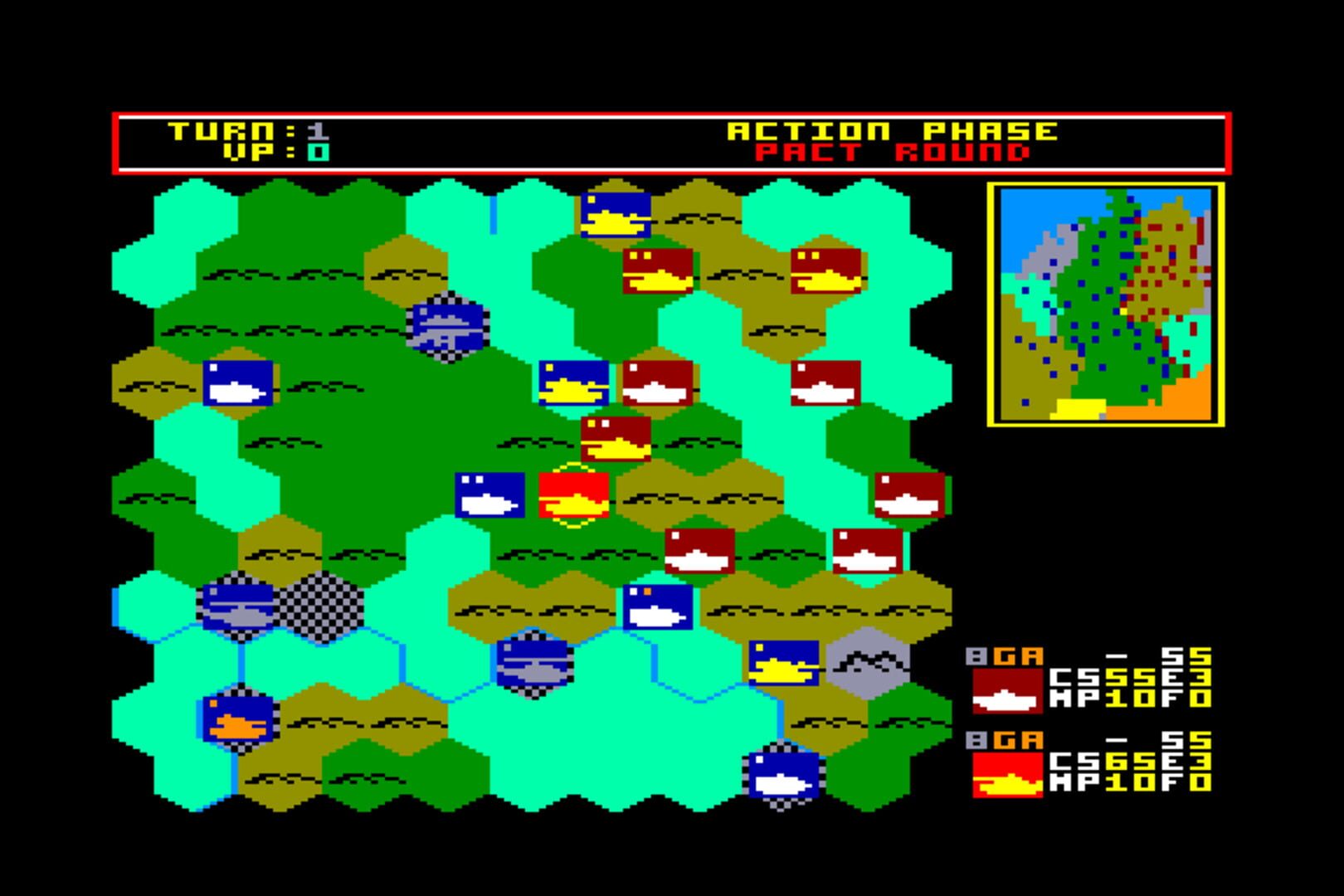
The game is a turn-based strategy and revolves around a fictional conflict between the powers of NATO and the Warsaw Pact. The player has the choice of choosing to control either NATO or Warsaw Pact forces at the beginning of the game. The player will begin the game on either side of Europe depending on which side was chosen; if NATO was picked, the player will start at western European countries (France, West Germany, Denmark) whereas if the player sides with the Warsaw Pact, the game will begin in eastern Europe. The map is hexagon-shaped and allows the player to move their units in six directions.
Each side has a variety of units; infantry move at a slower pace than mechanised infantry however armoured units are able to withstand more damage than regular units. The game displays two maps on screen; the larger, central map displays the current situation whereas a smaller map to the corner of the screen displays a mini-map of Europe, which runs north from Denmark to southern France.
Story
The events leading up the stand-off between NATO and the Warsaw Pact are detailed in a pre-game text; Iran declares war on Iraq and subsequently invades the latter nation, whilst Egypt succumbs to a civil war and establishes Islamic law over the country, culminating in an Egyptian invasion of Israel. The events in the Middle East prompt the superpowers of the United States and the British Empire to intervene, leading up to a conventional war in Europe against the Eastern bloc. The game is set in 1987.
Reception
The game received mixed reviews upon release. Richard Blaine of Your Sinclair praised the graphics as "wonderful" and the gameplay as "tough", adding that the game should be aimed at advanced players. Philippa Irving of Crash criticised the graphics as repetitively "dull", despite admitting that they were "clear enough" visually. Gary Rook of Sinclair User heralded the graphics as "superb", adding that the game was one of the "best looking" wargames he had ever seen at that time.
A reviewer of Computer and Video Games criticised the presentation, stating that the screen was too small and the lack of visual understanding made the game "completely unplayable". Mark Reed of Computer Gamer praised the graphics as being superior compared to Theatre Europe, heralding it as "much more detailed". However, Reed criticised the originality of the game and the lack of manual for the ZX Spectrum version.


