
- 82/100
- Players599 ratings
- 91/100
- Critics4 reviews
Where to get it
2008 · Sora Ltd. · Crossover · Fighting
Brawl
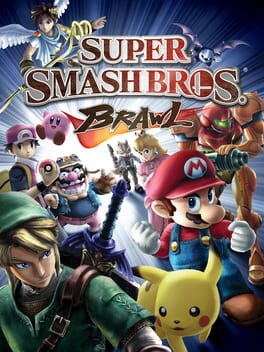
Super Smash Bros. Brawl is the third installment in the Super Smash Bros. series and the follow-up to Super Smash Bros. Melee.
- Released
- 31 January 2008
- Platforms
- PlayStation 4Wii
- Genres
- CrossoverFightingPlatform fighterPlatformer
- Developers
- Sora Ltd.
- Publishers
- Nintendo
- Series
- Super Smash Bros.
- Modes
- Co-opMultiplayerSingle-player
- Perspective
- Side view
- Themes
- Action
- Engine
- Havok
- Country
- Japan
- Age ratings
- CLASS_IND 10ACB PGCERO AESRB TPEGI 12USK 12
- Languages
- English, French, German, Italian, Japanese, Korean, Spanish (Spain)
- Copies sold
- 13.3 million as of 2021-03-31
- Entry
- #3 in Super Smash Bros.
- Directors
- Masahiro Sakurai
- Composers
- Nobuo Uematsu
About
Super Smash Bros. Brawl is a 2008 crossover fighting game developed by Sora Ltd. and published by Nintendo for the Wii. The third installment in the Super Smash Bros.
series and the successor to Super Smash Bros. Melee, it was the first game in the series not to be developed primarily by HAL Laboratory. Brawl was developed by a creative team under Sora that included members from several Nintendo and third-party development teams. It was announced at a pre-E3 2005 press conference by Nintendo president Satoru Iwata.
›Story
In "The Subspace Emissary" adventure mode, fighters from across Nintendo's franchises are drawn into conflict when the Subspace Army, led by the Ancient Minister, begins detonating Subspace Bombs that transport parts of the world into an alternate dimension. The fighters must unite against this threat while villains Bowser and Wario attempt to reduce heroes to trophy form using specialized weapons. As the crisis escalates, the true mastermind Tabuu, the embodiment of Subspace who has been controlling Master Hand, is revealed. After Tabuu annihilates the assembled fighters with a devastating attack, King Dedede's fail-safe brooches revive key heroes who then rescue their allies. With Sonic's intervention disrupting Tabuu's power, the united fighters defeat him and restore the consumed areas.
Keywords
- motorcycle
- gravity
- ninja
- pikachu
- photography
- minigames
- mascot
- guitar playing
- death
- robots
- 2.5d
- frog
Media
The articlegameplay, story, development, reception
Gameplay
Following its predecessors, Brawl is a platform fighter that uses a battle system unlike that of typical fighting games. Players can choose from a large selection of characters, each attempting to knock their opponents off the screen as they fight on various stages. The characters in Brawl include most of the same ones as the predecessors, such as Mario and Pikachu. Instead of using traditional health bars that start at a maximum value and lose value, Brawl characters start the game with 0%; the value rises as they take damage, to a maximum of 999%.
As a character's percentage increases, the character flies further back when hit. When a character is knocked beyond a stage's boundary and disappears from the screen, the character loses either a life, a point, or coins, depending on the mode of play. Brawl includes a function which allows players to create profiles with personalized button configurations for each control method along with their chosen username. Super Smash Bros.
Story
In the Adventure mode titled "The Subspace Emissary", Mario and Kirby face each other on a stadium located in the Super Smash Bros. universe. In this world, when a fighter is defeated, they become an inanimate trophy-like object, but they can be returned to their animate forms when the object's stand is touched by an active fighter. Suddenly, the Halberd appears, releasing a stream of purple snowflake-like particles known as Shadow Bugs that form the soldiers of an evil force known as the Subspace Army.
B. units, and transports the stadium into Subspace, an alternate dimension where the Subspace Army resides. The army's advance prompts the fighters to join forces and attempt to repel the threat, while its pawns, villain fighters Bowser and Wario, attempt to deter the allied fighters by using powerful raygun-like weapons that instantly reduce them to their trophy forms, with the former using the Shadow Bugs on some of them to create evil doppelgängers. King Dedede begins independently gathering some fallen fighters, placing golden brooches on them.
Development
At a pre-E3 2005 press conference on May 17, 2005, Nintendo president Satoru Iwata announced that the next installment of Super Smash Bros. was soon to be in development for its next console and would be a launch title with Wi-Fi compatibility for online play. The announcement was a surprise to Sakurai, who left HAL Laboratory in 2003. He was not informed of Nintendo's intent to release another Smash Bros.
game, despite the fact that Iwata told Sakurai shortly after his resignation from HAL that if a new Smash game were developed, he would want Sakurai to again serve as director. It was not until the day after the conference that Iwata requested that Sakurai hold a private meeting with him, where he was asked to be involved as Brawl's director. Sakurai agreed to become director, and development of the game began in October 2005, when Nintendo opened a new office in Tokyo just for its production. Help from a variety of studios such as original series developer HAL Laboratory, Monolith Soft and Paon was enlisted, with Game Arts as the main team in the preliminary development stages.
Reception
The editors of Japanese game magazine Famitsu, who awarded it a perfect score, praised the variety and depth of the single-player content, the unpredictability of Final Smashes, and the dynamic fighting styles of the characters. Chris Slate of Nintendo Power awarded Brawl a perfect score in the March 2008 issue, calling it "one of the very best games that Nintendo has ever produced". GameSpot editor Lark Anderson noted that Brawl's "simple controls and gameplay make it remarkably accessible to beginners, yet still appealing to veterans", while GameTrailers mentioned the amount of content that gives the game "staying power that few other games possess". Eurogamer praised the game's ability to stay fun in both single-player and multiplayer modes, while "fulfilling its usual role of dominating a willing crowd's evening into the early hours, and now allowing you to sustain that after everyone's gone home".
Game Revolution hailed Brawl's soundtrack as "spectacular ... spanning a generous swath of gaming history". Game Informer highlighted Brawl's "finely tuned balance, core fighting mechanics, and local multiplayer modes". Edge concluded that, while the Smash Bros.
Legacy
Brawl is unusually moddable for a console game, due to the "Smash Stack" exploit found within the game's built-in stage builder when loading stages from an SD card. Rather than stage data, a specialized program can be inserted onto the SD card that renders the builder unusable while present, but allows loading of fan-made patches from the card on top of the game's on-disc data. These patches range from simple character skins and balance adjustments to more complex modifications such as whole additional characters and extra stages more complex than the internal stage builder allows.
In 2011, a team of competitive Super Smash Bros. players, known collectively as the Project M Back Room (PMBR), began development on a mod of Brawl titled Project M. The project was designed to retool Brawl to play more like its predecessor, Super Smash Bros. Melee, in response to complaints about Brawl's physics, slower-paced gameplay, use of chance elements, and mechanics of certain attacks compared to Melee.
Releases by platformdates and regions as published
Title IDsone per regional release, with its latest update
Editions and related releases
- Built on it
- Project MProject M EX RemixSuper Smash Rex
In the same series
 Nintendo exclusive83
Super Smash Bros.
1999 · Nintendo 64, Wii +1
HAL Laboratory
 Nintendo exclusive94
Super Smash Bros. Melee
2001 · GameCube
HAL Laboratory
 Nintendo exclusive87
Super Smash Bros. Ultimate
2018 · Nintendo Switch
Sora Ltd.
 Nintendo exclusive89
Super Smash Bros. for Nintendo 3DS
2014 · Nintendo 3DS, Wii U
Sora Ltd.
Games like this
- Nintendo exclusive87
Super Smash Bros. Brawl
2008 · Wii, Browser
Fighting · Platformer
 Nintendo exclusive88
New Super Mario Bros.
2006 · Nintendo DS, Wii U
Platformer · Gravity
 Nintendo exclusive93
Super Mario Galaxy 2
2010 · Nintendo Switch, Wii +1
Platformer · Gravity
 Nintendo exclusive91
Paper Mario: The Thousand-Year Door
2004 · GameCube, Browser +1
Gravity · Mascot
- Nintendo exclusive89
Super Smash Bros. for Wii U
2014 · Wii U
Fighting · Platformer
 Nintendo exclusive92
Metroid Prime: Trilogy
2009 · Bundle · Wii, Wii U
Platformer · Gravity
 78
Soulcalibur IV
2008 · PlayStation 3, Xbox 360
Crossover · Fighting
 85
Power Stone 2
2000 · Arcade, Dreamcast +1
Fighting · Platformer
Collections1 collection
Platform libraries
Description adapted from its source, CC BY-SA 4.0.