The articlegameplay, story, development, reception
Gameplay
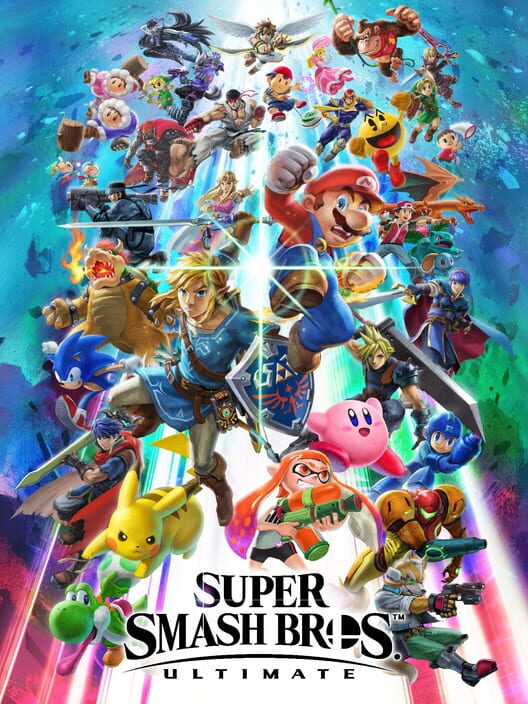
Super Smash Bros. Ultimate is a platform fighter for up to eight players in which characters from Nintendo games and third-party franchises fight to knock each other out of an arena. Each player has a percentage meter that increases as they take damage, representing the amount of knockback they take from attacks; the higher a character's percent, the easier it is to launch them into the air and out of the arena. Standard battles use one of three victory conditions: Timed, where players aim to earn the most KOs within a time limit; Stock, where each player or team has a set number of lives and aims to be the last player standing; and Stamina, in which the percentage meter is replaced with a measure of hit points that opponents try to reduce to zero to win. Players can adjust the rules to their liking and save them as presets for future matches.
Players have the option to enable various items to spawn at random during battle, which can be picked up and used in various ways to grant them an advantage; for instance, Poké Balls and Assist Trophies respectively summon Pokémon and other non-playable characters to assist the user in battle. In Timed matches, certain Assist Trophies can be attacked and defeated to earn points. Each character also possesses a powerful Final Smash attack, which can be performed either by obtaining a Smash Ball or by filling up a special meter, either of which can be toggled on and off. The base game features 103 different stages (plus one additional stage added in a free update), with additional stages being bundled alongside DLC fighters.
Most stages have dynamic elements and hazards that can be toggled on or off in the rules, and each stage has an alternative Battlefield and Omega form with standardized layouts. A new feature called Stage Morph allows players to select two stages that the game alternates between at certain intervals during a match. Other tweaks include new icons and gauges for character-specific abilities, such as Cloud's Limit gauge.
In addition to returning modes such as Classic, Special Smash, and Home-Run Contest, Ultimate adds new modes. These are Smashdown, where each character can only be played once; Squad Strike, where players battle in teams of either 3 or 5 characters; and Tourney, a tournament mode that allows up to 32 players to battle in playoff brackets.
Ultimate introduces the Spirits mechanic, replacing the collectible trophies from previous games. Each of these Spirits, based on characters from represented franchises, can be used to power up a fighter with unique abilities. Players mainly gain Spirits through pre-made challenges called "Spirit Battles" that represent the character the Spirit depicts, which are embodied by one or more of the game's fighters and other specific level effects. For example, the Spirit battle of Rayquaza, a flying dragon Pokémon, requires players to defeat a large version of Ridley with a similar color palette and wind effects.
Players are encouraged to strategically choose Spirits based on the level effects; in the same example, a player would need to equip a Spirit that provides wind resistance or immunity, or one that allows them to deal extra damage to a giant opponent. A separate mode called the Spirit Board presents a rotating set of Spirit battles for players to gain Spirits from. Spirits have a growth and evolution system, in which they can be leveled up to become more powerful or converted into Cores to summon new Spirits. Certain Spirits will also become an "enhanced" form upon reaching max level, but will return to level 1.
Nintendo offers limited-timed Spirit events in cross-promotion with other games and franchises, with the Spirits featured only available to collect during the event. Eventually, these Spirits make their way into general rotation and can be found on the Spirit Board. The local multiplayer mode also allows for the option to use Spirits.
==== World of Light ====
Ultimate features the return of Adventure Mode, which was previously absent in 3DS/Wii U. It is now integrated into the Spirits mode with a new story, World of Light, which prominently uses the game's Spirit mechanics. The mode's narrative begins with an evil entity, Galeem, destroying the Smash Bros. world, vaporizing almost all of the fighter characters and placing them under his imprisonment; only Kirby, due to his Warp Star, evades this attack.
Players explore the titular World of Light, a new world that Galeem created in the original world's place, to rescue captured fighters and Spirits -the remnants of other characters' physical forms- by completing marked Spirit Battles. Players can use regained allies and Spirits to overcome certain challenges on the map and defeat Galeem. However, after Galeem is defeated, a new enemy, Dharkon, emerges; after Dharkon's defeat, it wages war against Galeem. If just Galeem is defeated, Dharkon will engulf the world in darkness, but if just Dharkon is defeated, then Galeem will cover the universe with light.
However, by defeating an equal number of light and dark Spirits on the final map, players are able to challenge and defeat both of them, freeing the Spirits from their control.
The game supports local multiplayer, local wireless with other systems, and online play via Wi-Fi or LAN connections. By defeating players online, players earn tags which can be traded for in-game currency to buy new Spirits, music, and Mii Fighter costumes. The game is compatible with Joy-Con controllers, the Nintendo Switch Pro Controller, and GameCube controllers via a USB adapter. Like the previous entry, amiibo figurines can be used to create AI-controlled Figure Players, which can be trained to become stronger.
Shortly after the game's release, a service for the Nintendo Switch Online mobile app, known as "Smash World", was launched, which allows players to check their game statistics and share images and videos captured from the game to social media. Ultimate features over 900 music tracks
Development
Super Smash Bros. , the same studios that developed Super Smash Bros. for Nintendo 3DS and Wii U, for the Nintendo Switch, with series creator Masahiro Sakurai returning as game director. Unlike previous Super Smash Bros.
games, the team was not assembled from the ground up, which sped up preparation time. The project plan for the game was in the works by December 2015, when the DLC for 3DS and Wii U was in development, and finished after it was completed. Staff gathering was done soon afterward. The development period was shorter compared to previous entries in the series.
Hatena assisted with the development of some elements, and tri-Crescendo contributed to programming and design.
According to Sakurai, producing a Super Smash Bros. game for the Switch was the last request that former Nintendo president Satoru Iwata had given him before his death in 2015, and he wanted to make the game the best possible product he could to respect him. Sakurai sought to include every character from previous games, as to not disappoint fans. However, he knew this would be a complex problem for both development and licensing; it would also drastically increase the cost of development.
The return of Bandai and Sora made it easier for this to happen. Sakurai also wanted to adjust character abilities to speed up the game, although not to an extent that would alienate players unfamiliar with the series. Sakurai knew that Ultimate was a core game for Nintendo and that it had a dedicated player base that he did not want to disappoint, and believed that completing this goal was necessary to satisfy them. Sakurai was also faced with the decision to either create a completely new game system or build off of pre-existing ones; he chose to build off pre-existing ones because there would only be about a third of the characters he desired in the final game.
All the returning characters' abilities had to be re-balanced so they could work in Ultimate. Originally, gameplay would differ between the Switch's docked and handheld modes, but Sakurai scrapped this idea since the system's screen in handheld mode was better than he thought. Sakurai believed this would be the only Smash game to have the full roster of returning characters, calling the effort to include the characters, music, stage settings, and other elements as "unprecedented", and cautioned that future games in the series would likely be smaller in scope. However, he still wanted to add as many fighters as possible through DLC.
Voice lines recorded by David Hayter for Snake were re-used for Ultimate. Xander Mobus, who voiced Crazy Hand, Master Hand, and the announcer in Super Smash Bros. for Nintendo 3DS and Wii U, also made a return with new voice clips, in addition to reprising his role as Joker from Persona 5 when he was added as DLC. The addition of Ridley from Metroid as a playable character had been highly requested within the Super Smash Bros.
community for some time. In 2008, Sakurai stated that he knew Ridley was a high-demand character, but thought that he was "impossible" to add unless they were able to sacrifice the character's size for balancing purposes. So that Ridley could be included in the game, Sakurai studied the art of the character and redesigned him so he could stand upright. All characters were chosen at the beginning of development except for Incineroar, who had not been created yet; the team instead left a space open for a Sun and Moon Pokémon.
The Inklings' ink mechanic proved challenging to implement due to its interactions with environments.
The team built Ultimate from scratch with new assets and content. Localization manager Nate Bihldorff stated that the game significantly upgraded lighting effects and texture rendering from the game engine of the Wii U version. The World of Light mode was inspired by Brawl's (2008) Subspace Emissary, and Sakurai chose to start it with a cataclysmic event because he thought it would leave a greater impact on players. The team conceived the Spirits mechanic because they wanted to create an enjoyable single-player mode, but did not have enough resources to create character models.
While it did not let them tell stories for individual fighters or create new locations and rules, it let them use various characters and assets. One part of the team chose Spirits to include in the game and had to thoroughly research them; according to Sakurai, the Spirits mode was essential for using various franchises.
Like previous games in the series, Ultimate features several well-known video game music composers and arrangers providing a mix of original music and rearrangements of various tracks for the represented franchises, with over 1,000 tracks in total. New to Ultimate is the tying of tracks to franchises instead of individual stages, as well as the ability to create custom playlists to listen to outside the game when the Switch is in handheld mode. Sakurai stated that he began contacting composers over a year before release, providing them with a database of over a thousand suggested track ideas. In addition, he allowed them to submit their own personal favorites, with those choices being given priority for inclusion.
While Sakurai oversaw the process and preferred that the music retain the spirit of the original games, the direction of them was generally handled by the composers themselves. The main theme, "Lifelight", composed by Hideki Sakamoto, is the basis of most of the game's original music.
As with previous entries, Nintendo planned to offer new fighters through DLC; however, unlike with the 3DS and Wii U, where players could request which characters they wished to see in the game, Nintendo chose which characters they would add by November 2018. Like the previous title, additional Mii costumes were released as paid DLC, with certain costumes also adding new music tracks to the game. Sakurai believed that despite characters like Joker, the
Reception
Ultimate received "universal acclaim" from critics, according to the review aggregator platform Metacritic. Fellow review aggregator OpenCritic assessed that the game received "mighty" approval, being recommended by 97% of critics. Critics lauded the huge cast of characters and levels, new game modes, and combining of the best elements from its predecessors. com called it the best game in the series, praising its features which "brilliantly mix gargantuan content with nostalgia".
Bleacher Report hailed the game's colorful art style, faster gameplay, and unique stages. IGN praised the game's decision to bring back every character from the series as "ambitious and excellent". The game's massive soundtrack and portable music player were praised by The Verge.
However, the game's online mode received criticism for its technical performance and matchmaking. Many players found significant lag affecting their games, even when using wired connections over wireless, while the game's matchmaking features did not adhere to players' criteria, with players frequently playing matches with rule sets they did not choose. The matchmaking process was further criticized for making it difficult for friends to join matches over random players, and not allowing multiple local players to join in online matches. There had been so many complaints on Ultimate's subreddit that the administrators forwarded all complaints to a separate thread.
The lag and loading time issues are lessened on the Nintendo Switch 2, which is backwards compatible with Switch games such as Ultimate. The World of Light mode also received mixed reviews. While some found the single-player mode both accessible and challenging, others found the mode tedious and excessive.
In November 2018, Nintendo announced Ultimate was the most pre-ordered game for the Switch and in the series. The Association for UK Interactive Entertainment reported that Ultimate was the fastest-selling Switch and Super Smash Bros. game in the United Kingdom, with physical launch sales 302% higher than those for Super Smash Bros. 5% higher than those for Brawl.
2 million copies, outselling Pokémon: Let's Go, Pikachu! and Let's Go, Eevee! and The Legend of Zelda: Breath of the Wild in the region.
Within 11 days of its release, Ultimate had sold more than three million copies within the United States, making it the fastest-selling Switch game in the country. It was similarly the fastest-selling Switch game as well as the fastest-selling game for any Nintendo console in Europe based on the first 11-day sales. It was estimated that the game sold and shipped over five million copies within its first three days of release. Within three weeks, Ultimate became the fifth best-selling Switch game in the United Kingdom, surpassing the sales of Splatoon 2.
08 million copies worldwide. Ultimate was also Nintendo's fastest-selling game of all time until being surpassed by Pokémon Sword and Shield in 2019. 10 million copies worldwide, making it the best-selling fighting game of all time, surpassing the record of Street Fighter II, and became the third-best-selling Nintendo Switch game, only behind Animal Crossing: New Horizons and Mario Kart 8 Deluxe. 24 million.
The game won the award for "Best Nintendo Switch Game", "Best Fighting Game", and "Best Multiplayer Game" in IGN's Best of 2018 Awards, whereas its other nominations were for "Game of the Year" and "Best Video Game Music".