The articlegameplay, story, development, reception
Gameplay
Soulcalibur IV features Story, Arcade, Training, and Museum modes. A new mode, Tower of Lost Souls, requires players to win battles to gain rewards. The game runs in HD resolution with 5.1 channel surround sound on both platforms.
The Character Creation mode from Soulcalibur III returns in Soulcalibur IV. However, instead of including original weapon styles for use with certain classes of fighters, Soulcalibur IV allows players to choose which character from the series they would like their created character to mimic. This differs from Soulcalibur III, which featured many unique styles such as "Grieve Edge". The styles of Algol, the bonus characters, and the Star Wars guest characters cannot be used by player-created characters.
A wide array of new equipment pieces are available for use in Soulcalibur IV's Character Creation mode, and new options include a broader range of character voices and the ability to adjust their pitch. Players may also modify a character's general physique and muscularity.
Additionally, equipped items now affect a character's statistics. Armor, weapons, and accessories may increase health, attack, or defense; they may also grant skill points that allow the character to equip special traits affecting playstyle. These traits may include automatically triggered guard impacts, the ability to inflict damage on a blocking opponent, or even a statistic increase based on parameters such as an opponent's alignment or gender. Standard characters can also be modified in this manner, albeit only modestly, allowing custom costumes and skill sets to be used in Special VS.
mode. Custom characters may still be utilized in Standard VS. mode but without any special abilities gained through equipment or weapon choice. One profile is permitted for Offline VS.
mode, meaning that only one profile's created characters can be loaded at any given time.
Multi-fighter battles in Soulcalibur IV employ a different structure from its predecessors, known as Active Matching Battle (AMB). Similar to the tag system of games such as The King of Fighters 2003, the AMB system allows players to switch to other members of their fighter party mid-battle. Instead of starting a new round for each defeated opponent, new opponents enter the battle immediately after a K.O., with the exception of certain combatants. Matches utilizing the AMB system only appear in the Story and Tower of Lost Souls modes.
Soulcalibur IV introduces an all-new Critical Finish system. Next to a player's health meter is a colored gem known as the Soul Gauge. The gem changes color when the player blocks an attack or has their own attack blocked by a Guard Impact. The color transitions from blue to green, then to red, and eventually flashes red.
The player's Soul Gauge regenerates if they successfully hit the opponent with an attack, guard, or otherwise. If a character manages to deplete the opponent's Soul Gauge, the enemy suffers a piece of armor destruction (characters now display permanent visual damage, such as broken and torn clothing) and experiences a brief stun during which the character can execute a powerful Critical Finish move by pressing all four face buttons simultaneously. Each character has a unique Critical Finish move. Namco developed the Soul Gauge to mitigate the advantages of constant guarding, thus enhancing the game's tempo and making matches more offensive.
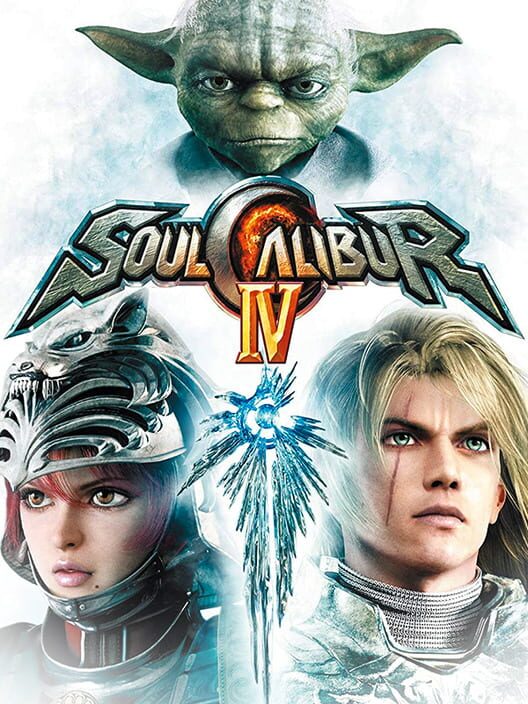
The Star Wars guest characters, Darth Vader, Yoda, and the Apprentice, utilize unique attacks powered by the Force. Darth Vader can employ Force-based blasts, punches, and chokes; Yoda can use the Force to propel himself into the air for intricate aerial attacks; and finally, the Apprentice is capable of wielding Force lightning and other dark-side abilities. These moves consume a special Force Meter, which gradually recharges when not in use. If the Force Meter is depleted, the player momentarily loses control of the character.
For the first time in the series, Soulcalibur IV includes an online multiplayer option. The versus modes available in online battles are Standard VS (for classic matches) and Special VS (for customized characters). Created characters are playable in the online multiplayer mode. A player's wins and losses are recorded and used to establish a ranking level that reflects their online skill.
Story
The story of Soulcalibur IV, conveyed through in-game written profiles and cutscenes, centers around the ancient king Algol, his tower, and his connection to the origin of the spirit sword known as Soulcalibur. Each character's motivations and relationships with others are explored in a mode called Chain of Souls. As is customary, none of the individual endings from the previous game are considered canonical events, and most characters' motivations from that game remain unresolved. However, a small number of characters experienced significant events related to the universal events of Soulcalibur III.
Siegfried has died and been resurrected by the Soulcalibur sword. Sophitia's daughter Pyrrha has been kidnapped by Tira and malfested by Soul Edge, leaving Sophitia to fight for the side of evil in defense of her now-corrupted daughter. Tira is also suffering from a split personality disorder. Most characters are still driven by a desire to either obtain, destroy, or defend one or both of the legendary swords now wielded by Siegfried and Nightmare, with most facing Algol as the final boss of Story mode.
All characters feature animated ending cutscenes.
Reception
Soulcalibur IV received mostly positive reviews from media outlets. In 2014, six years after its initial release, it held an average Metacritic score of 85 for both its PlayStation 3 and Xbox 360 versions. The game was praised for its polished graphics, deep Character Creation mode, and long-awaited online play capability. Reviewers noted that the gameplay was accessible for newcomers and beginners while still offering plenty of depth and technicality for veterans and experienced players, including an abundance of single-player challenges in Tower of Lost Souls mode. The music was also praised, and Gaming Revolution summarized the game as "some of the best weapons-based fighting action in town".
Certain criticisms were directed towards the guest characters from the Star Wars franchise, with several critics maintaining that their presence felt unnatural and that Yoda and The Apprentice, in particular, were "broken" (a reference to a perceived imbalance in fighting games that gives some characters a vastly unfair advantage over others) and "absurd", respectively. Yoda's smaller size (and thus his immunity to grab attacks) was mentioned as one design issue. At the same time, Yoda's short range and low damage output were deemed problematic, making him both overpowered and underpowered simultaneously.
Soulcalibur IV topped the UK sales charts for several weeks on both the PS3 and Xbox 360. As of March 31, 2009, the game had sold 2.3 million copies worldwide.
IGN Best of 2008: Best Xbox 360 Fighting Game
Spike TV Video Game Awards: Best Fighting Game
IGN's Top 20 Most Popular Xbox 360 Games of 2008: 17th
Virgin Media's Top 20 Beat 'Em-Ups of All Time (2009): sixth
During the 12th Annual Interactive Achievement Awards, the Academy of Interactive Arts & Sciences nominated Soulcalibur IV for the "Fighting Game of the Year". In 2010, the game was included as one of the titles in the book 1001 Video Games You Must Play Before You Die.