The articlegameplay, story, development, reception
Gameplay
One of the biggest innovations introduced by Soulcalibur to the gameplay system of its predecessor, Soul Edge, is the eight-way run. Previous 3D fighters had only limited movement along the third axis, with sidesteps and rolls providing useful but unsustained lateral movement. In Soulcalibur, simply holding down a joystick direction causes the character to move in that direction, giving the player a sense of freedom and deepening the strategy of the game.
Soulcalibur also features "forgiving buffering", allowing players to enter an input for one move before their characters have finished recovering from their previous move, which makes executing a quick succession of moves easier (other fighting games such as the Tekken and Virtua Fighter series have relatively strict buffering requirements, meaning expert timing is required to pull off many combinations, but Soulcalibur features much more lenient timing to successfully execute a buffer). Finally, the Guard Impact offensive blocking maneuver shown in Soul Edge has been given a deeper range of techniques, allowing players to push back or redirect attacks past themselves as well as swatting away an opponent's weapon to stun them.
Story
The mystical sword of the legends, the "Soul Edge", ended up in the hands of the dreaded pirate Cervantes de Leon of Spain. For the next 25 years he stayed dormant on the remnants of a Spanish port town taking the souls of those who reached him during their search for the sword. Like Soul Edge this game begins in the year 1583. The reign of terror of Cervantes was soon to start but through the joined efforts of Greek divine warrior Sophitia Alexandra and Japanese ninja Taki he was stopped and killed with one of the twin Soul Edge blades shattered in the process.
As it was about to tear itself apart a young German knight Siegfried Schtauffen approached the port town and battled Cervantes whose corpse had been momentarily reanimated through the will of the Soul Edge. After emerging victorious Siegfried's attention turned to the sword. At the moment he took the hilt of the cursed blade Soul Edge released a bright column of light into the sky. This was known as the "Evil Seed" which was bound to bring calamity and death in its wake.
Three years after those events, Soul Edge uses Siegfried as its host, and now Siegfried is Nightmare, a knight wearing azure armor and sporting a hideously deformed right arm. Europe plunges into a vortex of slaughters as he and his followers claim souls to strengthen the blade in its weakened state. Unknown to them a group of warriors met on their journey to stop Soul Edge and with them three sacred weapons join once again.
Development
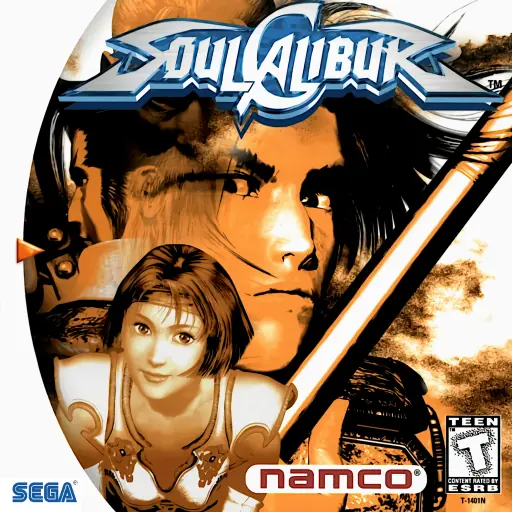
After releasing Soul Edge, Namco took some time to evaluate what had made the game successful before jumping into the development of its sequel. Producer Hiroaki Yotoriyama decided to give the sequel a new name instead of just calling it Soul Edge 2 in order to have a fresh start and take the series in a new direction. The name Soulcalibur is a portmanteau of the word soul (as in Soul Edge) and King Arthur's sword Excalibur (ultimately, the name would be used within the game's universe for the holy weapon which would counteract Soul Edge's evil). Inspired by an internal Namco prototype featuring a character able to run openly in a field, the eight-way run system was implemented.
Upon application, the development team was surprised at how well it meshed with their fighting system and decided to build the rest of the game around it. During development they worked closely with Namco's Tekken development team, sharing ideas and research. Yotoriyama felt that with that cooperation and partnership, they were able to develop "the greatest weapon-based fighting action game in the world".
Yotoriyama has described the game's concept as expressing "fun and diversity in weapon combat", citing the contrast in how one weapon would affect gameplay compared to another and how they would react to each other upon clashing. Each character's fighting style was designed to revolve around their weapon, though he noted that because of the differences they experienced difficulty in balancing the gameplay. He described the availability of movement in comparison to Tekken 3 as a large contrast between the two series and more tactical and emphasized how it interacted with the game's "ring out" feature. Each character in Soulcalibur was designed around the idea that they could be viewed as a real person could, and to this end, motion creator Masataka Ishiguro emphasized the arm and leg movements for each character in relation to their weapon, wanting players to "feel the individual motions and the realism within the game"
It had been announced in January as "New Weapon Fighting Game" and a test version was shown at E3 in May. The team for the arcade version of Soulcalibur consisted of roughly sixty people working on Namco's System 12 hardware, while the team developing the home port was reduced to about forty. Given a deadline of seven months to coincide with the North American launch of the Dreamcast, the transition was difficult for the team, due to the differences in hardware. However, due to the similar capabilities and limits of each system, content was left intact between the two versions, with Yotoriyama feeling that the team was "obsessed" with giving their best effort for the port.
The biggest technological change to the Dreamcast port was to render all of the game's stages in full 3D polygons, whereas the far backgrounds in the arcade original were flat, two-dimensional images. Additional content was also added to the game to ensure replay value, based on researching other fighting games marketed at the time. Many of the team's ideas that they were unable to incorporate into the port were eventually used for later games in the series.
Reception
In Japan, Game Machine listed Soulcalibur as the third most successful arcade game of August 1998.
3 million by 2002. It is the second biggest selling game on the system. In Europe, Sega credited Soulcalibur as one of the best-selling games supporting the Dreamcast's early commercial performance, after the console surpassed 500,000 sales in the region within two months of its launch. French publication Gamekult retrospectively described Soulcalibur as the "system-seller" the Dreamcast had needed, noting that contemporary reviews frequently presented the game as a reason to purchase the console.
French magazine Joypad similarly stated that the game strongly justified purchasing a Dreamcast. In Germany, the Dreamcast version topped Media Control's Dreamcast sales chart in February 2000. In Spain, it was the second best-selling Dreamcast game through December 1, 1999, and subsequently topped a monthly sales chart based on data from retailer Centro Mail. Hobby Consolas later credited the game with helping boost Dreamcast sales in the country.
The game won the 1999 E3 Game Critics Award for "Best Fighting Game". At the 3rd Annual Interactive Achievement Awards, the Academy of Interactive Arts & Sciences awarded Soulcalibur with "Console Game of the Year" and "Console Fighting Game of the Year" (along with a nomination for "Game of the Year").
Blake Fischer reviewed the Dreamcast version of the game for Next Generation, rating it five stars out of five, and stated that "Beautiful, deep, and far more compelling than any 3D fighter in recent memory, Soul Calibur is reason enough to own a Dreamcast."
The game received universal critical acclaim, garnering perfect 10/10 scores from GameSpot and IGN, and was for nearly a decade the last game to receive a perfect rating from IGN, until the release of Grand Theft Auto IV in 2008. It is the second game ever to get a perfect 40/40 from Japanese gaming magazine Famitsu (the first being The Legend of Zelda: Ocarina of Time). As of 2017, game review aggregator website GameRankings has the Dreamcast version ranked as the seventh best-reviewed game of all time, as well as being the highest-scoring title in the fighting game genre.
The Dreamcast version of Soulcalibur also holds a score of 98, making it one of the highest-rated video games of all time across all consoles and platforms, on Metacritic.
Soulcalibur was named as the number one best Dreamcast game by Game Informer. In 2009, IGN ranked Soulcalibur as the fifth best Dreamcast game, while ScrewAttack ranked it sixth. GamesRadar named Soulcalibur the best Dreamcast game of all time on their list. In 2005, GameSpot ranked Soulcalibur as the sixth best launch title yet, calling it "not only one of the greatest launch games or one of the greatest fighters, but one of the greatest games ever.
Period." In 2022, Cultured Vultures ranked Soulcalibur as the best Dreamcast game of all time.
In addition, it is often considered to be one of the greatest games on all platforms, including:
Game Informer (2001): "The Top 100 Games of All Time" (74th place).
IGN (2003): "Top 100 Games" (38th place).
Retro Gamer (2004): "Top 100 Games" (75th place).
IGN (2005): "Top 100 Games" (43rd place).
IGN (2006): "Readers' Choice The Top 100 Games Ever" (sixth place).
Electronic Gaming Monthly (2006): "The Greatest 200 Videogames of Their Time" (22nd place).
ScrewAttack (2007): "Top Ten Fighting Games" (seventh place).
Cinema Blend (2008): "Top 10 Best Fighting Games of All Time" (fourth place).
UGO.com (2010): "Top 25 Fighting Games of All Time" (second place).
Complex (2011): "The 50 Best Fighting Games of All Time" (fifth place).
Game Informer (2019): "30 best fighting game of all time" (third place)