Ludography
78/100
Players42 ratings
70/100
Critics1 review

Where to get it

BS Special Tee Shot cover

1994 · Remake · HAL Laboratory · Puzzle · Sports

BS Special Tee Shot

Nintendo exclusiveRemake

Kirby's Dream Course is a 1994 miniature golf video game developed by HAL Laboratory and Nintendo EAD and published by Nintendo for the Super Nintendo Entertainment System (SNES).

Also known as
Kirby's Dream Course · Kirby Ball · Kirby Bowl
Released
21 September 1994
Platforms
SNESWiiWii UNintendo 3DS
Genres
PuzzleSports
Developers
HAL Laboratory
Publishers
Nintendo
Modes
MultiplayerSingle-player
Perspective
Bird view / IsometricSide view
Themes
ActionFantasy
Country
Japan
Age ratings
PEGI 3CERO AGRAC ALLACB GUSK 0CLASS_IND LESRB E
Languages
English

About

Kirby's Dream Course is a 1994 miniature golf video game developed by HAL Laboratory and Nintendo EAD and published by Nintendo for the Super Nintendo Entertainment System (SNES). A spin-off of the Kirby series and the first released for the SNES, players control the pink spherical character Kirby through a series of courses by launching him towards the goal hole at the end. Kirby can hit enemies to collect power-ups that grant him unique abilities, such as those that allow him to destroy certain obstacles or fly around the level.

HAL Laboratory originally designed Dream Course as a standalone game called Special Tee Shot. Though it was previewed in several magazines and displayed on the packaging for the console, HAL replaced the game's original characters with those from the Kirby series following its popularity on the Game Boy. Special Tee Shot was later released for the Satellaview peripheral in Japan. Dream Course received favorable reviews, both at release and retrospectively, for its unique design and absurdity.

›Story

Scan the course and check out the obstacles ahead. Get ready for the most surprising game play imaginable in Kirby's battle against King Dedede!

This checkboard challenge brings outrageous hazards and bizarre surfaces. Warp panels instantly transport you to new and exciting challenges. Conveyer belts provide higher levels of adventure. Turntables take the action in a whole new direction.

Gordo, Kracko, Whispy Woods and a cast of zany characters await you. Gain special powers including Fireball, Freeze, Spark and Parasol. Transform your enemies into stars revealing eight hidden cups of each wildly different course. Control the force and angle of your shot and sink Kirby for a hole-in-one!

Keywords

  • golf
  • 2d
  • mascot
  • ufo
  • cute
  • digital distribution
  • platform exclusive
  • nintendo power
  • protagonist's name in the title
  • virtual console
  • melee
  • kirby

Media

The articlegameplay, story, development, reception

Gameplay

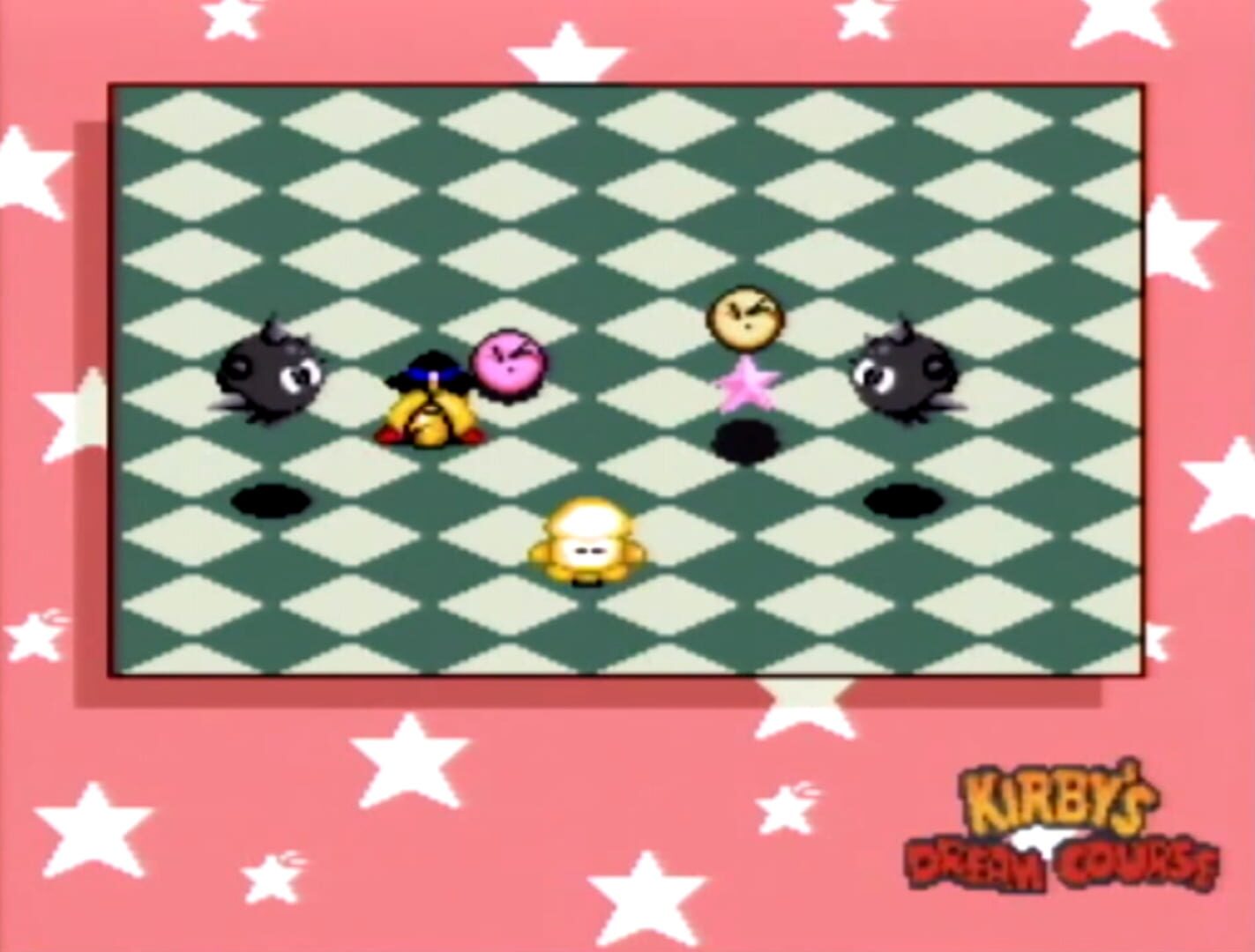
Kirby's Dream Course is a mini golf video game set at an isometric perspective, similar to games such as Marble Madness (1984). Its plot involves Kirby's nemesis King Dedede stealing all of the stars in the night sky. Kirby sets out to stop Dedede and return the stars to the sky.

In single-player, players maneuver Kirby around a miniature golf course by deflecting him towards a specific area of the playfield within a limited number of strokes. Players must set the power, angle, and spin to connect with various enemies found throughout the levels, claiming a star for each enemy defeated. When only one enemy remains, that enemy transforms into the goal hole. Kirby can knock himself into certain enemies to acquire a Copy ability, which can be used to clear courses in a faster period of time. These Copy abilities include Kirby turning into a tornado, a sparking ball that can destroy certain obstacles, and a UFO that allows Kirby to float and move at will for a short time.

Development

Kirby's Dream Course was developed by HAL Laboratory and Nintendo EAD and published by Nintendo for the Super Nintendo Entertainment System (SNES). HAL originally designed the game as a standalone title called Special Tee Shot in 1992, which featured its own original characters and art assets. Though it received several previews from magazines and was displayed prominently on the packaging for the console, the company shelved the project following the success of its Kirby series on the Game Boy. HAL later reworked Special Tee Shot into a Kirby game by replacing many of the original characters with those from the Kirby series, and implementing several mechanics to make it fit into the Kirby universe, such as the power-up system.

While Kirby was always intended to be pink, Shigeru Miyamoto assumed during development of Kirby's Dream Land that Kirby was yellow, as there was no color artwork of Kirby available at the time. In reference to this, the developers of Kirby's Dream Course repurposed Miyamoto's color choice as the second player's character, a yellow version of Kirby nicknamed "Keeby". The character's name is a portmanteau of 黄色 kīro "yellow" and カービィ Kābī "Kirby". Following the appearance of an unnamed yellow Kirby in Kirby 64: The Crystal Shards (2000), a yellow color palette became a recurring colorization for additional players playing as a Kirby in the Kirby and Super Smash Bros.

Reception

Kirby's Dream Course received praise for its wacky nature and innovation. GamePro writer Scary Larry claimed it was just as refined and fun to play as earlier games in the Kirby series. A writer for Next Generation found its mini golf-inspired gameplay unique compared to other games, as did a reviewer from Electronic Gaming Monthly. Next Generation and Larry also highlighted Dream Course's complexity, which was uncommon for a golf game at the time.

The game's colorful visuals were also praised for their offbeat design and sense of humor. Electronic Gaming Monthly noted that the game's controls required time getting used to; Larry added the accuracy of the player's shots were sometimes questionable and not well-refined. Tom Guise of Computer and Video Games believed its originality made it one of the best SNES games, which Electronic Gaming Monthly agreed with. Javier Abad, a reviewer for Nintendo Acción, commented on the game's difference in design from other games in the series, but felt Kirby fans would enjoy it for the controls and graphical style.

Releases by platformdates and regions as published

Releases by platform
PlatformReleasedRegions
SNES21 September 1994Japan · North America 1 February 1995 · Brazil 1 May 1995 · Europe 24 August 1995
Wii24 April 2007Japan · Europe 29 June 2007 · Australia 29 June 2007 · North America 23 July 2007 · Korea 24 February 2009
Wii UDigital Compatibility Release8 May 2013Japan · Europe 23 May 2013 · North America 23 May 2013
Nintendo 3DS9 June 2016Europe · North America 27 July 2016

Title IDsone per regional release, with its latest update

Title ids and disc serials by release
PlatformTitle IDRegionLatest update
SNESSHVC-CGJapan—

Decompilations and portscommunity projects that rebuild or port the game

Editions and related releases

Included in
Super NES Classic Edition
Followed by
Kirby's Dream Land 2
Follows
Kirby's Pinball Land
Part of
Special Tee Shot
Remake of
Special Tee Shot

Games like this

Collections2 collections

Platform libraries

Development status

Description adapted from its source, CC BY-SA 4.0.