
The articlegameplay, story, development, reception
Gameplay
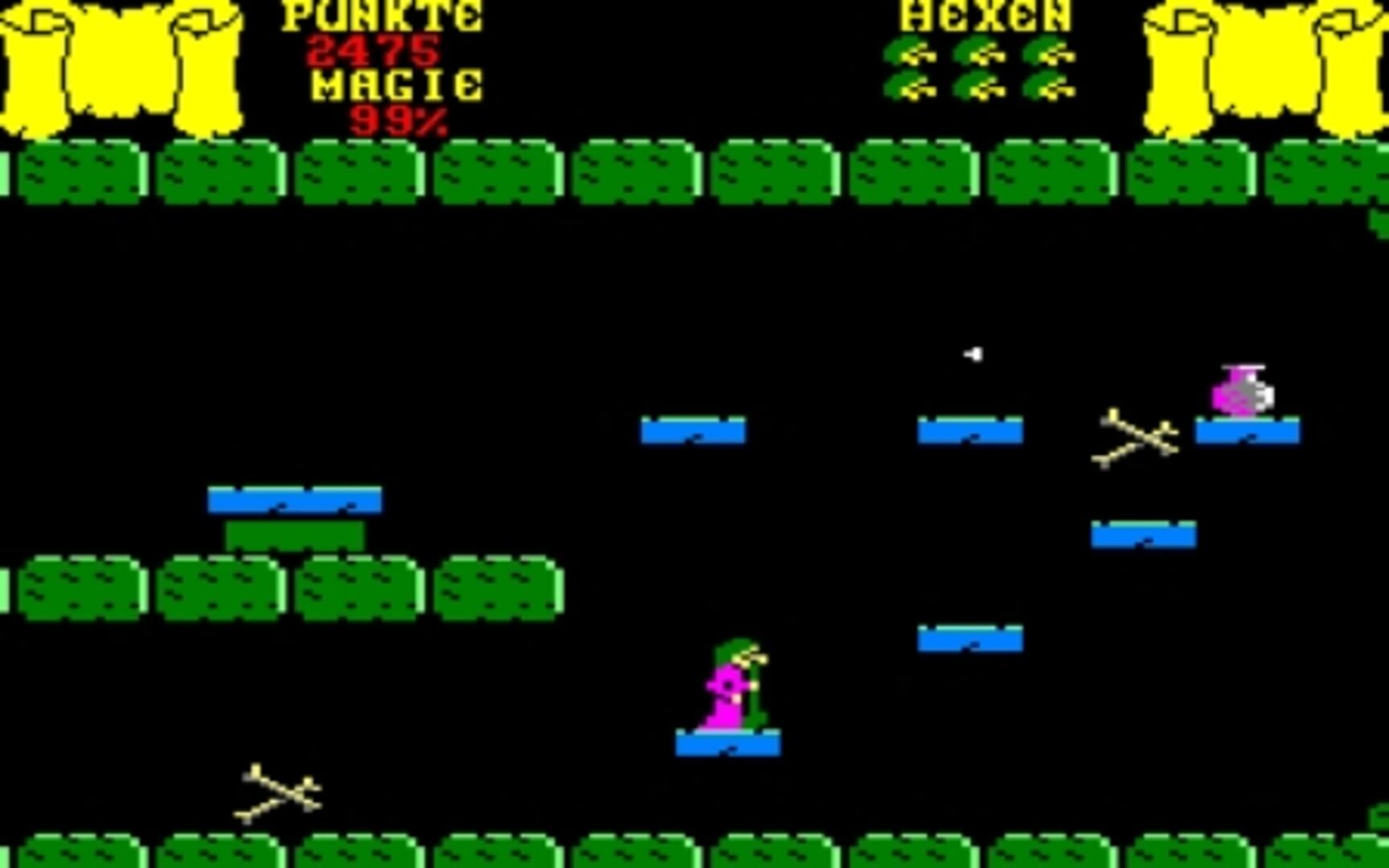
Cauldron is divided into two modes of play: shooting while flying and jumping along platforms. The player navigates the witch protagonist through a 2D game world from a side-view perspective. Areas set on the surface feature the witch flying on a broomstick whereas underground segments require her to run and jump in caverns. The game begins in the witch's cottage, where she keeps six parchments that can combine into a spell. The objective is to collect six ingredients—each one corresponds to a parchment—and return them to the cottage in order to complete the spell necessary to defeat the antagonist, the Pumpking.
The game world includes forest, mountains, and ocean terrains. While traversing the world, the witch encounters Halloween-themed enemies, such as pumpkins, ghosts, skulls, and bats, as well as creatures, such as sharks and seagulls. In the flying segments, the player must search for randomly scattered coloured keys to access underground areas that contain the six ingredients. While flying, the witch moves with inertia when changing direction, similar to the 1981 arcade shooting game Defender.
Development
Following The Evil Dead's release in 1984, Palace Software hired Steve Brown to design games and produce art as well as Stan Schembri to assist Richard Leinfellner with programming. Cauldron began development as a game based on the 1978 slasher film Halloween. Palace co-founder Pete Stone viewed video games as an extension of films and wanted to follow The Evil Dead with another horror movie adaptation.
After the company obtained Halloween's video game rights, Brown was assigned the project. Unable to develop a concept he was happy with, Brown took the game in a new direction. Inspired by the Halloween holiday, he envisioned a game featuring witches and pumpkins. Stuart Hunt of Retro Gamer, however, attributed the switch to Mary Whitehouse's campaign against violent horror films in the 1980s.
Reception
Cauldron was well-received by the video game press, who focused on the graphical quality and game design. Tony Takoushi of Computer and Video Games described the game as a "quality arcade-adventure" and called the graphics stunning. Reviewers from Crash magazine praised the animation and detail of the graphics, as well as the gameplay. 64's reviewers—Julian Rignall, Bob Wade, and Gary Penn—echoed similar statements about the graphics.
The group complimented the gameplay, specifically the adventure aspects, and considered the large game world a positive component. A Computer Gamer reviewer praised the flying portions of the game, calling the gameplay enjoyable. While he praised the platforming portions, the reviewer commented that design flaws made the game more difficult than it should have been. Clare Edgeley of Sinclair User praised the graphical quality of the ZX Spectrum version but commented that the colours occasionally overlap and the screen flickers.
Legacy
Following the success of Cauldron, Palace released a direct sequel, Cauldron II: The Pumpkin Strikes Back, in 1986. The game is set after the events of the first game and features a bouncing pumpkin that survived the witch's ascension to power. Players navigate the pumpkin around a castle in search of the Witch Queen to enact revenge. The commercial success of the two Cauldron games prompted Palace to give Brown more creative freedom for his next project, Barbarian: The Ultimate Warrior.
After Palace Group sold Palace Software to Titus Software in 1991, Titus released Super Cauldron in 1992 on MS-DOS personal computers. It was later released in 1993 on Amiga, Atari ST, and Amstrad CPC.


