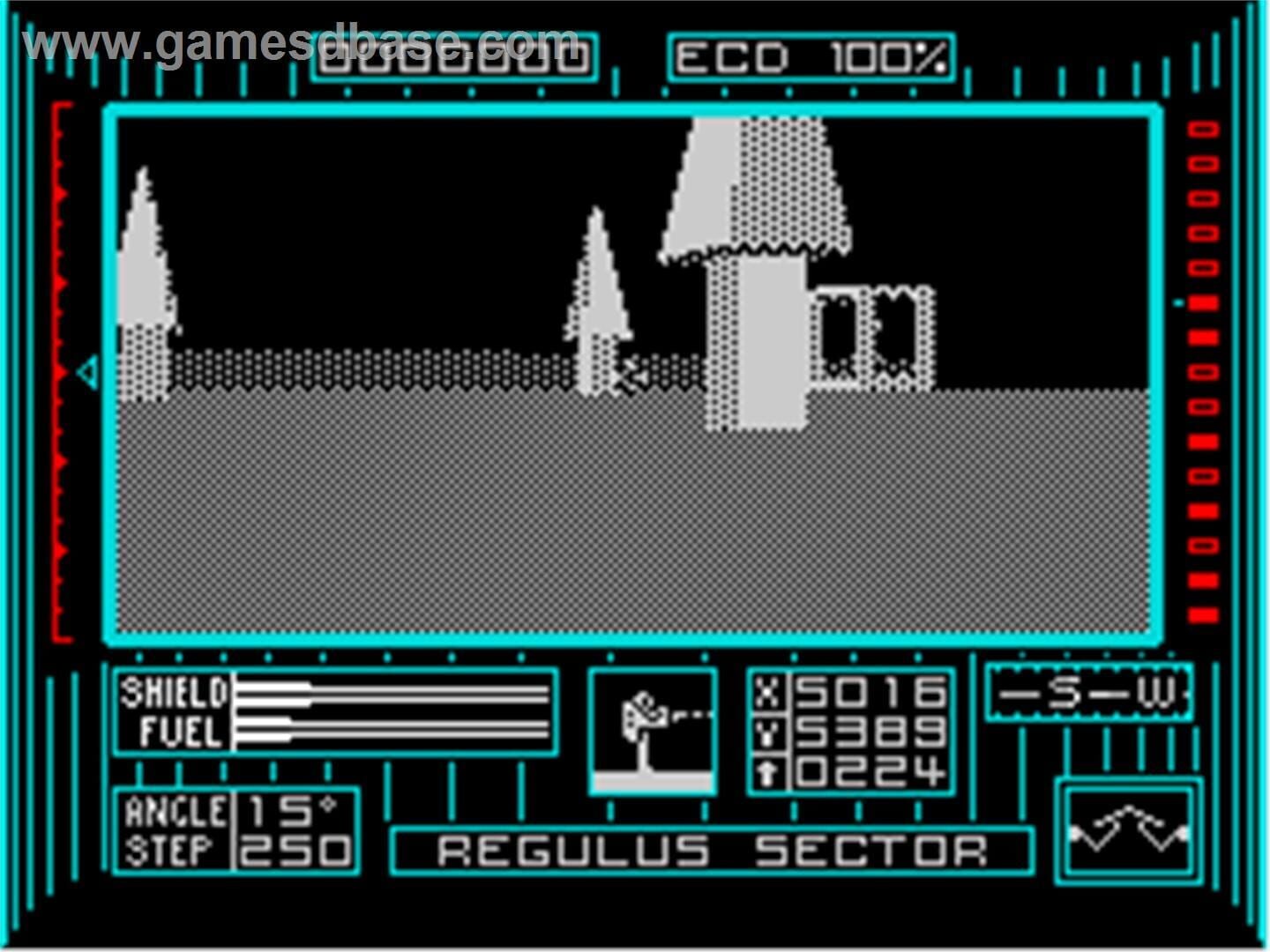

1988 · Incentive Software · Action · Adventure
Dark Side
The game is set on the alien moon Tricuspid orbiting the planet Evath. Terrorists (the Ketars, the villains of the first game Driller) hijacked the moon's facilities and built Zephyr One, an immense beam weapon on the moon's dark side with the purpose of destroying Evath. The player is a government agent, sent secretly to the moon's surface with the mission of deactivating the weapon before it becomes fully charged. This is accomplished by destroying a power network in the form of ECD (Energy Collection Device) columns, dotted around the moon and connected with power lines all the way to the beam weapon.
- Released
- 1988
- Platforms
- AmigaAmstrad CPCAtari STAtari ST/STECommodore 64Commodore C64/128/MAXMS-DOSZX Spectrum
- Genres
- ActionAdventureFirst-person shooterPuzzleShooter
- Developers
- Incentive SoftwareMajor Developments
- Publishers
- Spotlight SoftwareMicro StatusIncentive Software
- Modes
- Single-player
- Perspective
- First person
- Themes
- ActionScience fiction
- Engine
- Freescape
- Country
- United Kingdom
About
Dark Side is a 1988 video game published by Incentive Software for the Amiga, Atari ST, Amstrad CPC, Commodore 64, IBM PC compatibles, ZX Spectrum, and Sharp MZ-800. The game is a sequel to Driller, set in the Evath system but this time on Evath's second moon Tricuspid.
Keywords
- 3d
Media
The articlegameplay, story, development, reception
Gameplay
To complete the mission, the player has an arsenal of beam weapons mounted on a jetpack-equipped pressure suit. The aim is to destroy all ECDs in a specific order and avoid capture or death by the traps left by the terrorists. ECDs are connected to power lines and can only be destroyed when all preceding ECDs have been deactivated, otherwise they will instantly regenerate. The player has a limited amount of time available to complete the game, based on the energy accumulated in Zephyr One.
When the weapon is fully charged, the beam is fired, destroying Evath, and the game ends. As the player destroys ECDs, the charge accumulation rate is reduced, allowing more time for the player to complete the mission.
Story
The game is set on the alien moon Tricuspid orbiting the planet Evath. Terrorists (the Ketars, the villains of the previous game Driller) hijacked the moon's facilities and built Zephyr One, an immense beam weapon on the moon's dark side with the purpose of destroying Evath. The player is a government agent, sent secretly to the moon's surface with the mission of deactivating the weapon before it becomes fully charged. This is accomplished by destroying a power network in the form of ECD (Energy Collection Device) columns, dotted around the moon and connected with power lines all the way to the beam weapon.
Development
Dark Side was the second game to use the Freescape engine, which allowed the production of full three-dimensional environments using filled polygons in which the player could move around freely. It also gave the player the ability to look up and down, as well as rotate left and right, something which was rare amongst 3D games of the time. The same engine was used for Total Eclipse, The Sphinx Jinx, Castle Master and Castle Master II: The Crypt.
Releases by platformdates and regions as published
Games like this
 64
Necromunda: Hired Gun
2021 · PlayStation 4, PlayStation 5 +3
Adventure · First-person shooter

The Eidolon
1985 · Amstrad CPC, Apple II +5
Adventure · First-person shooter

Nanosaur
1998 · Linux, Windows +1
Adventure · Shooter

Nerf Legends
2021 · Nintendo Switch, PlayStation 4 +4
Adventure · Shooter
 Xbox exclusive
Ugo Volt
2011 · Windows, Xbox 360
Adventure · First-person shooter
 60
Space Hulk: Deathwing
2016 · PlayStation 4, Windows +1
Adventure · First-person shooter
 Nintendo exclusive90
Space Marshals
2015 · Android, Nintendo Switch +1
Action · Adventure
 PlayStation exclusive
Terracon
2000 · PlayStation
Adventure · Shooter
Collections4 collections
Platform libraries
- Amstrad CPC games
- Atari ST gamesCommercial games
- ZX Spectrum games
Genres
Description adapted from its source, CC BY-SA 4.0.