
The articlegameplay, story, development, reception
Gameplay
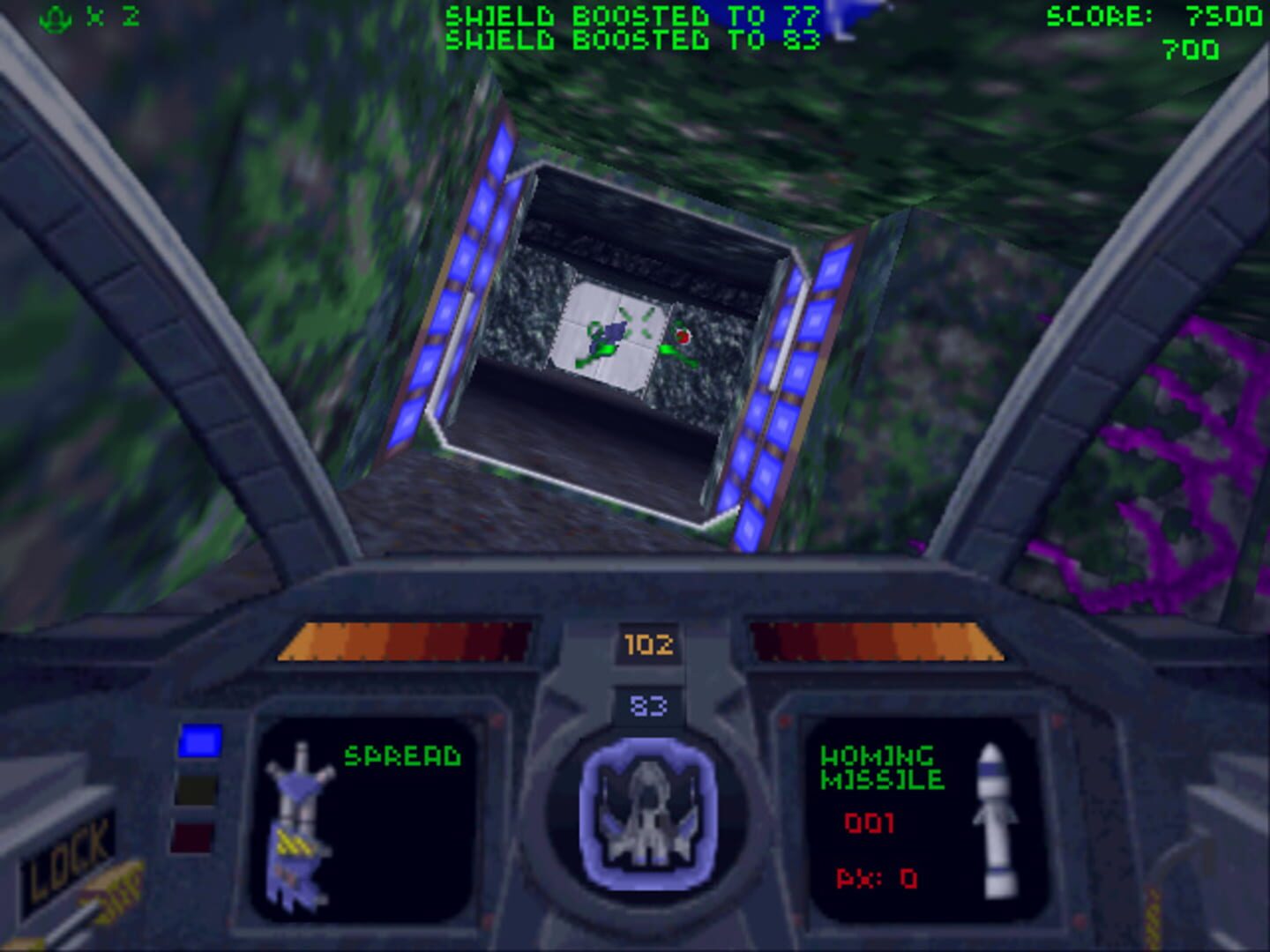
Descent is a first-person shooter and shoot 'em up game wherein the player pilots a spaceship through labyrinthine mines while fighting virus-infected robots, using the ship's armaments. They must find and blow up each mine's reactor core, triggering a countdown before the reactor meltdown that will destroy the mine and the player if they fail to reach the exit, which was supposedly inspired by the Millennium Falcon's attack on the Second Death Star in Return of the Jedi. The exit door is always open after the blowing up of the reactor and upon the mine meltdown countdown. However, for two levels, the reactor core is replaced with a boss robot.
To obtain access to the reactor, the player must collect one or a combination of three colored access keys for each level. As a secondary objective, the player can also choose to rescue PTMC (Post Terran Mining Corporation) workers taken hostage by infected robots. Points are received for defeating robots, rescuing hostages, blowing up the reactor or defeating the boss robot, and escaping the mine before its self-destruction; accumulating enough points will reward the player with an extra life (see below). If the player is too late to escape the mine meltdown, the player loses a life and all accumulated powerups while any embarked hostages are killed, causing the player to begin the next level with only the laser level reset to level one and the default number of concussion missiles for the difficulty level, and therefore, the player receives no bonus scores at the end of the mine.
Story
Descent is set in 2169. The story begins with a briefing between PTMC executive S. Dravis and the player's character, PTMC's best "Material Defender", who is hired on a mercenary basis to eliminate the threat of a mysterious alien computer virus infecting the machines and robots used for off-world mining operations.
The PTMC developed numerous mines in the Solar System's planets and moons for a variety of uses, including resource extraction, science research, and military installations. Prior to entering a mine, the player receives an intelligence briefing upon the robots used there, however the computer virus has resulted in some existing robots either modified considerably or even new robots being produced that PTMC is unaware about. The player starts with the mines on the Moon and later shift to Venus and to Mercury, where a boss robot has to be destroyed. Afterward, the mines progress further away from the Sun, as the player visits Mars, then the moons of Jupiter, Saturn, Uranus, Neptune, and eventually to Pluto and its moon Charon. The player accesses the three secret levels located in the asteroid belt using alternative exit doors hidden in specific levels.
Development
Descent was co-created by programmers Mike Kulas and Matt Toschlog. It has origins as far back as 1986, when Toschlog first joined the gaming industry at Sublogic, where he also first met Kulas. There, the pair worked on various simulation titles from Flight Simulator 2 to Jet. Toschlog left the company in 1988 for Looking Glass, where he worked with Ned Lerner to develop Car and Driver.
Kulas joined the company in 1990 to develop utilities for Car and Driver. The two had devised an idea of an indoor flight simulator that used shaded polygons. After working on Ultima Underworld however, they realized they could add textures to the polygons for a spectacular effect. By April 1993, they finished a two-page sketch for what would become Descent.
Reception
Customer reception of the shareware version of Descent was very positive, with players praising the fully 3D environment and commentators noting perceived "loyalty and goodwill" that both Parallax and Interplay fostered. However, it also garnered player complaints about a technical bug that would recharge each robot's shields whenever the player ship was destroyed (the problem was exacerbated on the last level of the shareware, where the power reactor is replaced with a boss and the gameplay thus becomes extremely difficult). It also received complaints for lacking the ability to save in-game, instead saving the player's progress between levels. Parallax recognized the bug and the popularity of the save feature, so they released patches to address the issues.
Mark Burgess of PC Zone called it one of the best shoot 'em up games and wrote that it justified shareware, giving it a perfect five floppy disks out of five. Descent would later go on to become one of the games to inspire other retailers and software companies to look into and embrace the shareware model.
Legacy
Descent is credited with starting a subgenre of six-degrees-of-freedom first-person shooters, and remains an icon of the subgenre. It holds a Guinness World Record for being the first fully 3D first-person shooter, and its popularity spawned two sequels: Descent II in 1996 and Descent 3 in 1999. It also led to a 1999 trilogy of Peter Telep novels based on the series, comprising Descent, Descent: Stealing Thunder, and Descent: Equinox. It brought about a handful of similar "Descent clones", most notably Forsaken, which was released by Acclaim Entertainment in 1998 and had similar graphics and almost identical gameplay to Descent.
In 1997, Interplay released Descent to Undermountain, a role-playing video game that used a modified version of the Descent graphics engine.