

- 88/100
- Players37 ratings
1996 · Perfect Entertainment · Adventure · Point-and-click adventure
Discworld II: Missing Presumed...!?
Discworld II: Mortality Bytes! is the second point-and-click adventure game based on Terry Pratchett's series of fantasy novels set on the mythical Discworld. The game was developed and produced in 1996 by Perfect Entertainment for the PC, and ported in 1997 for the PlayStation and Sega Saturn. It was published by Psygnosis for the PC and PlayStation, and by Sega for the Saturn (only in Europe).
- Released
- 30 November 1996
- Platforms
- MS-DOSPlayStationSega SaturnWindows
- Genres
- AdventurePoint-and-click adventure
- Developers
- Perfect Entertainment
- Publishers
- SCE Studio Liverpool
- Modes
- Single-player
- Perspective
- Side view
- Themes
- FantasyComedy
- Country
- United Kingdom
- Age ratings
- ESRB T
- Languages
- English, English (UK), French, German, Spanish (Spain), Spanish, Italian
- Time to beat
- 10hmain story12hwith extras13hcompletionist
About
Discworld II: Missing Presumed...!? (released as Discworld II: Mortality Bytes! in North America) is a 1996 point-and-click adventure game based on Terry Pratchett's series of fantasy novels set on the mythical Discworld, and sequel to the 1995 video game of the same name. The story sees players assume the role of Rincewind the "wizzard" as he becomes burdened with the task of finding Death and coercing him out of an impromptu retirement and back into his regular duties. The game's plot borrows from a number of Discworld books, including key elements from Reaper Man and Moving Pictures.
The game was developed in 1996 by Perfect Entertainment and published by Psygnosis for the PC, and featured the return of Eric Idle in his role as Rincewind in the previous game. The game was ported to the PlayStation and Sega Saturn in 1997. The Saturn port was published by Sega and was exclusive for the European market. The game received positive reviews across Europe, but fared less well in North America.
Keywords
- bloody
- wizards
- vampire
- magic
- death
- horse
- humour
- witches
- undead
- based on - book
- camera
- trolls
Media
The articlegameplay, story, development, reception
Gameplay
Discworld II is a third-person point-and-click graphic adventure game. In each location, players can examine and interact with people and objects, solving puzzles by finding items needed by people or to retrieve other objects, with the game's story divided into four acts. Items can be stored in one of two inventories: Rincewind's, who can carry two items; and the Luggage's, which can carry an infinite amount. Conversations are mainly carried out through the choice of four options, or attitudes, that Rincewind can take: greeting, sarcasm, questioning, and musing – though additional topics can appear for certain characters as the player explores the game's world. Overhead maps are provided for traveling between locations – one for the city of Ankh-Morpork, and another for outside the city – with new locations becoming available as the game progresses.
Players can add items to the Luggage, or leave locations quickly, by double-clicking either. Like most other point-and-click adventure games, each act of the story primarily focuses on players finding and interacting with the set of items and characters needed in order to progress the story.
Story
One night whilst returning from a pub with The Librarian, Rincewind witnesses an assassin plant a cart bomb in the Fools' Guild and attempts to disarm it. However, he accidentally causes the bomb to detonate, destroying the guild and killing its occupants. Unknowingly, the blast also catches out Death whilst attending to his duties, ejecting him from the saddle of his horse and causing him to disappear without trace. His absence swiftly leads to the souls of the departed throughout Ankh-Morpork remaining bound to their bodies and becoming undead. After witnessing Windle Poons suffer the same fate at his appointed time of death, the wizards of Unseen University suspect what the cause is and decide to invoke a ritual to summon Death, with the Archchancellor tasking Rincewind to collect the needed items for it.
The ritual successfully summons Death to them for a brief time, only for him to reveal that he is on indefinite vacation, having grown disillusioned with the thanklessness of his task. The Archchancellor fails to reason with him to return to work, and assigns Rincewind to locate him and return him to his duties. However, Death refuses when found, only agreeing to do so if he receives credit for the work he undertakes for mortals. To fulfil his desire, Rincewind arranges for him to become a star in his own film – referred to as 'clickies' on the Discworld – employing Cut-Me-Own-Throat Dibbler as the director, and securing various props and other items needed to complete filming. The finished production is initially poorly received at its screening, until Rincewind splices in footage of an Elf Queen that he took as a request during his work, which hypnotizes the crowd into loving the film.
Development
The game, on two CD-ROMs (one for the console versions), features hand-drawn environments and animations, full voice acting and a simple interface. Although the game does not run on XP systems onwards, the game can still be played on modern systems with the ScummVM or DOSBox emulators. ScummVM can take the real game data such as scripting information or scenes, and collate them together displaying it all on its own version of Discworld 2's Tinsel engine.
A number of changes were made to the voice cast since the previous Discworld game. While Eric Idle reprised his role as Rincewind, Tony Robinson did not return, and Jon Pertwee died before production could begin. Rob Brydon and Kate Robbins did return, however, and Young Ones actor Nigel Planer was added to the cast. The Death of Rats is voiced by "Katharine the crocodile", and Rob Brydon seemingly provided the new voices for Dibbler, Windle Poons and Havelock Vetinari (The Patrician).
Reception
Like its predecessor, Discworld II was a "massive hit" in Europe and the United Kingdom, according to director Gregg Barnett. However, the game was less successful in the United States.
Discworld II was very well received by professional critics, scoring an 80.5% average (for PC) on GameRankings, based on six reviews. It was ranked 73rd on Adventure Gamers' list of the "Top 100 All-Time Adventure Games" in 2011. The site's staff said that while the puzzles were not standout, they were at least more logical than those of the original Discworld, and that the game held up better in modern times than it did at the time of release, since contemporary PCs were better able to handle its sophisticated cartoon graphics. "That's Death", a song in the game written and sung by Eric Idle and arranged, produced, and played on by Tom Scott, was picked by PC Gamer as one of the best songs in PC gaming.
Releases by platformdates and regions as published
Title IDsone per regional release, with its latest update
Box artone per regional release we hold art for
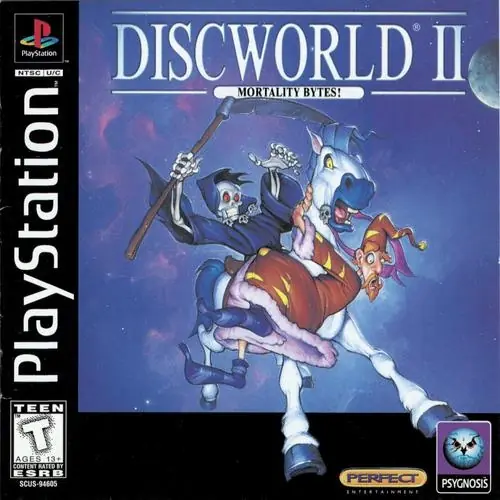
North America
PlayStation
Editions and related releases
- Followed by
- Discworld Noir
- Follows
- Discworld
Games like this
 70
Curse of Enchantia
1992 · Amiga, MS-DOS
Adventure · Point-and-click adventure
 86
Return to Monkey Island
2022 · Android, Linux +6
Adventure · Point-and-click adventure
 PlayStation exclusive69
Magicka 2
2015 · Linux, PlayStation 4 +2
Adventure · Wizards
 76
King's Quest
2015 · PlayStation 3, PlayStation 4 +3
Adventure · Point-and-click adventure
 Xbox exclusive88
Monkey Island 2: LeChuck's Revenge
1991 · Amiga, FM Towns +4
Adventure · Point-and-click adventure
 PlayStation exclusive80
Warhammer: Dark Omen
1998 · PlayStation, Windows
Wizards · Vampire
 71
The Legend of Kyrandia: Fables and Fiends
1992 · Amiga, FM Towns +3
Adventure · Point-and-click adventure
 79
Broken Sword – Shadow of the Templars: Reforged – Nintendo Switch 2 Edition
1996 · Linux, MS-DOS +4
Adventure · Point-and-click adventure
Collections3 collections
Platform libraries
- Sega Saturn gamesGames
Publishers
- Sony Interactive Entertainment gamesVideo games
Genres
Description adapted from its source, CC BY-SA 4.0.