Ludography
83/100
Players55 ratings
70/100
Critics1 review
Discworld cover

1995 · Perfect Entertainment · Adventure · Point-and-click adventure

Discworld

Timed Sega exclusive

Discworld is a game released for PC (subsequently Mac, and Playstation) by Teeny Weeny / Perfect 10 studios in 1995. The game was released both on floppy disk and CD-Rom. The latter featured a commentary team created of many veterans of famous Brit-Coms. This included Monty Python's Eric Idle, Radio 4's (later to be more famous) Rob Brydon, ex- Doctor Who John Pertwee, 70s pop singer Kate Robbins, and Blackadder star Tony Robinson. The game is a riff on the Discworld title 'Guards, Guards', however many elements of the text have been shifted, not least the inclusion of Rincewind as protagonist.

Also known as
Discworld: The Trouble With Dragons · Ohlam Ha disc · Terry Pratchett's Mundodisco · Terry Pratchett's: Discworld · ディスクワールド
Released
1995
Platforms
Sega CDmacOSMS-DOSPlayStationSega Saturn
Genres
AdventurePoint-and-click adventurePuzzle
Developers
Perfect Entertainment
Publishers
SCE Studio LiverpoolPsygnosis
Modes
Single-player
Perspective
Side view
Themes
FantasyHistoricalComedy
Country
United Kingdom
Age ratings
ESRB TUSK 6ACB G
Languages
EnglishFrenchGermanSpanishItalianJapanese
Time to beat
11hmain story12hwith extras13hcompletionist
Directors
Gregg Barnett

About

Discworld is a point-and-click adventure game developed by Teeny Weeny Games and Perfect 10 Productions and published by Psygnosis. It is based on Terry Pratchett's novels of the same name. The player assumes the role of Rincewind the "wizzard", voiced by Eric Idle, as he becomes involved in exploring the Discworld and preventing a dragon from terrorising the city of Ankh-Morpork. The story borrows elements from several Discworld novels, with its central plot loosely based on the events in Guards! Guards!

Pratchett was originally reluctant to grant a licence for a game based on his novels after the commercial failure of a video game adaptation of The Colour of Magic in 1986. Gregg Barnett, the game's designer, managed to persuade the writer through offering, alongside an initial design concept, to faithfully recreate elements from the novels. As part of his desire to have a large adventure for CD-based computer systems and opening up a potential market for similar video games, he convinced Pratchett to create an original story that would offer a game based on the entire series rather than an adaptation of one book. Development included incorporating a British cast of comedians to voice several of the characters.

›Story

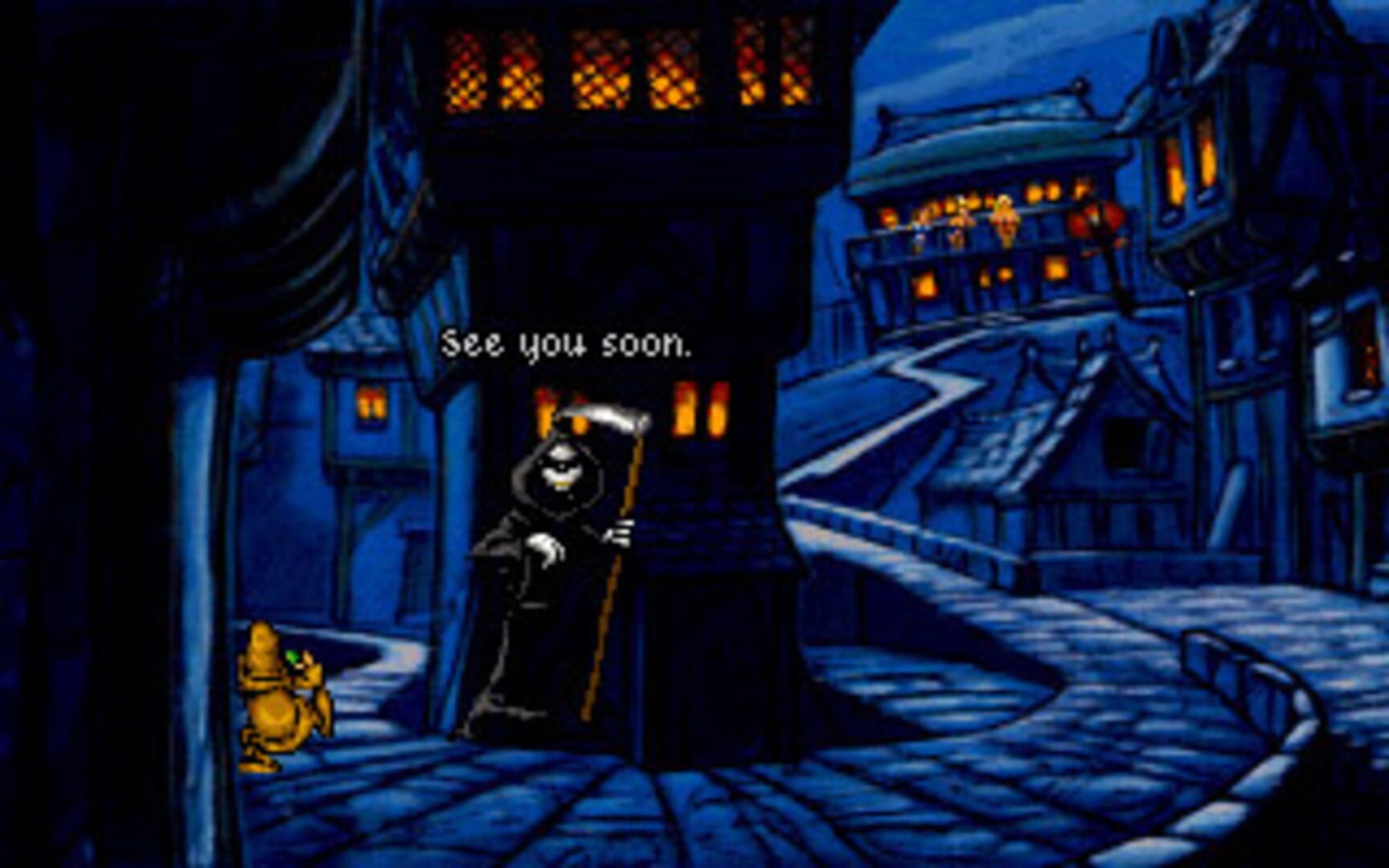
A typically nasty secret order has summoned up a dragon, and is using it to wreak havoc upon the city. But it's not down to Carrot and co to stop it. It's down to Rincewind, the highly inept wizard. The player takes control of him, and try to save the city from destruction, in a journey that takes you from Ankh-Morpork to the edge of the Disc and beyond. The game incorporates many characters from non-Rincewind Discworld adventures, such as Nanny Ogg, The Ankh-Morpork guards, Cut-me-own-throat Dibbler, Trolls, the Patrician and Death.

Keywords

  • wizards
  • medieval
  • magic
  • amazon
  • humour
  • witches
  • based on - book
  • cartoon cutscene
  • treasure chest
  • anti-hero
  • voice chat
  • book tie-in

Media

The articlegameplay, story, development, reception

Gameplay

Discworld is a third-person point-and-click graphic adventure game. In each location, the player can examine and interact with people and objects. The player can also pick up and use items to acquire other objects or solve puzzles to remove obstacles. Conversations focus on Rincewind using one of four topics with characters: Greet; Sarcastic or Joking; Question; and Vent Anger.

Extra topics may sometimes appear related to a subject that Rincewind learns during the course of the game. The player can interact with a variety of people, including the Archchancellor, Dibbler, the Librarian, and Death.

Story

A secret brotherhood summons a dragon from its native dimension to cause destruction and mayhem across the city of Ankh-Morpork. Rumours of the dragon's rampage across the city reaches Unseen University. Since the Archchancellor wishes the involvement of at least one wizard in the matter, Rincewind is summoned to handle the problem. After obtaining a book to learn what is needed to track the dragon to its lair, Rincewind searches the city for the required components to assemble a dragon detector and brings them back to the Archchancellor.

After the Archchancellor mentions that the dragon's lair is stocked with gold, Rincewind snatches the dragon detector from him, searches the city, finds the lair, and takes all the gold. Just before he leaves, the dragon stops him and requests his aid in removing the brotherhood's hold upon her, claiming they are using her for evil and are planning to make her go on a major rampage.

Development

Terry Pratchett was pleased with the 1986 interactive fiction game The Colour of Magic, but criticised its poor marketing. He was reluctant to grant Discworld licences due to concern for the series, and wanted a reputable company who cared about the property. Other video game companies had previously approached Pratchett seeking a licence. One such company was AdventureSoft, and their failure to obtain a Discworld licence led to the creation of Simon the Sorcerer, which took inspiration from the Discworld series of books.

When the creative director and designer Gregg Barnett sought out the Discworld licence, he intended to show Pratchett that he cared about Discworld instead of getting money. Barnett said in an interview that Pratchett was more invested in how the intellectual property would be treated than money. During negotiations, he offered to design the game before signing a deal; he did so, and Pratchett agreed. Gregg said the design showed respect for Discworld, and that was what persuaded Pratchett.

Reception

Discworld was a "massive hit" in Europe and the United Kingdom, according to director Gregg Barnett. However, the game was less successful in the United States. It received generally positive reviews. The humour and graphics in particular were widely praised, but some thought that the difficulty was too harsh.

It tied for third place in Computer Game Review's 1995 "Adventure Game of the Year" award category. The editors noted its "good voice work" and "very nice animation", and praised its humour. In 1996, GamesMaster ranked Discworld 78th on their "Top 100 Games of All Time". In 1998, Saturn Power listed the game 91st in its Top 100 Sega Saturn Games.

Releases by platformdates and regions as published

Releases by platform
PlatformReleasedRegions
Sega CDCancelled1 January 1995Worldwide
MS-DOS17 March 1995North America · Europe 17 March 1995
macOS17 March 1995North America
PlayStation15 October 1995Europe · North America 16 November 1995 · Japan 5 July 1996
Sega SaturnCancelled15 August 1996Europe · Japan 13 December 1996 · North America 30 September 1997

Title IDsone per regional release, with its latest update

Title ids and disc serials by release
PlatformTitle IDRegionLatest update
PlayStationSCES-00012Europe—
SLES-00193Europe—
SLPS-00251Japan—
SLPS-02656Japan—
SCUS-94600North America—
Sega SaturnT-11302H-50Europe—
T-20502GJapan—

Box artone per regional release we hold art for

Decompilations and portscommunity projects that rebuild or port the game

Editions and related releases

Based on
Discworld
Followed by
Discworld II: Missing Presumed...!?

Games like this

Collections7 collections

Description adapted from its source, CC BY-SA 4.0.