The articlegameplay, story, development, reception
Gameplay
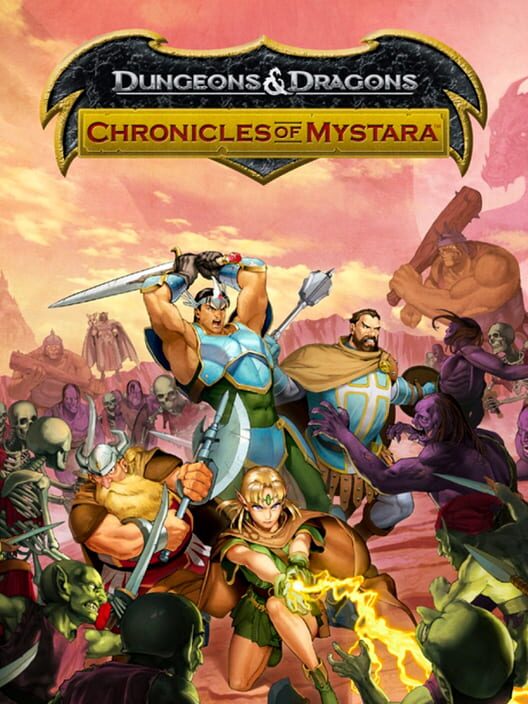
Tower of Doom is a side-scrolling arcade game with four playable characters (cleric, dwarf, elf, fighter) and classic Dungeons & Dragons monsters as enemies. Bosses include a troll that regenerates unless burned, a large black dragon, the dreaded Shadow Elf (Mystara's equivalent of the drow), a beholder, the optional superboss Flamewing (a great wyrm red dragon) and the final boss Deimos (an archlich).
At various points in the game, the players are presented with a choice of paths to take to continue progress. Each path goes to a different area, and it is impossible to visit every area during a single playthrough.
Gameplay is more technical than the average beat 'em up game. In addition to the usual basic attacks and jumping, it includes blocking, strong attacks, turning attacks, dashing attacks, crouching and evading. It also requires the use of careful tactics, as most enemies have the same abilities as the heroes and a longer range.
Daggers, hammers, arrows and burning oils can be used as throwing weapons, and many enemies have similar weapons. Spells can be used via magical rings or by the two spellcasters (a cleric and an elf).
Story
The Republic of Darokin in Mystara is under a terrible siege as the number of monsters and their attacks rise. A group of four adventurers step forth to rescue various areas, then are sent by the merchant lord Corwyn Linton to investigate the attacks, revealed to be masterminded by the Arch Lich Deimos. The adventurers eventually make their way to Deimos' Tower of Doom and ultimately destroy him.
Development
At the beginning of the 1990s, Capcom acquired the license to create D&D games. As part of the deal, they ported Eye of the Beholder to the Super Nintendo Entertainment System. The Japanese branch of Capcom were having difficulty getting TSR's approval for creating a D&D game, so they turned to Capcom USA to negotiate. Capcom and license-holder TSR met in January 1992 to discuss how the game should be approached.
They decided to write the story first, and build the game around the story. Most of the staff at Capcom USA were not familiar with D&D rules and lore, so assistant James Goddard turned to D&D enthusiast Alex Jimenez to come up with a concept and make it understandable to a Japanese audience, all the while testing the product. Some of Jimenez's inspirations for the beat em up' style came from Golden Axe, while the multiple paths were based on Thayer's Quest. There was debate between Capcom and SSI on whether to make the game Asian-themed or Western-themed, which Jimenez himself managed to resolve.
Jimenez supplied concept art for the characters. One of his biggest difficulties was trying to help the Japanese developers grasp the D&D elements. The game was originally supposed to have two buttons in the arcade controls, but two more were needed to accommodate the inventory system.
Once the initial game design was complete, Jimenez translated it into an actual Dungeons & Dragons scenario and told his gamers group in San Jose to play it, with himself as gamemaster. Capcom of Japan then revised the scenario design based on the players' reactions.
Reception
In Japan, Game Machine listed Dungeons & Dragons: Tower of Doom on their March 1, 1994 issue as being the second most-successful table arcade unit of the month, outperforming titles like Raiden II and Fatal Fury Special. In North America, RePlay reported Tower of Doom as the most-popular arcade game at the time. Play Meter also listed Tower of Doom as the fourteenth most-popular arcade game at the time. The game received a rave review from GamePro, who commented that its action is not as fast as it could be, but rather furious, smoothly controlled, and intuitive. They also praised the game's length, complexity, and non-linear nature, and its faithful recreation of Dungeons & Dragons elements.
According to GameSpy's Allen Rausch, Dungeons & Dragons: Tower of Doom was "equally good, though not as well remembered" as other "Final Fight-style beat-'em-ups at the arcade" like Teenage Mutant Ninja Turtles and The Simpsons. Rausch felt combat was fun and had more depth, and "came loaded with secrets to find and treasures to swipe" and after the players beat the game's seven levels, they find that the ultimate bad guy was actually just the pawn of an even bigger bad guy.