The articlegameplay, story, development, reception
Gameplay
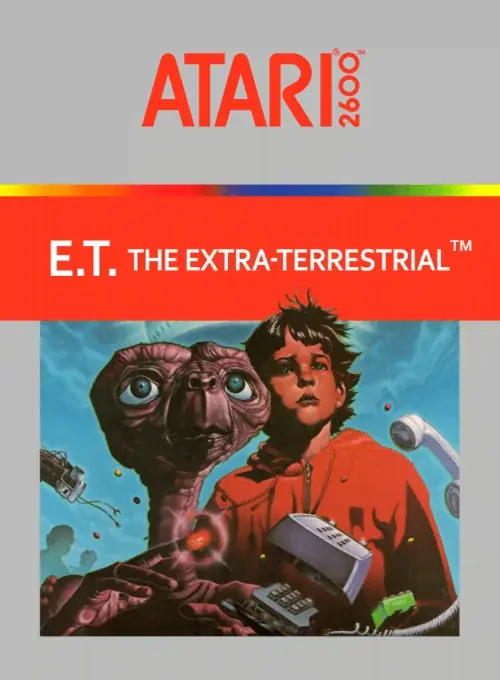
T. T. from a top-down perspective. The objective is to collect three pieces of an interplanetary telephone.
The pieces are found scattered randomly throughout various pits (also referred to as wells). There is no overall time limit. T. performs any actions (including moving, teleporting, or falling into a pit, as well as levitating back to the top).
T. T. can call Elliott to obtain a piece of the telephone, or the player can save the candy pieces for bonus points at the end. T.
to an area where he can use the phone, which allows him to call his home planet. T. has to arrive at the landing zone before it reaches zero. T.
gets to the forest where his ship abandoned him and stands and waits in the designated area for the ship to come, the ship will appear on-screen and take him back to his home planet. Then the game starts over, with the same difficulty level, while changing the location of the telephone pieces. The score obtained during the round is carried over to the next iteration. T.
has three lives and if he dies within those three lives Elliott will come in and revive him. T. can get a fourth life if the player finds a geranium in one of the wells. T.
runs out of energy or when you decide to quit playing".
The game is divided into six environments, each representing a different setting from the film. T. into the wells. T.
out of them. An icon at the top of each screen represents the current area, each area enabling the player to perform different actions. T. for observation and an FBI agent who chases the alien to confiscate one of the collected telephone pieces or candy.
The game offers diverse difficulty settings that affect the number and speed of humans present and the conditions needed to accomplish the objective.
Development
T. the Extra-Terrestrial in June 1982, Steve Ross, CEO of Atari's parent company Warner Communications, began negotiations with the film's director Steven Spielberg and its distributor Universal Pictures to acquire a license to produce a video game based on the film. T. Although the exact details of the transaction were not disclosed in the announcement, it was later reported that Atari had paid US$20–25 million ($67–83 million when adjusted for inflation to 2026) for the rights, a high figure for video game licensing at the time.
-based video game, Atari CEO Ray Kassar replied: "I think it's a dumb idea. We've never really made an action game out of a movie." T. property had also been planned, but this was deemed to be impossible given the short deadline.
On July 27, 1982, after negotiations were completed, Kassar called Howard Scott Warshaw to commission him as developer of the video game adaptation. Kassar informed him that Spielberg asked for Warshaw specifically and that development had to be completed by September 1 to meet a production schedule for the Christmas holiday season. Although Warshaw had spent over a year working on consecutive development schedules for games (seven months working on Yars' Revenge and six months on Raiders of the Lost Ark), he accepted the offer based on the challenge of completing a game in a short time frame and at Spielberg's request. Warshaw considered it an opportunity to develop an innovative Atari 2600 game based on a film he enjoyed, "provided we reach the right arrangement".
Kassar reportedly offered Warshaw US$200,000 and an all-expenses-paid vacation to Hawaii in compensation. Warshaw was flown via private jet to Warner Bros. Studios Burbank to meet with Spielberg.
Warshaw used those days to design the structure and segmented the concept into four ideas: world, objective, the path to achieve the objective, and obstacles. T. phoning home, as the goal. The player would need to gather parts for a phone to call his ship and arrive at a special landing site to achieve this goal.
Warshaw considered obstacles as an element that would determine the success of a game, and experienced difficulties when taking into account the time constraints and technical limitations of the console. Inspired by the film, adults were implemented as antagonists that would chase the alien. Pits were devised as an element to hide the pieces of the phone as well as expand the game world.
Warshaw and other Atari executives presented this design to Spielberg, who was not enthusiastic. According to Warshaw, Spielberg asked him, "Couldn't you do something more like Pac-Man?" Believing the concept too derivative of a common game design, Warshaw proceeded with his concept, which he believed would capture the sentimentality he saw in the original film Warshaw later stated that, in retrospect, Spielberg's idea might have had merit. He spent the remaining time programming.
Atari graphic designer Jerome Domurat assisted Warshaw with creating graphics for the game. Atari anticipated enormous sales based on the popularity of the film, as well as the stability of the video game industry at the time. Due to time limitations, Atari skipped audience testing. Emanual Gerard, then part of the Office of the President of Warner, later suggested that the company had fallen into a false sense of security by the success of its previous releases, particularly its console version of Pac-Man, which was commercially successful despite poor critical reaction.
Reception
T. video game was high, and Atari hoped it would be a sought-after Christmas gift. , would become "an increasingly profitable source" for video game development. At first, retailers ordered more supplies than what was expected to be sold, but Atari received an increasing number of order cancellations as new competitors entered the market, which they had not anticipated.
John Hubner and William Kistner of InfoWorld have attributed the cancellations to changes Atari initiated in its relationship to distributors. On November 1, 1982, Atari informed them that their contracts were canceled and that exclusive deals would be established with select distributors. Hubner and Kistner believed the action prompted retailers to cancel orders, which Atari had not properly tracked.
E.T. enjoyed initial commercial success, being among the top four on Billboard magazine's "Top 15 Video Games" sales list in December 1982 and January 1983. The game sold over 2.6 million copies by the end of 1982. However, at least 669,000 copies were later returned in 1983. One retailer said that "mostly grandmothers" bought the game; because of word-of-mouth, children preferred the best-selling Pitfall!
's success. Even though the game was a bestseller during the holiday season, retailers still stated that its sales figures did not meet expectations. Warner Communications also expressed disappointment at the number of sales. Lower-than-expected sales figures combined with excess inventory, which produced a negative supply and demand event, prompted retailers to repeatedly discount the price.
According to Ray Kassar, about three and a half million of the four million produced were sent back to the company as unsold inventory or customer returns. T. a major financial failure for Atari.
Upon release, the game was criticized by reviewers, with the gameplay and visuals both areas of concern. New York magazine's Nicholas Pileggi described it as a loser compared to other games Atari could have released during the time period, such as Donkey Kong and Frogger, and Video Games called it "really for kids (the littler ones)". In 1984, the game was named by readers of Softline as the second-worst Atari program of 1983, after Congo Bongo.
Nevertheless, the game received some positive contemporary reviews. An editor for The Miami Herald described it as difficult to learn to play, but believed that doing so was worth it. T. repeatedly falls back into holes.
Arcade Express scored it six out of ten in December 1982. T. 14 times, there's no more suspense left—unless you bring home this one-player cartridge", adding that "it's certain that your patience won't run out—if you're a kid. (Adults may prefer to wait for a game based on My Dinner with Andre.)"
Later reviews were comparably negative. Kevin Bowen of GameSpy's Classic Gaming called the gameplay "convoluted and inane", also criticizing its story for departing from the serious tone of the film, and author Steven Kent described the game as "infamous" within the industry, citing "primitive" graphics, "dull" gameplay, and a "disappointing story". T. cartridges, with one child noting that the game "sucked", and was impossible to complete.
Modern critics have also bemoaned the repeated need to fall down pits. Emru Townsend of PC World discussed the game with a group who described the pits as "monotonous". Sean "Seanbaby" Reiley claimed that the pits are "time-consuming" and "difficult to leave without falling back in". Trent Ward, formerly a reviewer for Next Generation described returning the game as a result of the pits.
Classic Gaming argued that despite the negative reception, the game can be enjoyable after the player has learned to navigate the pits.
T. has frequently been listed among the worst video games ever made. Reiley ranked it number one in a list of the 20 worst games of all time in Electronic Gaming Monthly's 150th issue. T.
a similar ranking. T. at the top of his list of the worst video games, and said that "about a third of the people I quizzed came up with this title almost instantly, and it's not hard to see why." GameTrailers ranked it second worst on their "Top Ten Best and Worst Games of All Time" list.
Critics often attribute the poor quality to the short development time. Townsend commented that the rushed development was very apparent. Warshaw's contributions have been met with mixed responses. Classic Gaming called the game poorly designed, while IGN's Levi Buchanan stated the "impossibly tight schedule" given to Warshaw absolves him of blame. Warshaw does not express regret for his part in E.T., and believes he created a good game given the time available to him.
Legacy
E.T. is often cited as one of the most important video games. GamePro, GameTrailers and Bowen cite the game as the first poor quality-film–video-game tie-in. Patrick O'Luanaigh of SCi Games called it the most famous disaster story among film-inspired video games as well as within the industry. GamePro publication named it second-worst movie game ever, citing it as an example of how poor gameplay can bring negative reception to strong licenses.
T. has not been lost on the industry". The game is associated as a cause of the video game industry crisis of 1983. T.
games, along with an increase in competition, prompted retailers to demand official return programs from video game manufacturers. T itself did not contribute greatly to the collapse, outside of Atari, by mid-1983. The release timing led to the game gaining the reputation of being responsible for the 1983 crash.
By the end of 1982, Atari had begun to lose dominance as more competitors entered the market. T. Atari's biggest mistake, as well as the largest financial failure in the industry. Reiley commented that the game's poor quality was responsible for ending the product life of the Atari 2600.
's poor reception was attributed by Kent to have had a negative impact on Atari's reputation and profitability. 's combined effect on the company's reputation and the industry's reaction. Buchanan also cited the game as a factor in Atari and the industry's crash. He stated that the large amount of unsold merchandise was a financial burden to Atari, which pushed the company into debt.