The articlegameplay, story, development, reception
Gameplay
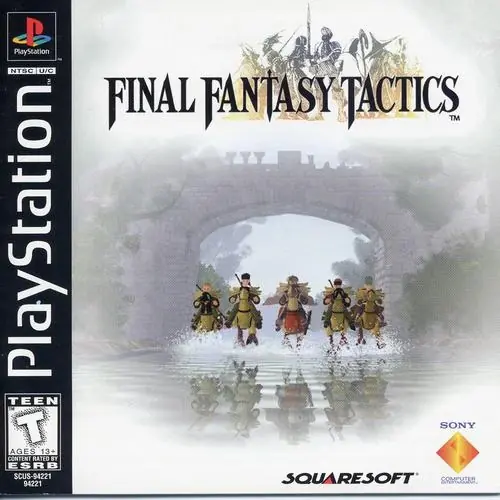
Final Fantasy Tactics is a tactical role-playing game in which players follow the story of protagonist Ramza Beoulve. The game features two modes of play: battles and the world map. Battles take place on three-dimensional, isometric fields. Characters move on a battlefield composed of square tiles; movement and action ranges are determined by the character's statistics and job class.
The battlefield also factors in elements such as terrain and weather to determine strategic advantages and disadvantages during clashes. Battles are turn-based; a unit may act when its Charge Time (CT) reaches 100 and increased once every CT unit (a measure of time in battles) by an amount equal to the unit's speed statistic. During battle, whenever a unit performs an action successfully, it gains experience points (EXP) and job points (JP). Actions can include magical attacks, physical attacks, or using an item.
Story
The story takes place in the kingdom of Ivalice, inspired by the Middle Ages. The kingdom is located in a peninsula surrounded by sea on the north, west and south, with a headland south of the landmass. It is heavily populated by human beings, although intelligent monsters can be found living in less populated areas. Magic is predominant in the land, although ruins and artifacts indicated that the past populace had relied on machinery, such as airships and robots.
Ivalice's neighbors are the kingdom of Ordalia in the east and Romanda, a military nation to the north. While the three nations share common royal bloodlines, major wars have taken place between them. An influential religious institution known as the Glabados Church heads the dominant faith, centering around a religious figure known as Saint Ajora.
Development
Tactics was conceived in 1993 by Final Fantasy series creator Hironobu Sakaguchi, who is a fan of the tactical role-playing genre. Due to his heavy involvement with the mainline series, he was unable to realize it at the time. Production finally began at the end of 1995 under Yasumi Matsuno, who until that year had worked at Quest Corporation on the Ogre Battle series, resigning once work was completed on Tactics Ogre: Let Us Cling Together and bringing several of its staff over to Square. During this period, Square had broken its long-standing development partnership with Nintendo and moved their game projects over to Sony's PlayStation.
Matsuno acted as director and lead scenario writer. Sakaguchi was the game's producer. The lead programmer was Taku Murata, who had previously worked on the Mana series. Matsuno described the working environment at Square as more democratic than at Quest, with a greater ability for the whole staff to contribute design ideas.
Reception
Final Fantasy Tactics sold nearly 825,000 copies in Japan in the first half of 1997, and ended the year at almost 1.24 million copies sold. By 2007 the game had sold approximately 1.35 million copies in Japan. As of August 2011, the original PlayStation version had sold over 2.4 million copies worldwide.
Final Fantasy Tactics received critical acclaim upon its release. Some reviews lauded the battle sequences as challenging, requiring more strategic planning than ordinary RPGs and utilising many gameplay mechanics in later battle sequences. The visuals were also lauded, particularly the spell effects, 3D battlegrounds, and camera that can be rotated and zoomed. Other reviewers disagreed and considered these elements a problem because it necessitated that the battles consist of fewer characters.
Legacy
The world of Final Fantasy Tactics has been featured in several other Square video games. After the game's release, the development staff developed Vagrant Story, which featured several subtle references to Final Fantasy Tactics. In an interview, Matsuno said both titles are set in the same fictional world of Ivalice.
During the development of Vagrant Story, Matsuno and Sakaguchi initiated a sequel to Tactics, which would have used 2D graphics due to issues with 3D development at the time. The project was outsourced to an unspecified developer because of the team's commitment to Vagrant Story and was later cancelled for unspecified reasons.