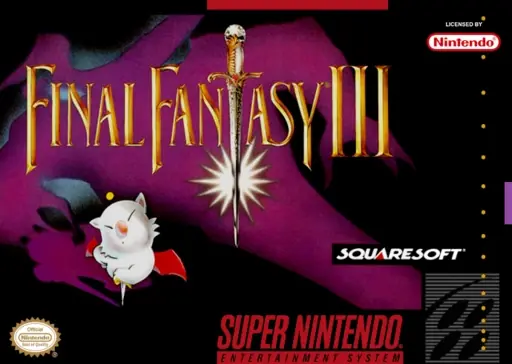
The articlegameplay, story, development, reception
Gameplay
Like previous installments, Final Fantasy VI consists of four basic modes of gameplay: an overworld map, town and dungeon field maps, a battle screen, and a menu screen. The overworld map is a scaled-down version of the game's world, which the player uses to direct characters to various locations. As with most games in the series, the three primary means of travel across the overworld are by foot, chocobo, and airship. With a few plot-driven exceptions, enemies are randomly encountered on field maps and on the overworld when traveling by foot.
The menu screen is where the player makes such decisions as which characters will be in the traveling party, which equipment they wield, the magic they learn, and the configuration of the gameplay. It is also used to track experience points and levels.
Story
Instead of the strictly medieval fantasy settings featured in previous Final Fantasy titles, Final Fantasy VI is set in a world with deliberately more industrial and mechanical design elements; developers described a setting where machinery and magic coexist. Opera and the fine arts serve as recurring motifs—most notably the opera sequence—documented in developer interviews and later remaster materials. During the first half of the game, the planet is referred to as the World of Balance, and is divided into three lush continents. The northern continent is punctuated by a series of mountain ranges, the southern continent has been mostly subjugated by the cruel Gestahl Empire, and the eastern continent is home to the Veldt, a massive wilderness inhabited by monsters from all over the world. An apocalyptic event mid-game transforms the planet into the World of Ruin; its withering landmasses are fractured into numerous islands surrounding a larger continent.
The game alludes to a conflict known as the "War of the Magi", which occurred one thousand years prior to the beginning of the game. In this conflict, three quarreling entities known as the "Warring Triad" used innocent humans as soldiers by transforming them into enslaved magical beings called Espers. The Triad realized their wrongdoings; they freed the espers and sealed their own powers inside three stone statues. As a precaution, the espers sealed off both the statues and themselves from the realm of humans.
Development
Final Fantasy VI entered development after the release of its predecessor V in December 1992. The development of the game took just one year to complete. The development team consisted of approximately 30 people, which was considered large for the time. Series creator and director Hironobu Sakaguchi could not be as intimately involved as in previous installments due to his other projects and his promotion to Executive Vice President of the company in 1991.
For that reason, he became the producer and split director responsibilities for VI up between Yoshinori Kitase and Hiroyuki Ito: Kitase was in charge of event production and the scenario, while Ito handled all battle aspects. Sakaguchi supervised Kitase's cutscene direction and ensured that the project would coalesce as a whole. The idea behind the story of VI was that every character is the protagonist. All members of the development team contributed ideas for characters and their "episodes" for the overall plot in what Kitase described as a "hybrid process".
Reception
Final Fantasy VI received critical acclaim and was commercially successful in Japan upon release. 55 million copies in Japan, where it became the best-selling video game of 1994. In the United States, where it went on sale in the last quarter of 1994, it was the top-selling Super NES game in October and became the year's eighth best-selling Super NES cartridge. Despite this, it was not a commercial success in that region, according to Sakaguchi.
62 million of those copies being shipped in Japan and 860,000 abroad. Final Fantasy Collection sold over 400,000 copies in 1999, making it the 31st-best-selling release of that year in Japan. Final Fantasy Anthology has sold approximately 364,000 copies in North America. Final Fantasy VI Advance sold over 223,000 copies in Japan by the end of 2006, one month after release.
Legacy
Following Final Fantasy VI, Square began testing for its next entry Final Fantasy VII on the Nintendo 64, but technical issues, escalating cartridge costs and the higher storage capacity of CD technology persuaded Square to move VII and all their subsequent titles onto the PlayStation. During early testing on 3D development software, the team rendered a battle involving Final Fantasy VI characters Terra, Locke and Shadow. The decision to move to PlayStation soured the relations between Square and Nintendo. Due to this, Final Fantasy VI was the last series title to release on a Nintendo platform until Final Fantasy Crystal Chronicles came out on the Nintendo GameCube in 2003.
It was also the last new mainline Final Fantasy game to come to a Nintendo platform until 2018 when the abridged Final Fantasy XV: Pocket Edition was released on Nintendo Switch, followed by the subsequent rereleases of Final Fantasy VII, VIII, IX, X, X-2 and XII throughout 2019, and ports of Final Fantasy VII Remake, Final Fantasy VII Rebirth and Final Fantasy XIV releasing on Nintendo Switch 2 throughout 2026. Final Fantasy VII Revelation, the third entry in the Final Fantasy VII Remake trilogy, will be the first new mainline entry to be developed for a Nintendo console since VI when it releases in April 2027 for Nintendo Switch 2. Final Fantasy VI was included in the Super NES Classic Edition under its original titling as Final Fantasy III for the North American and European release in September 2017.