The articlegameplay, story, development, reception
Gameplay
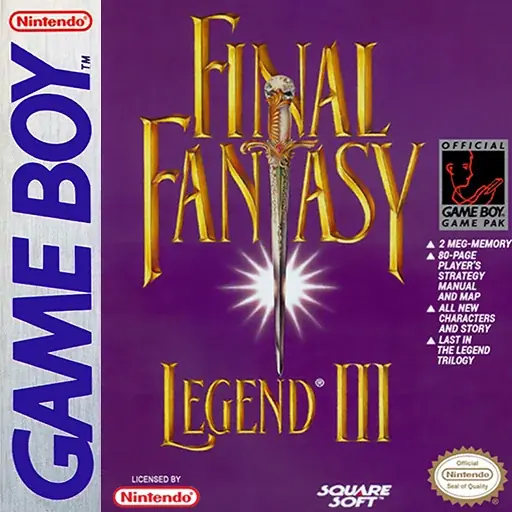
Final Fantasy Legend III, known in Japan as SaGa 3: Jikuu no Hasha, is a role-playing video game set in a science fiction-based world where players take on the role of a four-person party as they travel between environments in different time periods. The party explores different environments from a top-down perspective, talking with characters to advance the narrative, using shops to buy and sell items and equipment, and entering battles during exploration. Players choose their basic characters from two different races, humans and mutants, who have different ways they can raise their experience levels. Travel between eras is carried out using the airship Talon, which is upgraded during the campaign to reach new areas.
Battles play out using a turn-based combat system, where party members attack enemies using their equipped weapons or magic spells. Humans raise their level using experience points in battle, while mutants raise their attributes and skills based on usage in battles. Humans and mutants can evolve into monster or robot character classes using items gained from enemies; meat triggers evolution into beasts, then monsters, while mechanical parts transform characters into cyborgs, then robots. Characters are further customized by equipping magic stones, gaining access to new abilities. Dying in battle forces the player to reload a previous saved game.
The Nintendo DS remake retains the original story, but removes the experience point-based leveling while incorporating mechanics established in earlier and later SaGa titles. These include skill learning and statistic leveling based on player actions in battles, nonlinear storytelling and exploration through the "Free Scenario System", and upgrades to the party's ship. The graphics were also changed, shifting from 2D top-down to an angled 3D presentation. A new mechanic is "Time Gear", a special ability which stops time in field environments, freezing enemies and disrupting environmental effects which can halt the party.
Story
In the world of SaGa 3, a non-sentient being called the Water Entity is engulfing the world in a great flood. The Water Entity also summons monsters onto the land and low lying cities are abandoned. As a party of four warriors sets out to confront the entity, several youths from the future arrive to help, and it is realized that the Entity's destruction is occurring across all time periods. To stop the Entity, the party collects parts for the Talon, a ship capable of travelling between time periods and dimensions, hoping to foil the Entity.
They learn that the Water Entity was created by the dimensional realm of Pureland, who once waged a war so destructive that it threatened multiple dimensions. The god Sol, creator of the Talon, sealed the ravaged Pureland away and scattered the Talon across time periods to prevent its use. The Water Entity was manifested as an act of vengeance from Pureland's primal water deity Xagor. After breaking into Pureland, the original Talon is destroyed and must be rebuilt, with the party redubbing it Talon2.
While exploring Pureland, the party encounter Sol, who now houses the soul of Xagor, and are forced to kill both. In his last act, Sol destroys the Water Entity and the party escape back to their own dimension, destroying the Talon2 in the process.
Development
Production began in 1990, following the completion of the previous game. At the time, developer Square had started production on two parallel projects; the third Game Boy SaGa title, and a Super Famicom entry titled Romancing SaGa begun at the request of the console's manufacturer Nintendo. Series creator Akitoshi Kawazu was completely occupied with developing Romancing SaGa, making Final Fantasy Legend III the only series title he was not involved in. Production was given by Kawazu to a newly-founded Square studio in Osaka, with Chihiro Fujioka producing the game.
The world used design elements and motifs from science fiction, traditional fantasy, and referenced Norse mythology. The design of the Talon, called the Stethros in Japanese, was based on the Lockheed F-117 Nighthawk stealth fighter. The game's title included the term "Final Chapter", as Kawazu was at the time intending to end the SaGa series and brand. These plans changed and the SaGa series continued, leaving Kawazu confused in retrospect about his choice of the title.
Fujioka noted that in addition to creating the game, the team were also establishing themselves as a department, and as a result a great deal of effort was put into the production. They decided to overcome the Game Boy's limitations by leaving some aspects to the player's imagination instead. In the case of graphics, this meant establishing first an object, then its shadows, allowing the player to visualize the missing colors themselves; a similar concept was applied to the game's music to overcome the limitation of working with only three notes for composition. In contrast to the previous SaGa titles which used non-standard leveling mechanics, Final Fantasy Legend III used traditional leveling alongside character growth elements from earlier titles. The Japanese cover art was created by Katsutoshi Fujioka, who designed covers for the previous SaGa releases.
The game's music was co-composed by Ryuji Sasai and Fujioka. The two had worked together before Fujioka joined Square, so he brought on Sasai to compose the soundtrack. As Fujioka worked on the game's programming, Sasai stated he would handle the game's music; though a musician himself, Fujioka opted to contribute four additional songs to the game. As the game was trying new elements, the composers sought to do the same.
To this end, they used four sound channels, and created a stereo sound element that could both be fed through the console's single speaker and work on headphones. Sasai compared the limitations with the audio to a guitar capable of only six tones, though the cartridge capacity for the Game Boy at the time provided some difficulty. As a result, they concentrated on smaller songs, reducing the length of the tracks until they felt the music gave the proper impression.
A compilation album featuring music from the three Game Boy SaGa titles, All Sounds of SaGa, was published in 1991 by NTT Publishing. The music was released in a soundtrack album in 2018 alongside music from the original SaGa and SaGa 2.
Reception
In Japan, SaGa 3 topped the Famitsu sales charts from December 1991 to January 1992. As of 2002, the game had sold 650,000 units, making it the third best-selling title of the Game Boy SaGa releases, and the lowest-selling original SaGa title as of that time. The DS remake debuted in eighth place in Japanese sales charts, with opening sales of over 27,300 units. By the end of the year, the title had sold just over 59,000 units.
The Western Game Boy release of Final Fantasy Legend III received mostly positive reviews, maintaining a 71% aggregate score on GameRankings. The Collection of SaGa version earned a score of 70 out of 100 on Metacritic based on 14 critic reviews.
In their review of the original game, Japanese gaming magazine Famitsu noted the user-friendly alterations, but one critic felt that it was notably dissimilar from earlier SaGa titles. Electronic Gaming Monthly lauded it as a good quality RPG, citing the game's graphics and story as its high points, giving it four reviewer scores of 8 out of 10 and an Editor's Choice Gold Award. Nintendo Power largely agreed with these sentiments, stating that the game had "excellent game depth and good graphics for a Game Boy RPG", but found the title's story and gameplay to be too similar to previous Final Fantasy Legend games.
IGN called attention to the game's dated graphics and faulted the soundtrack, yet still found the game's music to be better than most Game Boy titles. They additionally found fault with the game's equipment screen due to obtuse design and poor image quality, though declared it to be accessible even to novice players. GamePro applauded the game for the battle simulator feature, the ability to transform the character using parts of slain enemies, and the booklets and map included in the game box; they made special note of the time travel mechanic, praising the feeling of fighting enemies in the past after seeing them in later periods. Corbie Dillard of Nintendo Life, writing in a 2009 retrospective review, called it a fitting conclusion to the Game Boy SaGa trilogy, though he noted some continued irritating elements in gameplay and design from earlier titles.
GameDaily named it alongside the related Game Boy Final Fantasy titles as definitive games for the system, describing it as providing "hours of role-playing excitement". The sentiment was shared by gaming magazines Electronic Gaming Monthly and Pocket Games, the latter of which ranked the titles together 8th out of the Top 50 games for the Game Boy.
Reviewing the DS remake, Famitsu praised the continued innovation of class evolution, noted its fast-paced narrative, and lauded the new Time Gear mechanic. Michael Baker of RPGamer praised the improved mechanics and further polish from the SaGa 2 remake, though felt that the plot was still lacking. In their own review of the Collection of SaGa compilation, Jordan Rudek Nintendo World Report called the third game a good place to start for beginners due to its stronger narrative and more traditional gameplay design compared to other SaGa titles. Nintendo Life's Mitch Vogel felt that all three titles in Collection of SaGa were very simplistic by modern standards, with none of them having aged well compared to other titles of their time.