
1992 · Square · Adventure · Role-playing
Final Fantasy V
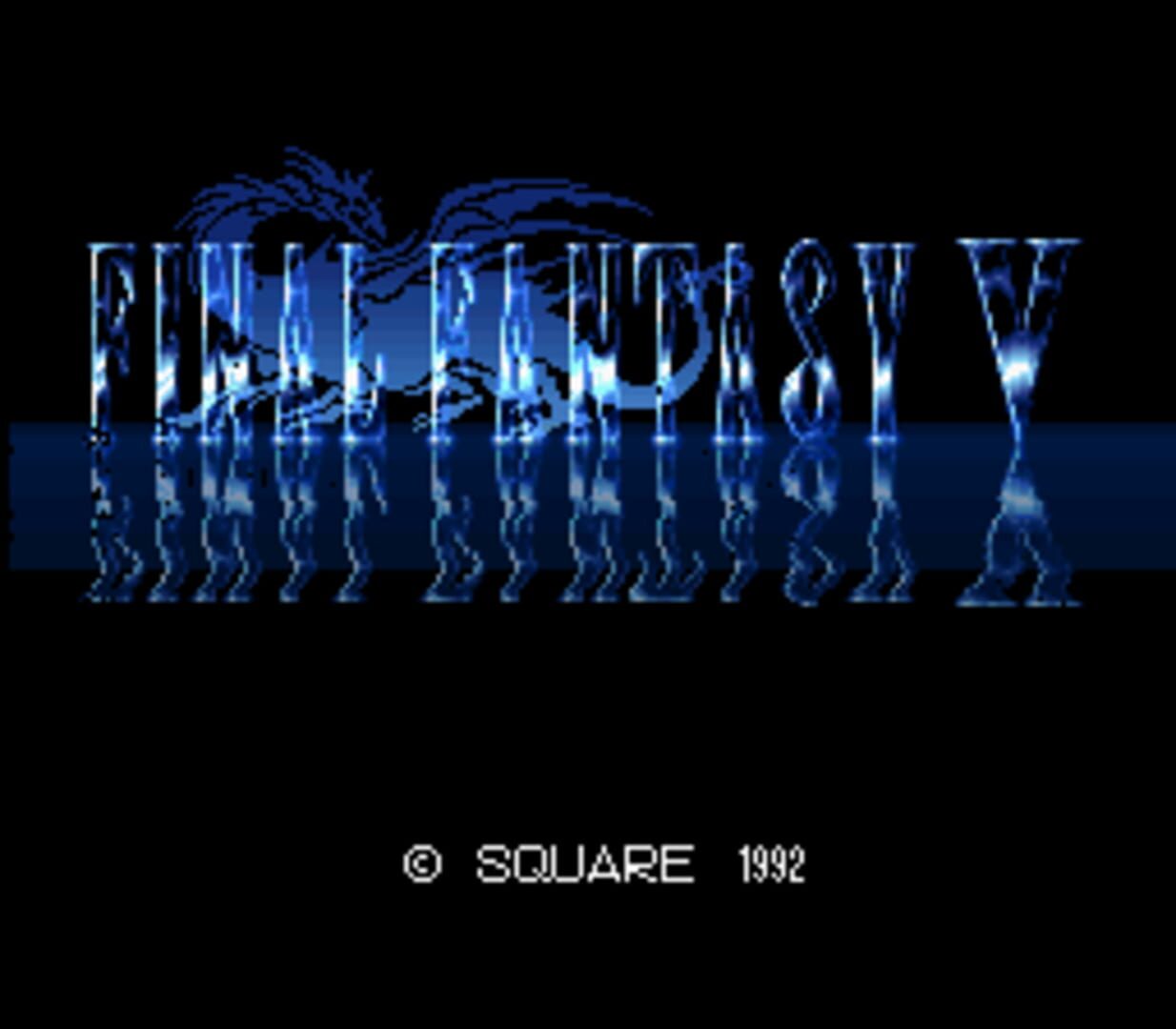
Final Fantasy V is a fantasy role-playing video game developed and published by Square in 1992 as a part of the Final Fantasy series. The game first appeared only in Japan on Nintendo's Super Famicom (known internationally as the Super Nintendo Entertainment System).
- Released
- 6 December 1992
- Platforms
- AndroidGame Boy AdvancePlayStationPlayStation PortableSNESWiiWindows
- Genres
- AdventureRole-playing
- Developers
- Square
- Publishers
- Square
- Series
- Final Fantasy
- Modes
- Co-opMultiplayerSingle-player
- Perspective
- Bird view / IsometricSide view
- Themes
- ActionFantasyOpen world
- Country
- Japan
- Age ratings
- GRAC 12+ESRB TCERO A
- Languages
- Japanese, English
- Copies sold
- 2.5 million
- Entry
- #5 in Final Fantasy
- Time to beat
- 25hmain story30hwith extras37hcompletionist
- Directors
- Hironobu Sakaguchi
- Composers
- Nobuo Uematsu
About
Final Fantasy V is a 1992 role-playing video game developed and published by Square for the Super Famicom. It is the fifth main installment of the Final Fantasy series. The game begins as a wanderer named Bartz investigates a fallen meteor. There, he encounters several characters, one of whom reveals the danger facing the four Crystals that control the world's elements.
These Crystals act as a seal on Exdeath, an evil sorcerer. Bartz and his party must keep the Crystals from being exploited by Exdeath's influence and prevent his resurgence.
›Story
Embark on an epic adventure as four heroes are driven together by fate: Bartz and his chocobo companion, Princess Lenna of Castle Tycoon, the mysterious Galuf, and the pirate captain Faris. The crystals that bring peace and prosperity to the world – earth, water, fire, and wind – have lost their power and are on the verge of destruction. These Crystals acted as a seal on Exdeath, an evil sorcerer. Bartz and his party must keep the Crystals from being exploited by Exdeath's influence and prevent his resurgence.
Keywords
- 2d
- jrpg
- classic
- steam
- class-based
- ability system
- grid-based movement
- possession
- psone classics
- virtual console
- playstation plus
- mercenary
Media
The articlegameplay, story, development, reception
Gameplay
Final Fantasy V includes many standard role-playing elements as well as renovated features introduced in earlier Final Fantasy games. Players navigate from a top-down perspective; a traversable overworld connects the various towns, dungeons, and other points of interest. The player can traverse the overworld by foot, Chocobo, hydra-guided ship, wind drake, or airship, depending on the situation. Most towns contain scattered inns for resting, shops for purchasing equipment, and people from whom the player can gain information.
The player may also embark on several side quests that become available as the story progresses. Characters grow in strength by gaining experience points from random encounters with monsters on the overworld or in a dungeon. Experience culminates in a "level up", in which character attributes such as hit points and magic power increase. A menu-based management system allows the player to equip, heal, and change each character's selected job outside of battle as well as to save the game's progress.
Story
The backstory of Final Fantasy V is revealed in phases through cutscenes and interactions with non-playable characters. One millennium before the events of the main story, a powerful mage named Enuo imperiled the world using the power of an evil entity called the "Void". The people retaliated by using twelve legendary weapons to vanquish Enuo, but the Void itself could not be destroyed. Consequently, the people split the world's four elemental Crystals into two sets, effectively creating two worlds. The Void then became sealed in a dimensional cleft between the two worlds.
Nearly a thousand years passed without incident, and both worlds prospered due to the powers of their Crystals of Wind, Water, Fire, and Earth. New kingdoms and towns flourished, and travel by ship acted as a critical means of commerce and communication. However, a sinister force was stirring in the second world—ever since the Void incident, malicious demons had been sealed inside a tree in the Great Forest of Moore. The corrupted amalgamation of spirits emerged as Exdeath, the game's primary antagonist. When Exdeath attempted to claim the world for himself, a group of heroes called the "Four Warriors of Dawn" (Galuf, Xezat, Dorgann, and Kelger) sealed him within the first world using its Crystals, and peace returned for another thirty years.
Development
Final Fantasy V was directed by Final Fantasy series creator Hironobu Sakaguchi who, prior to the release of Final Fantasy IX, called it his favorite Final Fantasy game. The image, and title logo designs were created by series illustrator and image designer Yoshitaka Amano, while the character designs and character sprites were designed by Kazuko Shibuya. The monsters were designed by Tetsuya Nomura. Amano has stated that he counts his depictions of both Faris from Final Fantasy V and Terra from VI among his favorite Final Fantasy designs.
The writing of the scenario text was a collaborative effort between Sakaguchi and Yoshinori Kitase. Sakaguchi conceived the plot and was in charge of it, while Kitase tried to include more humor to lighten up the relatively serious story. The Job System was designed by Hiroyuki Ito, who worked on the game as a battle planner alongside Akihiko Matsui. Mode 7 effects were used in the airship sequences, which moving in the airship would cause the planet to rotate on its axis.
Reception
Within a day of its release in Japan, Final Fantasy V sold about 900,000 cartridges for ¥8.8 billion ($69 million at the time, or $158 million adjusted for inflation), selling about 4.5 times as many copies as what Final Fantasy IV (1991) sold on its first day and close to the 1.3 million sold by Dragon Quest V (1992) on its first day. Final Fantasy V topped the Japanese sales charts in December 1992 and January 1993, selling 2 million copies during its first two months of release. It was Japan's fourth multi-million seller released in 1992 (following Street Fighter II, Super Mario Kart, and Dragon Quest V), and ended the year as the second best-selling game of 1992 in Japan (below Dragon Quest V).
Final Fantasy V went on to sell a total of 2.45 million units for the Super Famicom in Japan. It was also a commercial success overseas in South Korea, where it was the second best-selling game of 1992 (below Street Fighter II). The Japanese Game Boy Advance version has also sold nearly 260,000 copies as of December 2007. Final Fantasy Collection sold over 400,000 copies in 1999, making it the 31st best selling release of that year in Japan. The North American release of Final Fantasy Anthology sold 364,000 copies as of 2004.
Releases by platformdates and regions as published
Title IDsone per regional release, with its latest update
Decompilations and portscommunity projects that rebuild or port the game
Decompilation · Unverified
Editions and related releases
- Expanded editions
- Final Fantasy V Advance
- Ported as
- Final Fantasy V
- Remastered as
- Final Fantasy V
- Basis for
- Final Fantasy: Legend of the Crystals
- Built on it
- Final Fantasy VFinal Fantasy V Advance
In the same series
 73
Final Fantasy
1987 · Android, Famicom Disk System +8
Square
 PlayStation exclusive91
Final Fantasy X/X-2 Ultimate Box
2001 · PlayStation 2, PlayStation 3 +1
Square
 70
Final Fantasy II
1988 · Port · Android, NES +7
Square
 PlayStation exclusive70
Final Fantasy X-2
2003 · PlayStation 2, PlayStation 3 +1
Square
 70
Final Fantasy III
1990 · NES, Nintendo 3DS +6
Square
 82
Final Fantasy IV
1991 · Android, Game Boy Advance +11
Square
 95
Final Fantasy VI
1994 · Android, Game Boy Advance +8
Square
 88
Final Fantasy VII
1997 · Expanded · Android, Nintendo Switch +6
Square
 86
Final Fantasy VIII
1999 · Android, Nintendo Switch +5
Square
 86
Final Fantasy IX
2000 · Android, Nintendo Switch +7
Square
 Timed PlayStation71
Final Fantasy XI
2002 · Android, PlayStation 2 +3
Square
 87
Final Fantasy XII: The Zodiac Age
2006 · Nintendo Switch, PlayStation 2 +3
Square Enix
 77
Final Fantasy XIII
2009 · Android, PlayStation 3 +2
Square Enix
 Timed PlayStation83
Final Fantasy XIV
2010 · Nintendo Switch 2, PlayStation 3 +5
Square Enix
 79
Final Fantasy XV
2016 · Nintendo Switch, PlayStation 4 +3
Square Enix
 Timed PlayStation87
Final Fantasy XVI
2023 · PlayStation 5, Windows +1
Square Enix
 Nintendo exclusive72
The Final Fantasy Legend
1989 · Android, Game Boy +1
Square
 Nintendo exclusive80
Final Fantasy Adventure
1991 · Game Boy, Nintendo Switch
Square
 Nintendo exclusive79
Final Fantasy Legend III
1991 · Nintendo DS, Game Boy
Square
 Nintendo exclusive73
Final Fantasy Mystic Quest
1992 · SNES, Virtual Console +2
Square
 86
Final Fantasy Tactics: The Ivalice Chronicles – Nintendo Switch 2 Edition
1997 · Nintendo Switch 2, PlayStation +2
Square
 PlayStation exclusive83
Final Fantasy Chronicles
2001 · Bundle · PlayStation
Tose Co.
 Nintendo exclusive76
Final Fantasy Crystal Chronicles
2003 · Android, GameCube
The Game Designers Studio
 Nintendo exclusive86
Final Fantasy Tactics Advance
2003 · Game Boy Advance, Wii U
Square
Games like this
 85
Octopath Traveler II
2023 · Nintendo Switch, Nintendo Switch 2 +5
Adventure · Role-playing
 70
Cris Tales
2021 · Nintendo Switch, PlayStation 4 +5
Adventure · Role-playing
 70
Clock Tower
1995 · PlayStation, PlayStation Portable +6
Adventure · Often paired
 Timed Sega77
Beyond Oasis
1994 · Android, Linux +4
Adventure · Role-playing
 Nintendo exclusive85
Mega Man X
1993 · Android, MS-DOS +6
Adventure · Often paired
 Nintendo exclusive91
EarthBound
1994 · Game Boy Advance, Nintendo 3DS +3
Adventure · Role-playing
 Nintendo exclusive
Metal Max Returns
1995 · Remake · SNES, Wii
Role-playing
 Nintendo exclusive86
Fire Emblem: Genealogy of the Holy War
1996 · Nintendo 3DS, Nintendo Switch +3
Role-playing · Jrpg
Collections13 collections
Platform libraries
- Super Nintendo Entertainment System gamesRetail releases
- Virtual Console games for Wii U (Japan)Titles › Super Famicom
- Game Boy Advance gamesGames › List of games
- Virtual Console games for Nintendo 3DS (Japan)Available titles › Super Famicom
- PlayStation (console) games (A–L)Games list (A–L)
- Downloadable PlayStation games (Japan)
- Downloadable PlayStation games (North America)Released titles
- Downloadable PlayStation games (PAL region)Released titles
Years
- Games released in 2013List › January–March
- Games released in 2013List › July–September
Series and characters
- Final Fantasy gamesMain series
- Final Fantasy gamesMain series
- Final Fantasy gamesMain series
Themes
Publishers
- Virtual Console games for WiiTitles › Super Nintendo Entertainment System / Super Famicom
- Best-selling Super Nintendo Entertainment System gamesList
Description adapted from its source, CC BY-SA 4.0.